Lessons · Lesson 4 of 6
Eight steps, and only one order they can go in
Sequence the inspections and certificates between a sealed carton and the quay by what each one needs as its input, rather than by how long each takes.
Lesson 4 of 6 · 18 min
Eight steps, five owners
The Barmoth consignment finished packing on Monday 4 May. The container had to be at the port gate on Monday 11 May: five working days.
Between those two Mondays sit eight steps, and they belong to five different organisations.
| Step | Owner | Cannot start without |
|---|---|---|
| Final quality inspection | The buyer's inspector | Goods packed, cartons openable |
| Export conformity check | The origin's export control body | Goods in the factory |
| Pre-shipment inspection | An agency appointed by the destination | Goods in the factory, and a final invoice |
| Final invoice and packing list | The exporter | Everything that can change a quantity |
| Certificate of origin | The chamber of commerce | The final invoice |
| Legalisation of the certificate | A consulate or an apostille authority | The issued certificate |
| Export declaration and release | Customs | The final invoice and the booking |
| Stuffing, sealing, gate-in | The forwarder | The release |
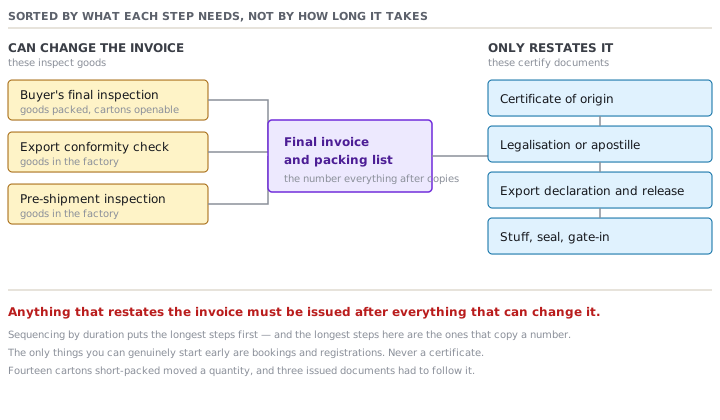
The rule that orders them
Look at the last column again, the one headed Cannot start without. One rule falls out of it:
Anything that restates the invoice must be issued after everything that can change the invoice.
Three of the eight steps restate the invoice: the certificate of origin, the legalisation of that certificate, and the export declaration. Two of the eight can change the invoice: the buyer's inspection, if it rejects, and the pre-shipment inspection, if it finds a difference.
So the order is forced. It is not a preference, and it is not a matter of urgency. Steps that can move a number go first. Steps that copy a number go last. And the gap between them is the only place slack can live.
The certificate that was started first
Nasira Barmoth's export clerk has done this for eleven years, and on Monday 4 May she started the certificate of origin. Her reasoning was good. The chamber is the slowest step in her experience, the consulate behind it is slower still, and starting the slowest thing first is what you do with a queue.
On Tuesday 5 May the destination's appointed inspection agency drew its sample. It found 14 cartons packed with 18 pieces instead of 20, so 28 pieces short across the consignment. The garments existed. They were on a rework rail and had not been returned to packing.
That is a small thing. Nasira held the 28 pieces back for the next consignment and re-issued the invoice at 8,372 pieces instead of 8,400.
Then it had to re-issue the certificate of origin too. A certificate that restates a quantity of 8,400 against an invoice for 8,372 will be refused by somebody, eventually, in a place where refusing it is expensive.
What a USD 408.80 change cost
- Value of the goods that moved: 28 pieces at USD 14.60, so USD 408.80
- Certificate re-issue fee: USD 68.00
- Courier of the original document to the consulate and back, twice: USD 96.00
- Fees: USD 164.00
- Elapsed: two days of a five-day window
The money is trivial, and it is not the finding. The finding is the two days. The legalisation behind the certificate needed two of the remaining three, which left the consignment one day of slack against a fixed gate-in date. It made the sailing. It made it by one day.
Three families of check, and they are not the same thing
It is worth being able to tell them apart. Different people ask for them, and they answer different questions.
One: an inspection the destination government requires, carried out in your country. Some importing states appoint agencies to verify goods before shipment — quantity, quality, classification or price — and the resulting certificate is a condition of import at the far end. An international agreement covers how these programmes are run. It requires them to be non-discriminatory and transparent, and to give the exporter a way to appeal a finding. Two practical consequences: you may appeal, and the procedures should be published.
Two: a check your own state requires on its own exports. A number of countries inspect or certify outbound goods, historically to protect the reputation of that country's exports. This is the family that varies most. It is also the one most likely to exist and be unknown to a merchandiser sitting in a group's head office abroad.
Three: certification of documents rather than goods. A chamber of commerce certifies a declaration you make about origin. Beyond that, some destinations want the document itself authenticated. There are two routes. An apostille, where both states are party to the Hague Convention abolishing the requirement of legalisation for foreign public documents. Or consular legalisation, where they are not. The apostille is one certificate from one authority. Consular legalisation is a chain, and the chain is what eats the days. Whether a particular chamber certificate qualifies for an apostille at all is a question for the authority that issues them, and states answer it differently.
What you can genuinely start early
Not a certificate. The things you can start early are the ones that do not depend on the final numbers.
- Book the inspections. Slots are the scarce thing, not the inspections.
- Register the shipment with any body that requires notice in advance.
- Get the file open at the consulate or the apostille authority, so the only thing missing on the day is the document.
- Agree the wording in advance for anything that has to be typed under pressure: the description of goods, the origin statement, the marks.
None of those restates a quantity, so none of them is invalidated when a quantity moves.
Prompt · Sequence the inspections and certificates for one shipment
The week a shipment is packing and four different people want their step done first.
Act as an export documentation manager sequencing one shipment. Facts: buyer [BUYER], purchase order [NUMBER], style [STYLE], quantity [PIECES], cartons [NUMBER], value [AMOUNT], origin [COUNTRY], destination [COUNTRY], last carton sealed on [DATE], container must be at the port gate on [DATE], vessel cut-off [DATE AND TIME]. The steps I know about are: [LIST THEM — BUYER'S FINAL INSPECTION, ANY EXPORT CONFORMITY CHECK, ANY PRE-SHIPMENT INSPECTION REQUIRED BY THE DESTINATION, INVOICE AND PACKING LIST, CERTIFICATE OF ORIGIN, ANY LEGALISATION OR APOSTILLE, EXPORT DECLARATION AND RELEASE, STUFFING AND SEALING]. For each I know or can guess: owner [NAME], duration [DAYS], and whether it must be booked [YES OR NO]. Do the following. First, split every step into one that can CHANGE a quantity or a value and one that only RESTATES it. Second, produce a sequence in which no restating step is issued before every changing step has finished, and show the sequence as dates against my two fixed dates. Third, tell me the total slack and where it sits, and name the single step whose slipping by one day costs me the gate. Fourth, list what I can start today that does not depend on a final number — bookings, registrations, pre-agreed wording — and write the actual booking requests for me. Fifth, tell me what has to be re-issued if the inspection finds a short pack, in what order, and what each re-issue costs in days. Sixth, if my sequence cannot fit, give me three options with what each one risks, and do not include hoping as one of them.
AI can make mistakes — check anything you act on.
Check yourselfYour buyer's final inspection is booked for the day after the certificate of origin is due back from the consulate. What do you do?Show the answer
Move the inspection, not the certificate. The inspection is the step that can change the invoice, so it belongs in front of everything that copies the invoice. If it genuinely cannot move, then you are shipping with a known risk: a rejection would invalidate a legalised document. The right response is to say so in writing to the person who set the dates. Not to hope.
What to take away
Sequence by what each step needs, not by how long it takes. Goods-steps first, document-steps last, and the longest document-step is the last one of all. Everything you can do early is a booking or a registration, never a certificate. A certificate issued early is not a head start. It is a re-issue waiting for a reason.