Lessons · Lesson 6 of 6
When the two declarations disagree
Separate the fields that must match across a border from the ones that legitimately differ, and build the export file that answers a verification request years later.
Lesson 6 of 6 · 18 min
A letter, twenty-two months later
The Ilvane consignment of order CAL-3374 sailed in May. Twenty-two months later, Vestreland's customs administration wrote to Calderhalt's importing company. It was not satisfied that the preferential origin claimed on that entry had been established, and it was asking the authorities in Adrasene to verify it.
Nothing had gone wrong with the goods. The overshirts qualified. The certificate was genuine. The claim was correct. Somebody at a desk in Vestreland had run a routine check and this entry came out of it, which is how most of these begin.
The request reached Adrasene, and from Adrasene it reached Nasira Ilvane. It asked for one thing above all others: the accepted export declaration for the consignment, with its registration number.
Two declarations about one box
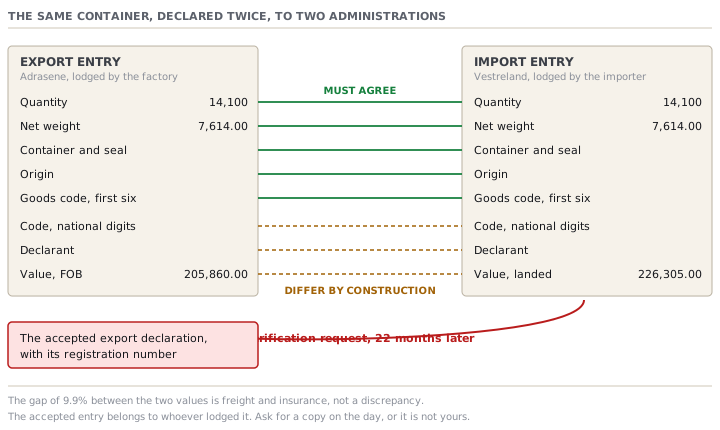
Every shipment is declared twice. Once in the country of manufacture, by you, to your own administration. Once at the destination, by the importer, to theirs. They are two statements about the same container, made by two different people, to two authorities with different interests, and worked out on different bases.
Some of what they say must match. Some of it must not.
| Field | Adrasene export entry | Vestreland import entry | Must they agree |
|---|---|---|---|
| Quantity | 14,100 pieces | 14,100 pieces | Yes |
| Net weight | 7,614.00 kg | 7,614.00 kg | Yes |
| Container and seal | As stuffed | As stuffed | Yes |
| Origin | Adrasene | Adrasene | Yes |
| Goods code, first six digits | The same | The same | Yes |
| Goods code, national digits beyond six | A national subdivision | A different national subdivision | No |
| Declarant | Nasira Ilvane | Calderhalt's importing company | No |
| Value | USD 205,860.00 | USD 226,305.00 | No |
| Basis of that value | FOB | Landed, including freight and insurance | No |
Why the two values differ, and why that is not a discrepancy
The export entry declares USD 205,860.00. That is 14,100 pieces at USD 14.60, the FOB price. The import entry declares USD 226,305.00, which is the same goods plus the freight and insurance to bring them in: USD 1.45 a piece, so USD 20,445.00 more, 9.9% above the export figure.
Neither is wrong. Export statistics are normally compiled on a free-on-board basis, and imports on a landed basis — the value including freight and insurance. That is one of the standard reasons why any two countries' figures for trade with each other never match. It is a difference of basis, not a disagreement. A merchandiser who understands that will not panic the first time an importer's entry shows a bigger number than the invoice.
What Nasira had, and what it did not have
The file for the Ilvane consignment was complete. Commercial invoice, packing list, certificate of origin, bill of lading, inspection certificate, the fabric purchase orders, the mill's own declarations, the cutting records, the payroll for the week the garments were made. Everything a verification of origin would want.
Everything except the export declaration.
Between the shipment and the letter, the group had moved its declarations from Okhalt Customs Services, its broker in Ilvane for nine years, to a larger firm. The accepted declarations from the Okhalt years had been lodged under Okhalt's licence, on Okhalt's terminal, in Okhalt's account with the administration. Nasira had the drafts it had approved. What the request asked for was the accepted entry with its registration number. That is a different document, and Nasira had never held a copy of one, because nobody had ever needed one.
What it cost
- Sum at risk, being the preference on that entry — an illustrative 9.6% of the customs value of USD 226,305.00: USD 21,725.28
- Time to recover the declaration from the previous broker: five weeks
- The broker's retrieval fee: USD 340.00
- Nasira's own time on it: USD 610.00
Vestreland issued its demand before the five weeks were out. Calderhalt's importing company paid it, as it was obliged to, and charged it back to Nasira under the purchase order's origin warranty. The verification then came back positive and the money was refunded, four months later.
- Cost of the money being out for four months, at Nasira's own borrowing rate of an illustrative 14.5% a year: USD 1,050.06
- Total cost of the episode: USD 2,000.06
The entitlement was never in doubt. It was merely unprovable for five weeks. Being unprovable for five weeks cost 9.2% of what was at stake, on a claim that was correct the whole time.
How to qualify is a different course
This lesson is not about whether the overshirts earned their preference. Whether a garment qualifies for preferential access to a given market is a different question: the origin rule, the processing it demands, the proof that must be made out and by whom. That is course 26.2 for the United States and course 26.3 for the European Union.
This is the other half, and it is squarely an export-side matter. Once you have qualified, can you still prove it two years later, out of your own file, without depending on anyone else?
The export file, and what goes in it
One page per shipment. Keep it somewhere other than the merchandising file, because merchandising files are archived by season, and this one has to survive a season, a system migration and a change of broker.
- The accepted export declaration, with its registration number, obtained as a copy at the time of acceptance. Ask for it as a matter of routine. A broker will send it if asked, and will not if not asked.
- The release, and any amendment or cancellation, so the sequence of what was permitted can be read.
- The certificates: origin, any conformity or pre-shipment certificate, and any legalisation.
- The evidence behind the origin claim: the input purchases, the mill declarations, and the production records that connect them to this order.
- The identity of the exporter of record on that entry, which lesson 2 showed can quietly be somebody else.
- Who lodged it, under whose licence — the single line that would have saved this episode.
How long to keep it is your administration's answer, not a course's, and it is question five of the five. Ask it, get the number in writing, then keep the file for longer than the number. The request comes from the other end, and their clock is not yours.
Prompt · Answer a verification request that has not arrived yet
Once, on a shipment that has already gone, to find out whether you could answer if you had to.
Act as a customs compliance auditor. I want you to run a drill on a shipment I have already made, as though a verification request had arrived from the destination's customs administration. Shipment facts: origin [COUNTRY], destination [COUNTRY], date of export [DATE], purchase order [NUMBER], style [STYLE], quantity [PIECES], export value and terms [AMOUNT AND TERM], whether preferential origin was claimed [YES OR NO AND UNDER WHICH ARRANGEMENT], the entity named as exporter on the customs entry [NAME], and who lodged the entry [MY STAFF OR WHICH BROKER]. The documents I can produce today are: [LIST THEM]. Do the following. First, list what a verification of origin on this shipment would ask for, in the order it would ask, separating documents I issued myself from documents issued by somebody else and from records held by a third party. Second, mark each one against my list as HELD, OBTAINABLE, naming from whom and how long it would take, or LOST. Third, tell me specifically whether I hold the ACCEPTED export declaration with its registration number, and if I do not, tell me exactly who does and what happens to my file if that party closes or changes systems. Fourth, price my exposure: the amount at stake, the cost of the money being out while the answer is found, and any charge-back my purchase order allows the buyer to make. Fifth, give me a one-page export file template listing exactly what to keep per shipment and where. Sixth, tell me the questions to put to my own customs administration about retention periods, and warn me where the destination's clock may be longer than my own.
AI can make mistakes — check anything you act on.
Check yourselfYour broker retires and closes the business. What have you lost?Show the answer
Potentially every accepted declaration he ever lodged for you. And with them, the ability to answer a verification request on any of them without going to your own customs administration and asking for its copy. That is possible, and slower, and not something you want to discover the week a demand is issued. The remedy is a habit rather than a project: a copy of every accepted entry, filed by you, on the day it is accepted.
The five questions, answered
Lesson 1 set out five questions that get you any country's export procedure. This course has answered them for one invented country, and shown what changes when the same order is made in two others.
- Who may be the exporter? A registered local legal person. And the choice carries your duty reliefs, your certificates and your future correspondence with it.
- What permission must exist before the goods may leave? The declaration and its release. Know which fields, changed by somebody else, invalidate it.
- What must be inspected or certified on the way out? Goods-steps first, document-steps last, sequenced by what each step needs and never by how long it takes.
- What is different for goods that will come back? Identity, a declared procedure and a clock. All three established before departure.
- What will you be asked for afterwards? The accepted declaration, most of all. You have to ask for it on the day, because it is not yours by default.
Answer those five for the country you ship from. Then answer them for the country you are thinking of moving to, and you will have a comparison worth more than a quoted price, because it is measured in the days that price assumes.