Lessons · Lesson 6 of 6
- 01 · An origin is a bundle of numbers, not a country
- 02 · Cost per minute, not cost per hour
- 03 · Concentration plus one: what the decision buys, and what it misses
- 04 · Proximity is a cash and markdown argument, not a freight argument
- 05 · An advantage in one category says nothing about the next
- 06 · Granted, given, built: what an origin can actually change
Granted, given, built: what an origin can actually change
Sort every line of your competitive position into the class that decides what to do about it, and price one thing worth building.
Lesson 6 of 6 · 18 min
Three classes, and only one of them is yours
Everything that decides where an order lands falls into one of three classes, and the class decides the action.
Granted. Duty treatment, quota, agreement membership, scheme eligibility. Decided by governments, in negotiations no factory attends. A factory cannot obtain it; it can only qualify for what has already been granted, and qualifying is real, difficult, documented work — the origin rules, the certificates, the records — which is the subject of courses 26.2, 26.3 and 26.4 and not of this one.
Given. The wage floor, the price of power, the port, the distance to the market, the exchange rate, the interest rate a local bank charges. Not chosen at the level of the firm, and slow to move. Some of it can be worked around; none of it can be decided.
Built. Efficiency, standard minute values, reliability, lead time, development capability, category depth, the quality of your buying, your banking relationship, your certifications. Everything in this class is the accumulated result of decisions somebody in your building made.
The reason to sort is not tidiness. The three classes require completely different responses, and a factory that puts a line in the wrong class either wastes effort on something it cannot move or, far more dangerously, relaxes about something it can.
Sort the actual gap
Take lesson 1's comparison between Halbrent and Sennary. Halbrent delivers at USD 25.42, Sennary at USD 26.98: Halbrent is ahead by USD 1.56. Where did that come from?
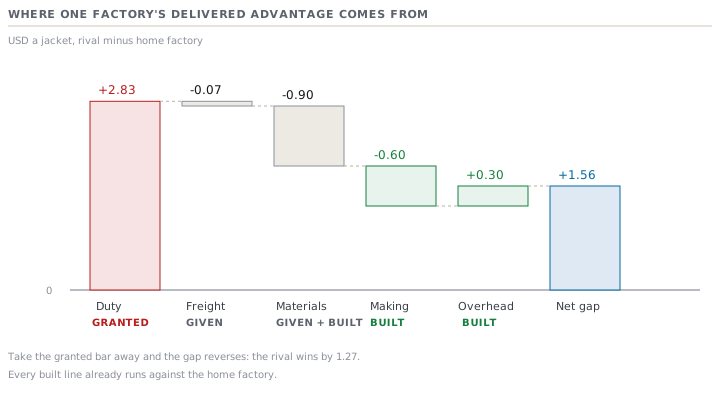
| Line, USD a jacket, Sennary minus Halbrent | Class | Effect |
|---|---|---|
| Duty | Granted | +2.83 |
| Freight and insurance | Given | -0.07 |
| Materials | Given and built | -0.90 |
| Making | Built | -0.60 |
| Overhead and margin | Built | +0.30 |
| Net, in Halbrent's favour | +1.56 |
Read it and the comfortable conclusion falls apart. Sennary makes the jacket better and buys its materials better. On making and materials together Sennary is USD 1.50 ahead. Every cent of Halbrent's advantage, and more, is a duty line granted by somebody who has never seen the factory.
Take the granted line away and the comparison reverses:
without the duty preference
  Halbrent, delivered  25.42
  Sennary,  delivered  24.15
  Sennary wins by       1.27
Halbrent is not a competitive factory that also enjoys a preference. It is a factory whose entire position is a preference, and its own numbers have been saying so for two years in a column nobody sorted.
The mistake nobody made
Three years ago Halbrent won a four-year outerwear programme on exactly that advantage. Everything that followed was correct.
The volume was real and contracted. The board approved a new building and six lines at USD 384,000, financed over five years. The payback was 3.1 years on the programme's own margin, which is inside the contract. The lines were commissioned on time and ran well. No forecast was inflated, no risk was hidden, and every person involved would make the same decision again on the same information.
In year three the buyer moved the programme, for reasons that had nothing to do with Halbrent's performance.
The six lines are now running at 34%. Here is the part that is not obvious and is the real damage:
overhead carried by six lines for a year   USD 975,024
absorbed at 34%                            USD 331,508
unabsorbed                                 USD 643,516
spread over the other eight lines' output   36,520,243 standard minutes
added cost per standard minute             USD 0.0176
Halbrent's cost per standard minute goes from USD 0.1004 to USD 0.1180 — up 17.6% — and ALD-2210 gains USD 0.74.
The comparison in lesson 1 was decided by USD 0.078 a jacket. The stranded capacity from a programme that ended puts nearly ten times that onto the price of the very next quote. A factory does not merely lose the order it lost; it loses the next one too, and the mechanism is an overhead line, not a sales failure.
Buying one built attribute, properly
The useful response to all of this is narrow: pick one thing in the built column, price it, fund it and measure it. Halbrent picked reliability — orders shipped complete on the agreed date, which stands at 74%.
The cost. A production planner at USD 14,400 a year, and a 4% capacity buffer held for recovery rather than sold, which costs Halbrent USD 91,002 a year in overhead it no longer absorbs. Together USD 105,402 a year.
The visible return. Over the last two years lateness cost Halbrent USD 61,300 in air-freight contributions and USD 148,000 in a repeat that was cancelled — USD 209,300, or USD 104,650 a year.
So on the losses it can see, the investment very nearly pays for itself, and no more. On that arithmetic alone you would not do it.
The invisible return is the real one, and Halbrent can measure it. Sorted by buyer, Halbrent's win rate with buyers who have experienced a late shipment from it is 18.2%. With buyers who have not, it is 44.4%. Nothing on any invoice records that, and it is worth several times the air freight.
What survives
Rank the three classes by how long they last, and the case for the built column makes itself.
Granted access can be withdrawn, and the withdrawal will not be about you. Preference schemes are creatures of policy: they are extended, narrowed, made conditional and allowed to lapse, and a factory learns about it from the trade press.
Given conditions turn. Wages rise as an origin succeeds — that is what success is. A currency moves. A port congests. Every origin that has ever been cheap has stopped being cheap, and the ones still exporting are the ones that used the cheap years to build something.
Built attributes stay, and they compound. Efficiency, method, reliability and category depth accumulate, travel with the firm, and are the only column that is still there when the other two move.
None of which requires knowing a single statistic about anybody's country. It requires eight numbers about yours, measured, sorted into three columns, and reviewed once a year.
Check yourselfYour delivered price beats a competitor by USD 1.20 a garment, of which USD 1.90 is a duty preference. What is your real position?Show the answer
You are USD 0.70 behind on everything you control, and your advantage is a policy line you cannot renew. Two consequences follow. Do not build fixed capacity against volume that exists only because of the preference. And find out, from the buyer, which built attributes it actually values, because those are the ones that will still be worth something if the preference narrows.