Lessons · Lesson 1 of 6
- 01 · An origin is a bundle of numbers, not a country
- 02 · Cost per minute, not cost per hour
- 03 · Concentration plus one: what the decision buys, and what it misses
- 04 · Proximity is a cash and markdown argument, not a freight argument
- 05 · An advantage in one category says nothing about the next
- 06 · Granted, given, built: what an origin can actually change
An origin is a bundle of numbers, not a country
Replace the country label with the attributes a buyer actually prices, and land four quotes at what they really cost.
Lesson 1 of 6 · 18 min
The situation
Aldermist is a mid-market outerwear and jersey brand. It sells through its own stores and a website in one destination market, and it buys a little under two hundred thousand outerwear units a year. In March it sends one tech pack to four factories and asks for a price on ALD-2210, a padded jacket, 48,000 units, one colour way of three, FOB terms, on board in the last week of July.
Four quotes come back within nine days. The merchandiser lays them out, and the sourcing director asks the question that this whole course exists to answer properly: which origin is cheapest?
That question has no answer, and the rest of this lesson is why.
What this course will not do, and why
It never names a country. Not one, in six lessons. That is a deliberate choice and it is worth a paragraph, because a reader is entitled to know what has been withheld.
Three reasons. First, the numbers people attach to country names — market share, average wage, factory count, export value, growth rate — circulate almost entirely through vendor blogs and consultancy decks, and are very rarely traceable to primary research. A course that repeated them would be quoting somebody's marketing at you and calling it a fact. Second, they go stale. A wage table is wrong within a year; a duty preference can be narrowed by a minister who has never heard of your factory. Third, and most usefully: the attributes that decide an order differ as much between two factories inside one origin as they do between two origins. Two plants an hour apart run at 51% and 78% efficiency, buy fabric on different terms, and quote the same jacket USD 2 apart.
So the four factories here are named — Halbrent, Tolvane, Draymill and Sennary — and each sits in a different origin, which is described only by the numbers that decide the order. The names are invented and carry no nationality. Wherever you sit, you are one of the four, and the arithmetic is the same one you would run on your own quote sheet.
The four quotes
| Line, USD a jacket | Halbrent | Tolvane | Draymill | Sennary |
|---|---|---|---|---|
| Shell, lining and wadding | 11.90 | 11.20 | 12.60 | 11.05 |
| Trims and packing materials | 3.40 | 3.55 | 3.85 | 3.35 |
| Making | 6.20 | 4.35 | 6.05 | 5.60 |
| Factory overhead and margin | 3.30 | 3.30 | 3.60 | 3.60 |
| FOB | 24.80 | 22.40 | 26.10 | 23.60 |
Read as prices, the spread is USD 3.70, which is 16.5% of the cheapest quote. That is a large number, and it is the number a sourcing meeting argues about.
Now read the same table as a decomposition. The widest single gap between any two factories is in materials — shell, lining, wadding and trims together run from USD 14.40 at Sennary to USD 16.45 at Draymill, a gap of USD 2.05. The widest gap in making is USD 1.85. The biggest line in every one of the four quotes is a thing the factory bought, not a thing it made, and the widest disagreement between the four is about what they paid for it.
That is the first correction to the folk model. An origin's price is not mostly a wage; it is mostly a purchase.
What the jacket actually costs delivered
FOB is not a price to the buyer. It is a price at a rail. Aldermist pays freight and insurance from there, and it pays duty on arrival — and duty is where the four separate.
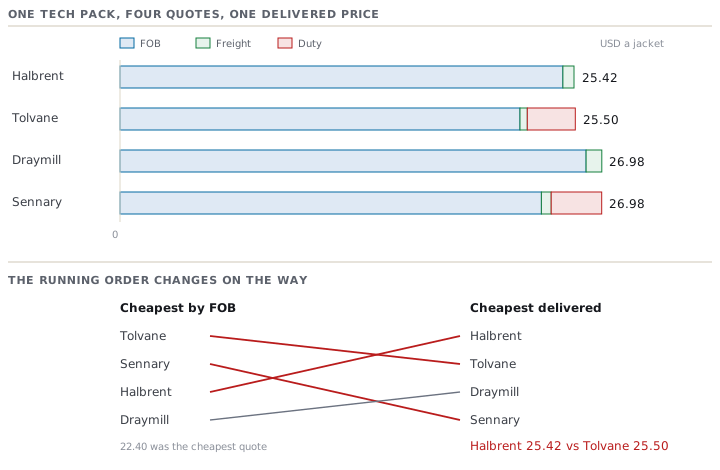
Two of the origins enter Aldermist's market duty free under an agreement Aldermist did not negotiate and the factories cannot join or leave. The other two pay the ordinary rate, which is 12.0% here. Aldermist's market assesses duty on the FOB value; some markets assess it on the value including freight and insurance, which is a real difference and it belongs to course 26.4, not here. Say which basis you are using, once, and then be consistent.
| USD a jacket | Halbrent | Tolvane | Draymill | Sennary |
|---|---|---|---|---|
| FOB | 24.80 | 22.40 | 26.10 | 23.60 |
| Freight and insurance | 0.62 | 0.41 | 0.88 | 0.55 |
| Duty rate | none | 12.0% | none | 12.0% |
| Duty paid | 0.00 | 2.69 | 0.00 | 2.83 |
| Delivered | 25.42 | 25.50 | 26.98 | 26.98 |
Three things happen in that table, and each is worth more than the whole of the first one.
The cheapest quote is not the cheapest jacket. Tolvane is 9.68% below Halbrent on FOB and 0.31% above it delivered. On 48,000 jackets that is USD 3,744 — small, but pointing the other way from the number the meeting was arguing about.
The spread collapses. USD 3.70 at the rail becomes USD 1.56 at the warehouse door. Most of what looked like an origin difference was a duty line and a freight line, and one of those is not a fact about the factory at all.
Two origins land at the same number for opposite reasons. Draymill is dear and duty free; Sennary is cheap and dutiable; both deliver at USD 26.98. They are not the same choice, and the difference shows up the moment anything moves. Narrow the preference and Draymill rises. Move the exchange rate or the wage and Sennary rises. Equal today, differently fragile tomorrow — which is a fact about the origins, not about the jacket, and it is the subject of lesson 6.
The eight numbers that actually make an origin
Strip the label away and what a buyer prices is this list. Four of them are on the quote; four are not, and the four that are not decide more orders.
- Duty treatment into this destination for this product. Granted by governments, qualified for by the factory.
- Cost per standard minute. Not the wage. Lesson 2.
- The standard minutes this factory needs for this garment. A different number in each of the four.
- What materials cost landed at the factory gate, which is a fact about mills within reach, input duties and the factory's own buying volume.
- Total pipeline days, from purchase order to the goods being sellable — not transit days. Lesson 4.
- Reliability, measured — the share of orders that shipped complete on the agreed date, over a period long enough to mean something.
- Minimum quantity and category depth — what this factory can do well, and from what quantity. Lesson 5.
- Payment terms, and the cost of the money that sits behind them.
Why you should not quote a country statistic, even a true one
A merchandiser preparing for a buyer meeting will be tempted to reach for a published figure: the origin's apparel exports, its average factory wage, its share of the destination's imports. Resist it, for a practical reason rather than a scrupulous one.
The buyer already has better numbers than you, and they are about you rather than about your country. Aldermist's sourcing director has four quotes, four delivered costs, four despatch records and four sets of sample rounds. Nothing you can say about a national average survives contact with that. Worse, if your national figure is flattering and your own record is not, you have just told the buyer which of the two you would rather discuss.
The counter-move is the one this course teaches: arrive with your own eight numbers, measured, dated, and next to the buyer's alternatives. That conversation you can win.
Check yourselfTolvane quotes USD 22.40 and Halbrent USD 24.80. Which is cheaper, and what do you need to know to answer?Show the answer
Neither, until you know the duty treatment, the freight and the basis on which duty is assessed. Delivered, Halbrent is USD 25.42 and Tolvane USD 25.50 — the running order reverses. The general rule: a quote is only comparable at the point where the buyer takes ownership of the cost, and FOB is not that point.
Prompt · Build my origin card from my own numbers
Before a buyer meeting, or whenever somebody in your company starts a sentence with a statistic about a country.
Act as a sourcing analyst. Build me an honest origin card for MY factory, using only numbers I give you, and refuse to fill any gap with an industry statistic, a country average or a published benchmark — if I have not given you a number, write UNKNOWN and tell me how to measure it. My facts: factory [NAME], product category [CATEGORY], the destination market I am quoting into [MARKET]. Duty treatment for this product into that market [DUTY RATE OR AGREEMENT, OR UNKNOWN], and whether duty there is assessed on FOB or on a value including freight and insurance [BASIS OR UNKNOWN]. My cost per standard minute [FIGURE] built from [LINE COST PER HOUR] and [STANDARD MINUTES PRODUCED PER HOUR], or the raw inputs if I have not divided them yet. Standard minutes for the garment I am quoting [SMV]. Materials landed at my gate: fabric [COST], trims [COST], and where each comes from [ORIGIN AND LEAD TIME]. My total pipeline from purchase order to the buyer's warehouse, stage by stage [MATERIALS DAYS, PRODUCTION DAYS, TRANSIT DAYS, CLEARANCE DAYS]. My on-time-in-full over the last twelve months, measured against the date agreed at order confirmation [PERCENTAGE, OR UNKNOWN]. My minimum order quantity and the categories I have actually shipped in the last two years [LIST]. Payment terms I can offer and what my bank charges me for the money behind them [TERMS AND RATE]. Now do four things. First, lay the card out as a table with a column saying MEASURED or UNKNOWN against every line. Second, sort every line into GRANTED, GIVEN or BUILT, and for anything you call BUILT name the action and the role that would change it — if you cannot name both, move it to GIVEN and say why. Third, tell me which three lines a buyer comparing me with two other origins would look at first for this product, and which of my UNKNOWNs is the most dangerous to leave unmeasured. Fourth, write me the four sentences I should say in the meeting, using only MEASURED lines. Do not mention any country's market share, average wage, factory count, export value or growth rate anywhere in your answer.
AI can make mistakes — check anything you act on.