Lessons · Lesson 3 of 6
- 01 · An origin is a bundle of numbers, not a country
- 02 · Cost per minute, not cost per hour
- 03 · Concentration plus one: what the decision buys, and what it misses
- 04 · Proximity is a cash and markdown argument, not a freight argument
- 05 · An advantage in one category says nothing about the next
- 06 · Granted, given, built: what an origin can actually change
Concentration plus one: what the decision buys, and what it misses
Price a second-origin trial properly, name what it is actually insuring against, and measure how much of the order really moved.
Lesson 3 of 6 · 18 min
The decision has a name and the name is misleading
The trade calls it China plus one. Read literally it is advice about one country, which is exactly why it travels badly: a buyer already concentrated somewhere else reads it as somebody else's problem, and a factory in the plus one reads it as a promise.
Strip the proper noun out and what is left is general and useful. A buyer with most of a category in one origin is holding a concentrated position, and is deciding whether to pay to be less concentrated. Which origin holds the concentration is irrelevant to the arithmetic. Call it concentration plus one and the same sums work for a buyer concentrated anywhere, including in yours.
Two consequences follow immediately, and both matter to a factory.
It is a risk decision, not a cost decision. Nobody diversifies to save money, and the arithmetic below shows a diversification that costs money in every year it works. A factory that pitches itself into a plus-one search on price has misread what is being bought.
It is priced like insurance, which means the buyer needs a loss number and a frequency. Most buyers have neither, and the merchandiser who brings them is unusually useful.
What the trial actually costs
Aldermist's board asks for a second origin. The 48,000 units of ALD-2210 are split: 36,000 stay with Halbrent, 12,000 go to Tolvane as a qualifying trial.
Tolvane's quote was USD 22.40 — at 48,000 units. At 12,000 it is USD 24.15, and the uplift is not a negotiating position:
- fabric and trim minimums that no longer divide into a large order: USD 0.61
- line setting and the learning curve on a style the factory has never made: USD 0.74
- development and sampling amortised over an eighth of the volume: USD 0.40
Then there are costs that never appear in a unit price because the buyer pays them directly.
| USD | |
|---|---|
| Social and technical audit, onboarding | 6,800 |
| Three extra sample rounds and courier | 4,150 |
| Two visits by the sourcing team | 9,400 |
| A technician on site for the first bulk week | 5,200 |
| Total, one-off | 25,550 |
| Per jacket over 12,000 units | 2.13 |
Now land it. Tolvane's origin is dutiable at 12.0% where Halbrent's is not.
Tolvane, 12,000 units
  FOB                        24.15
  freight and insurance       0.41
  duty at 12.0%               2.90
  one-off qualification       2.13
  ---------------------------------
  all-in                     29.59

Halbrent, delivered         25.42
difference a jacket          4.17
on 12,000 jackets       USD 50,006
USD 50,006 is the price of the decision in year one. Not a saving, not an investment with a return — a premium.
What the premium buys, and the number nobody has
The honest form of the question is not is this worth it? It is: what is the largest loss this prevents, and how often would it have to prevent it?
Aldermist's sourcing director can answer the first half. A ten-week interruption to the origin that holds the outerwear programme, landing on the autumn intake with no qualified alternative, costs the company USD 402,000 on its own reckoning — late stock, an air-freight contribution and a season's worth of markdown on what arrives after the weather turns. It is Aldermist's estimate of Aldermist's own loss, and every reader's number will be different.
The second half divides:
break-even frequency = 402,000 / 50,006 = once in 8.0 yearsSo the decision is now a single judgement a person can actually make: is an interruption of that size more likely than once in eight years? Aldermist cannot compute that, and it should not pretend to. It can only decide it, and having decided it, it has a defensible answer either way — which it did not have when the question was is diversification a good idea.
What the decision misses: units moved is not value moved
Here is the part that almost never gets measured, and it is the part a factory can turn into an argument.
Tolvane's quote is 65.8% materials. And Tolvane buys its shell fabric, its wadding and most of its trims from mills in the same origin the buyer is diversifying away from — which is not a scandal and not unusual: those mills are where the fabric is, which is often why the concentration existed in the first place.
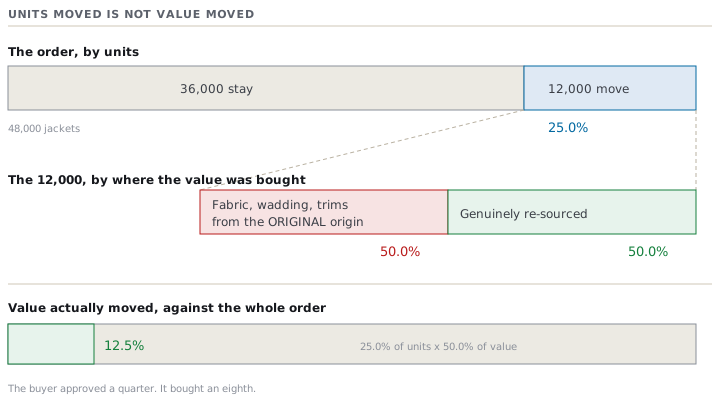
So work the share out properly.
units moved                     12,000 / 48,000 = 25.0%
of Tolvane's FOB, not from the original origin
  22.40 - 11.20 = 11.20             11.20 / 22.40 = 50.0%
value genuinely re-sourced      25.0% x 50.0%   = 12.5%
Aldermist believes it has moved a quarter of the order. It has moved an eighth of the value. And the half it did not move is the half most exposed to the events it is insuring against: a port, a policy, an energy interruption, a currency. If the interruption stops the mills, it stops Tolvane too, three weeks later than it stops Halbrent.
This is not an argument that the trial was pointless. It is an argument that the number was never checked. Two questions fix it, and both can be asked in an email:
- Where does your shell fabric come from, and your wadding, and your zips? Not the trader — the mill.
- What would you quote, and in how many days, if that source were unavailable?
The answers turn a units percentage into a value percentage, and the value percentage is the one the board thought it was approving.
What a plus-one order really is, from the factory's chair
Read the numbers back from the other side of the table. Tolvane is being paid USD 24.15 for a jacket it would make for USD 22.40 at scale, on a quantity too small to be profitable on its own, with an audit, extra sample rounds and a visiting technician.
That is not a small order. It is a paid option on a large one, and it should be run as one:
- The buyer's cost of the trial is USD 50,006. It will not spend that twice on the same origin. A trial that goes well is far more likely to grow than a new search is to start.
- The money is in year two, not year one. Price year one to be made well, not to be won cheaply — a plus-one lost on quality is lost permanently, while a plus-one that costs the buyer a little more than expected and arrives complete is a relationship.
- Ask what share of the programme the buyer intends the second origin to carry, and by when. If there is no answer, this is a price check wearing a strategy's clothes, and it should be quoted as a small order.
Check yourselfA buyer moves 30% of its units to your factory and calls it diversification. 70% of your FOB is fabric from the origin it is leaving. What share of the order's value has actually moved?Show the answer
9%. 30% of units, and 30% of each of those units' FOB is not from the original origin, so 30% x 30% = 9%. The buyer's exposure has barely changed, and the honest thing to tell it is exactly that — with the number, and with what you would have to do to raise it.
Prompt · How much of this order actually moved?
When a buyer describes a split as diversification, or when you are being courted as somebody's second origin.
Act as a supply-chain risk analyst. I want the difference between units moved and value moved, calculated rather than asserted. Facts: total order or programme [QUANTITY] units at [FOB] each, currently placed with [INCUMBENT] in origin A. The share being moved to a second origin is [QUANTITY] units with [SECOND FACTORY], at [FOB AT THAT QUANTITY] each. The second factory's FOB breaks down as fabric [AMOUNT], trims and packing [AMOUNT], making [AMOUNT], overhead and margin [AMOUNT]. Of those materials, the following are bought from mills or suppliers in origin A: [LIST WITH AMOUNTS]. One-off qualification costs the buyer pays directly: audit [AMOUNT], extra sample rounds [AMOUNT], travel [AMOUNT], technical support [AMOUNT]. Duty into the destination is [RATE] from origin A and [RATE] from the second origin; freight and insurance are [AMOUNT] and [AMOUNT] a unit. Do the following, showing every division. First, the units moved as a percentage. Second, the share of the second factory's FOB that is NOT bought from origin A. Third, those two multiplied — the share of the order's value genuinely re-sourced — and say plainly whether it is larger or smaller than the buyer thinks. Fourth, the full year-one cost of the trial per unit and in total, including the one-offs and the duty difference, as a premium and not as a saving. Fifth, ask me for the buyer's own estimate of the loss a serious interruption would cause, and divide the premium into it to give a break-even frequency in years. Do NOT invent a probability for that interruption: leave it as a judgement and say so. Sixth, list the questions I should send the second factory to make the value share real rather than assumed.
AI can make mistakes — check anything you act on.