Lessons · Lesson 2 of 3
Reading the mill's process route
Read a preparation route card line by line and name, before production starts, which parameter will cost you a shade or a shrinkage if it is compromised.
Lesson 2 of 3 · 35 min
The situation
A mill will send you a route card. It is one sheet. It lists every treatment your cloth will pass through. Most people file it without reading it. It is worth ten minutes, because every line on it is a place where somebody under pressure can save an hour. This lesson reads such a card line by line, and asks what quietly disappears when a step is shortened.
4 March. The same buyer, the same mill, a different style. SH-402 is Brandt & Selle's stretch poplin shirt: 97 percent cotton, 3 percent elastane, 4,200 pieces, FOB USD 11.20, order value USD 47,040. The fabric is 7,400 m. It was prepared and dyed at Ravi, finished on the stenter (the wide frame that dries and heat-treats fabric), and cut in Karachi.
Everything passed. The fabric roll test after finishing gave a length change of 2.1 percent on wash. That is inside the 3 percent the tech pack allows. The fabric was approved, cut and sewn.
Then the shirts failed the buyer's garment test. After three domestic wash cycles the length shrinkage measured 5.8 percent and the chest 4.1 percent, against a tolerance of 3 percent. Four thousand two hundred shirts, already made.
The cause was one line on the route card. Heat setting had been run at 180 °C for 25 seconds. The card said 190 °C for 30 seconds. Ten degrees, five seconds — and USD 47,040 of finished garments that no amount of re-pressing will fix. You can re-set a fabric. You cannot re-set a shirt.
Re-setting that fabric before it was cut would have been one more stenter pass at about USD 0.05 per m: USD 370.
A route card is a contract with physics
A process route card is the list of steps a mill will run on your fabric, each step with its settings. Most merchandisers glance at it and file it. Read it instead. Every line on it is a place where somebody can save an hour and cost you a season.
Here is the card for PO BS-3308, drawn as it arrives. The three flagged lines are the ones this lesson will tell you to police.
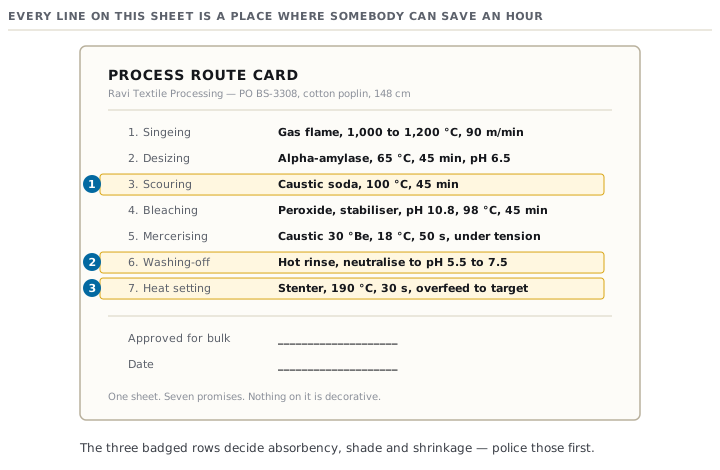
And here is the same card as a reading list: what each line buys you, and what fails if it is compromised.
| Step | Parameters on the card | What it is buying | If it is compromised |
|---|---|---|---|
| Singeing | Gas flame, 1,000 to 1,200 °C, 90 m/min, both faces | A clean surface, even light reflection | Hazy look; a shade that reads lighter than the standard |
| Desizing | Alpha-amylase, 65 °C, 45 min, pH 6.5 | Removal of the warp size | Resist streaks down the warp, no dye where the size was |
| Scouring | Caustic soda, 100 °C, 45 min, wetting agent and sequestrant | Absorbency, evenly, across the whole width | Patchy dyeing; shade variation between lots |
| Bleaching | Hydrogen peroxide, stabiliser, pH 10.8, 98 °C, 45 min | A neutral white ground | Cream cast under pale shades; pinholes where iron catalysed |
| Mercerising | Caustic 30 °Bé, 18 °C, 50 s, under tension, neutralise | Lustre, strength, dye uptake, stability | Dull hand; a darker shade needs more dye than costed |
| Washing-off | Hot rinse, acid neutralisation to pH 5.5 to 7.5 | Nothing reactive left on the cloth | Yellowing in store; shade drift; skin complaints |
| Heat setting | Stenter, 190 °C, 30 s, overfeed set to the shrinkage target | Dimensional stability for elastane and synthetics | Shrinkage that passes on the roll and fails on the garment |
Mercerising, and what it actually buys
Mercerising is the step people argue about most, because it is the one the mill charges for separately.
The cloth runs through concentrated caustic soda at about 27 to 32 °Bé, cold, at 15 to 20 °C, for roughly 50 seconds, under warp tension. Then it is stretched to width, neutralised and washed. The fibre swells. Its flat, collapsed cross-section rounds out. Its internal structure opens up. Three things follow.
- Lustre. The rounded cross-section reflects light in a single direction, so the fabric shines. This effect only exists if the tension is right. A mill that slackens tension to run faster has mercerised your fabric and given you no lustre — and it will still be on the invoice.
- Strength. Typically up 10 to 25 percent in tensile.
- Dye uptake. Typically up 25 to 40 percent. That means the same depth of shade from less dye. More usefully, it means better levelness, because the fibre takes dye more evenly.
Now the arithmetic. "It takes less dye" is quoted as though mercerising pays for itself. It does not, and it is worth knowing by how much.
Lot 3 is 4,000 m at 148 cm and 120 g/m². That is 710 kg of fabric. A navy on unmercerised cotton takes about 4.5 percent reactive dye on the weight of the fabric. Mercerised, about 3.2 percent. At USD 18 per kg of dyestuff:
| Dye on weight of fabric | Dyestuff | Cost | |
|---|---|---|---|
| Unmercerised | 4.5 percent | 31.95 kg | USD 575 |
| Mercerised | 3.2 percent | 22.72 kg | USD 409 |
| Saving | — | 9.23 kg | USD 166 |
USD 166 on 4,000 m is USD 0.04 per m. Mercerising costs around USD 0.12 per m, so USD 480 on this lot. The dye saving pays about a third of it.
So mercerising is not a cost-saving. You buy it for lustre on a shirting. You buy it for strength on a fine yarn count. You buy it for levelness on a difficult shade — and on a deep navy the levelness alone can be the difference between one dyeing and two. What you must never do is let it be dropped quietly from the route to hold a price, and then approve a bulk against a lab dip that was mercerised. That dip cannot be matched.
Heat setting, and the shrinkage that hides
Heat setting is the step that failed SH-402. It is the least understood step in the route, because its failure mode stays invisible for weeks.
Synthetic fibres and elastane are thermoplastic. That means they hold the shape they were last set in at a high enough temperature. They also carry internal stress from spinning, knitting and every process since. Heat setting on a stenter — polyester at 180 to 200 °C for 20 to 30 seconds, elastane blends at 190 to 195 °C for 30 to 45 seconds — releases that stress and fixes the fabric's dimensions.
Set below the right temperature and the stress is not released. It is only postponed. The fabric behaves for as long as it stays dry and untensioned. Then it meets heat and moisture again — in the garment wash, and in the customer's machine — and it goes where it wanted to go all along. An elastane knit that was never properly pre-set can lose 8 to 12 percent in dyeing alone.
That is exactly why the roll test passed at 2.1 percent and the garment failed at 5.8 percent. The stenter's overfeed had physically pushed the fabric into specification on the last pass. A fabric-stage wash test on freshly finished cloth measures a state that has not yet fully relaxed. The garment test, three wash cycles later, measured the truth.
Washing-off is a step, not a rinse
Two things live or die in the washing-off, and both of them ruin dyeings.
Residual peroxide. Hydrogen peroxide left in the cloth after bleaching attacks reactive dye in the bath. The result is a weak, uneven, unmatchable shade — and it looks exactly like a dosing error. It is prevented by a proper rinse, or by a peroxide killer called catalase. It is confirmed by dipping a test strip in the bath before the dye goes in. That test takes ten seconds. It is skipped constantly.
Residual alkali. Cloth that leaves preparation alkaline will yellow in storage. Its shade will drift over the weeks between dyeing and cutting. It can provoke skin complaints from the wearer. The target after washing-off is a pH of 5.5 to 7.5. Buyers' restricted-substance lists usually name a band close to that. It is one of the easiest things in the mill to get right — and one of the most common certificates to be issued without measuring anything.
The three lines to hold
If you read a route card and only ever police three parameters, police these. Scouring time and temperature, because they decide absorbency. Heat setting temperature, because it decides whether shrinkage appears in your customer's home. And the pH after washing-off, because it decides whether the shade you approved is the shade that arrives.
Prompt · Read a route card for the line that will cost me
When the mill sends its process route for approval and you have ten minutes to find the parameter that will fail later.
Act as a senior textile processing manager. A mill has sent me its preparation and finishing route for bulk and I want to know what each line is protecting me from before I approve it. Fabric: [COMPOSITION, CONSTRUCTION, GSM, WIDTH, YARN COUNT]. End use and garment: [DESCRIBE]. Shade and depth: [NAME, REFERENCE AND WHETHER PALE, MEDIUM OR DEEP]. Buyer's requirements that touch the fabric: [PASTE THE SHRINKAGE TOLERANCE, THE FASTNESS REQUIREMENTS, ANY RESTRICTED-SUBSTANCE LIMITS, AND WHETHER OPTICAL BRIGHTENERS ARE PERMITTED]. The mill's route card: [PASTE EVERY STEP WITH ITS PARAMETERS — TEMPERATURES, TIMES, CONCENTRATIONS, pH, LINE SPEEDS, DWELL AND TENSION]. What the approved lab dip was prepared on, if known: [DESCRIBE]. Give me: (1) a line-by-line table of the route with, for each step, what it is buying and the specific defect that appears if it is shortened, cooled or skipped; (2) any step that is missing from this route for this fabric and this end use, named explicitly, with what its absence will cost; (3) the three parameters on this card I should police hardest for this particular fabric and shade, and why those three and not others; (4) anything on the card that contradicts the lab dip or the buyer's requirements, including whether mercerising is specified under tension or slack; (5) the questions I should put to the mill in writing, worded so that the answer is a number rather than a reassurance. Where the card omits a parameter, say so as a finding rather than assuming a normal value.
AI can make mistakes — check anything you act on.
Check yourselfA mill quotes you two prices for the same poplin, USD 0.12 per m apart, and the cheaper one drops mercerising. The shade is a mid grey. What do you need to know before you take the saving?Show the answer
Whether the lab dip you approved was mercerised. If it was, the bulk cannot match it. Mercerised cotton takes about 25 to 40 percent more dye and reflects light differently, so the unmercerised bulk will read duller — and the dyer will chase the difference with recipe changes that make lot-to-lot consistency worse. If the dip was unmercerised, then the honest question on a mid grey shirting is what the lustre is worth to the buyer's handfeel approval. The answer may well be nothing. The saving is real. But taking it after a dip has been approved is not a saving. It is a re-approval.
Check yourselfYour fabric shrinkage report shows 2.1 percent against a 3 percent tolerance, and the mill is asking to skip the garment wash test to save four days. What do you say?Show the answer
No — and name the reason, not the rule. Fabric-stage results are measured on cloth that has just come off a stenter under tension and overfeed, so they systematically understate what the garment will do. SH-402 read 2.1 percent on the roll and 5.8 percent on the garment for exactly that reason. Ask instead for the heat setting record for those rolls: temperature, dwell time and line speed. If the setting ran to card, the risk is genuinely low, and the conversation about the four days becomes a real one. If it did not, you have just found the failure four weeks before the buyer does.