Lessons · Lesson 3 of 3
Testing what preparation achieved
Specify, witness and read the four measurements that prove a fabric is ready to dye, and recognise a mill certificate that was written rather than measured.
Lesson 3 of 3 · 33 min
The situation
Well-cleaned cloth and badly cleaned cloth look the same. They feel the same. They weigh the same. That is the whole difficulty of this subject. It is also why a handful of small laboratory tests exist at all. This lesson takes the four that matter, and gives each one its purpose and the result you want. Its second half is about paper rather than cloth: how to spot a certificate written at a desk.
18 March, 11:05. Lot 4 of PO BS-3308 — the last 5,000 m of the 17,000 — is prepared and booked into the dyehouse for the following morning. Ravi's laboratory emails the preparation certificate for it. Here it is, with lot 2's beside it.
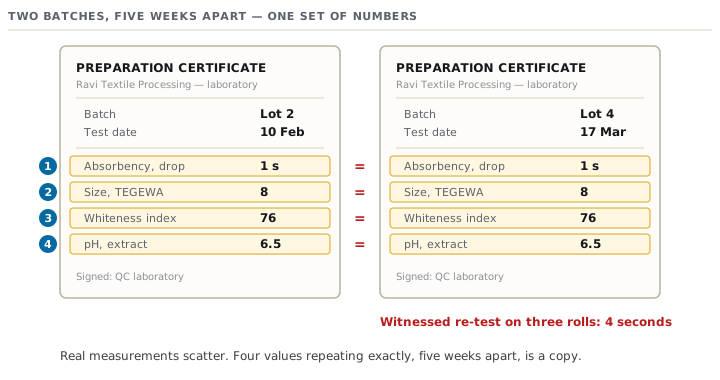
| Test | Lot 2 certificate | Lot 4 certificate |
|---|---|---|
| Absorbency, drop test | 1 second | 1 second |
| Residual size, TEGEWA | 8 | 8 |
| Whiteness index | 76 | 76 |
| pH of aqueous extract | 6.5 | 6.5 |
Four values. Four identical values. On two batches prepared five weeks apart, on a machine that produced a patchy lot in between. That is not impossible. It is not remotely likely either. And after lot 3, it is not something to accept on trust.
The merchandiser asks for one thing: a re-test on lot 4, witnessed, that afternoon, on cloth pulled from three different rolls. The drop test came back at 4 seconds. Not the nine that ruined lot 3 — but nowhere near the one on the certificate.
Re-scouring lot 4 cost USD 0.11 per m on 5,000 m: USD 550 and six hours. Lot 4 dyed to standard. The certificate had been copied from lot 2, because the laboratory tests one batch a week and issues paper for the rest. That happens in good mills as well as bad ones.
The four measurements
Preparation is invisible. You cannot look at prepared cloth and tell whether it will dye. That is the whole difficulty, and it is why these four numbers exist. Each one measures a different thing that a different preparation step was supposed to achieve.
Absorbency: the drop test
The most useful test in the mill, and the cheapest.
The method is AATCC 79. Mount the fabric taut in an embroidery hoop. Hold a burette about 1 cm above it. Release one drop of distilled water and start a stopwatch. Stop it the moment the drop stops being shiny — the instant its wet gleam goes and the surface turns matt. That is the wetting time.
Well-prepared cotton wets in under 1 second. Anything past 5 seconds will dye unevenly. Lot 3 took 9 seconds.
Three things about how the test is reported decide whether it is worth anything.
- Take readings across the full width, selvedge to selvedge. Ten points is normal. Edge-to-centre difference is exactly what patchy dyeing is made of. A single reading in the middle of the cloth cannot see it.
- Report the worst reading, not the average. A cloth that reads 0.8 seconds nine times and 7 seconds once is not a cloth with a mean of 1.4 seconds. It is a cloth with a problem in one place. The dye bath will find that place.
- Test the batch you are about to dye. Absorbency is a property of a batch, not of a mill.
For knitted fabric the equivalent is a sinking test. A small disc of fabric is dropped flat onto still water and timed until it sinks. Under 5 seconds is the usual expectation.
Residual size: the TEGEWA violet scale
Iodine stains starch. Put a drop of iodine solution on the desized cloth. Wait a minute. Compare the colour against a printed scale numbered 1 to 9. A 1 is a deep blue-violet — heavily sized. A 9 is a clean pale straw — fully desized.
The commercial target before dyeing is 7 or better, and 8 for pale shades and for anything to be printed. A print paste sits on the surface, so a resist mark under it is impossible to miss.
There is a trap in this test worth carrying with you. Iodine only sees starch. If the weaver used a polyvinyl alcohol or acrylate size, the cloth can read a clean 8 on the TEGEWA scale with the size still fully present, because there is nothing there for iodine to stain. When a fabric shows warp-direction resist streaks and the desizing certificate says 8, ask the first question: what was the size, and was it starch?
Whiteness: the whiteness index
Measured on a spectrophotometer (an instrument that measures colour as numbers), reported as a CIE whiteness index. Bleached cotton with no optical brightener usually lands somewhere around 70 to 80. Brightened whites run far higher, commonly 130 to 150.
For a merchandiser, the exact number matters less than two other things. First, consistency between prepared lots. The bleached ground sits underneath every pale shade, so two lots prepared to different whiteness will not produce the same pastel — however identical the dye recipe is. Second, whether optical brighteners were used at all. Some buyers ban them outright. Others specify a brightened white. A bulk brightened when the dip was not, or the reverse, is a shade rejection no dyer can argue their way out of.
pH after washing-off
The aqueous-extract pH, to ISO 3071 or AATCC 81. Cloth that leaves preparation alkaline yellows in storage, drifts in shade between dyeing and cutting, and can irritate skin. The target band is 5.5 to 7.5. Most buyers' restricted-substance lists name something close to it.
And one that is not a certificate
Before the dye goes into the bath: a peroxide test strip in the liquor. Residual hydrogen peroxide from bleaching destroys reactive dye and produces a weak, uneven shade that looks exactly like a dosing fault. The test takes ten seconds. It is skipped daily.
| Measurement | Method | Target | How often | The fault it prevents |
|---|---|---|---|---|
| Absorbency, drop test | AATCC 79, 10 points across width, report worst | Under 1 second | Every prepared batch, before dyeing | Patchy dyeing; shade variation between lots |
| Sinking time, knits | Disc on still water | Under 5 seconds | Every prepared batch | The same, on jersey and interlock |
| Residual size | TEGEWA iodine scale 1 to 9 | 7 or better, 8 for pale and print | Every desized batch of woven | Warp-direction resist streaks |
| Whiteness index | CIE whiteness, spectrophotometer | Agreed value, and consistent lot to lot | Every prepared batch for whites and pastels | A cream ground that shifts a pale shade |
| pH of aqueous extract | ISO 3071 or AATCC 81 | 5.5 to 7.5 | Every dye lot after washing-off | Yellowing in store; shade drift; skin complaints |
| Residual peroxide | Test strip in the bath | Nil before dye is added | Every dyeing on bleached cloth | A weak, unmatchable shade |
| Dimensional stability | ISO 6330 wash, ISO 5077 measurement | The tech pack tolerance | Fabric and again on garments | Shrinkage that appears at the customer |
Reading a certificate that was written rather than measured
Certificates are cheap to produce and easy to believe. These are the tells. Every one of them has turned up in a real file.
- Identical values across batches. Real measurements scatter. Four numbers repeating exactly is a copy.
- Whole numbers only, everywhere. A drop test genuinely reported to the nearest second, batch after batch, is a stopwatch nobody started.
- A test date that comes before the batch. Check the batch date against the certificate date. They are on the same page, and almost nobody looks.
- A mean with no range. If a laboratory took ten readings, it can give you ten readings. A mean alone hides the one point that will dye pale.
- A whiteness figure with no instrument and no light source named. Whiteness depends on the instrument. A number without its method is a number you cannot compare to anything.
- A lot number that does not match the rolls. The single most common defect — and it usually is not fraud. It is a laboratory testing what was in front of it rather than what is being shipped.
Prompt · Write the preparation test gate into the fabric approval
Before the first bulk batch is prepared, when you still have the leverage to say what will be measured and how often.
Act as a senior fabric quality manager writing an acceptance clause. I want the preparation tests written into my fabric approval so that they are actually run, on the batches that matter, rather than issued weekly as paper. Fabric: [COMPOSITION, CONSTRUCTION, GSM, WIDTH]. Fabric quantity and the number of prepared batches expected: [QUANTITY, LOT SIZES]. Shades and depths in this order: [LIST]. Whites or pastels in the range: [YES OR NO, AND WHICH]. Garment and its wash: [DESCRIBE ANY GARMENT WASH OR FINISH]. Buyer's tolerances: [PASTE SHRINKAGE, pH, FASTNESS AND ANY RESTRICTED-SUBSTANCE LIMITS]. Mill: [NAME, AND WHAT LABORATORY EQUIPMENT THEY HAVE, IF KNOWN]. Produce: (1) a table of the measurements I should require, each with its method reference, its target, its sampling — how many readings and taken where on the cloth — its frequency in terms of batches rather than time, and the single defect it is preventing; (2) the exact wording of the clause, in plain contractual English, including who witnesses each test, what is reported and in what format, and what happens to a batch that fails; (3) which of these tests I can perform myself during a visit with no laboratory, and how; (4) which results should be reported as a worst reading rather than a mean, and why that distinction matters for this fabric; (5) a short list of what I am deliberately NOT asking for, and the reason, so the mill can see the gate is proportionate. Do not include a test whose result nobody will act on.
AI can make mistakes — check anything you act on.
Prompt · Challenge a preparation certificate before you dye on it
When a mill's test certificate arrives looking a little too tidy and the batch is booked into the dyehouse tomorrow.
Act as a senior fabric quality manager reviewing a mill's preparation test certificate. I have to decide tonight whether to let this batch go into the dye machine tomorrow. The certificate: [PASTE IT IN FULL — EVERY VALUE, THE BATCH OR LOT NUMBER, THE TEST DATE, THE ISSUING LABORATORY AND ANY METHOD REFERENCES]. Certificates for the earlier batches of the same order: [PASTE THEM]. What the rolls in front of me are marked with: [LOT NUMBERS, DATES, METERAGE]. The route card parameters actually recorded for this batch: [PASTE]. Fabric and shade: [DESCRIBE, AND SAY WHETHER THE SHADE IS PALE, MEDIUM OR DEEP]. Value at risk if this batch dyes badly: [FABRIC COST PER UNIT, PREPARATION AND DYEING COST PER UNIT, QUANTITY, AND THE DOWNGRADE VALUE IF IT CANNOT BE SOLD AS FIRST QUALITY]. Assess it as follows. First, say for each value whether it is plausible, implausible or unverifiable, and give the reason — repetition across batches, impossible precision, a date that precedes the batch, a mean reported without a range, a method or instrument not named, a lot number that does not match the rolls. Second, say which single test I should insist is repeated in front of me, and exactly how it should be performed and reported. Third, price the decision both ways: the cost of holding the batch and re-preparing it, against the cost of dyeing it and being wrong, using my numbers. Fourth, draft the message to the mill requesting the witnessed re-test, worded so that it does not accuse anybody and does not leave room for a weekly average. Be explicit where the certificate is probably honest and simply not specific to this batch, because that is the common case and it changes the tone of the request.
AI can make mistakes — check anything you act on.
Check yourselfA desizing certificate reads TEGEWA 8, and the dyed cloth still shows pale streaks running down the warp. What is the most likely explanation?Show the answer
The size was not starch. The iodine test behind a TEGEWA number stains starch and nothing else. A polyvinyl alcohol or acrylate size sits on the warp completely invisible to it, so the cloth reads a clean 8 while still fully sized. Ask the weaver — not the processing house — what the size recipe was. If it was not starch, ask the mill what wash sequence it ran to remove it, and at what temperature. The second most likely explanation is that the certificate belongs to a different batch. That is why the lot number on the paper is worth checking against the rolls before you start a technical argument.
Check yourselfYou are approving a pale blue. The mill sends whiteness index values for the four prepared lots: 76, 75, 77 and 68. Everything else is in specification. What do you do, and why?Show the answer
Hold the fourth lot back and dye the three that agree. The bleached ground sits underneath a pale shade, so a lot that is eight points less white starts from a different colour. The same recipe will land it visibly different. The dyer can only correct that by changing the recipe for that one lot — which is how a four-lot order becomes four shades. The right sequence is to re-bleach the outlier to bring it in line with the other three, then dye it. And keep the lots separate through cutting, so that if a difference does survive, it falls between garments rather than between the front and the sleeve of one shirt.