Lessons · Lesson 1 of 3
Why greige fabric cannot be dyed
Follow one patchy dye lot back to the preparation step that caused it, and know what each stage of preparation is actually removing.
Lesson 1 of 3 · 34 min
The situation
Cloth straight off the loom looks like fabric. To a dyer it is not fabric yet. It still carries the plant's natural waxes. It carries a starchy coating that was painted on for weaving. It carries the oil of every machine it passed. This lesson is about the cleaning that must happen before any colour goes on. All of that cleaning exists to create one property: the cloth must be willing to drink water.

11 February, 14:20. Ravi Textile Processing, Faisalabad. Jigger 4 (a jigger is a dyeing machine that rolls the cloth back and forth through a bath) has just finished the third dye lot of PO BS-3308: 9,600 men's poplin shirts, style SH-214, for the Hamburg retailer Brandt & Selle. FOB USD 9.40. Order value USD 90,240. The fabric is 100 percent cotton poplin, 120 g/m², 148 cm wide on the roll. 17,000 m of greige is booked in four lots against a 6 May sailing. The shade is Harbour Blue. It was approved from a lab dip on 20 January.
Lots 1 and 2 matched the approved dip. Lot 3 did not. All 4,000 m of it came off the machine with pale, cloudy patches running the length of the piece. Not stripes on a repeat. Not a machine mark. Just areas that took less colour than the cloth around them.
The dyehouse manager makes the three moves everybody makes. Check the recipe. Check the dosing. Check the liquor ratio. All three were right. The recipe was the same one that produced lots 1 and 2 the day before, from the same drum of dye.
The answer was in a logbook two departments away. The preparation record for lot 3 showed scouring run at 88 °C for 25 minutes. The route card says 100 °C for 45 minutes. And the absorbency check taken on that batch at 07:30 — the one nobody read — said 9 seconds. The mill's own standard is under 1 second.
Nothing was wrong with the dyeing. The cloth was still partly waterproof when it went into the machine.
Greige is not clean cloth
A merchandiser looks at a roll of loom-state cotton and sees fabric. A dyer sees a chemical object. Several things sit on that cloth. They must come off, in order, before any colour will behave.
Cotton fibre reaches the mill carrying, on its own weight: waxes at roughly 0.4 to 1.2 percent, pectins at 0.7 to 1.2 percent, and proteins at 1.1 to 1.9 percent. It also carries mineral matter, and the natural colouring that makes unbleached cotton cream rather than white. The wax sits in the outermost layer of the fibre. The wax is the whole problem — it is what makes raw cotton repel water. Put a drop of water on greige poplin and it can sit there, whole and round, for a minute.
Woven greige carries something else on top: size. Before weaving, the warp threads are coated with starch, polyvinyl alcohol, acrylate, or a blend of them. The coating protects the warp through tens of thousands of loom cycles. Size is applied at something like 6 to 14 percent on the weight of the warp, and it is designed to stick. To a dyer, size is a transparent varnish laid down the length of every warp thread.
Then the small things: spinning and knitting oils, seed-coat fragments, loose fly, and whatever the loom shed left behind.
| On the fabric | Roughly how much | Removed by | If it stays |
|---|---|---|---|
| Protruding surface fibres | — | Singeing | Hazy, frosted look; uneven light reflection reads as a shade difference |
| Warp size | 6 to 14 percent on warp weight | Desizing | Dye resist marks and streaks in the warp direction |
| Waxes and pectins | 1.1 to 2.4 percent on fibre weight | Scouring | Uneven absorbency, patchy dyeing, shade variation lot to lot |
| Natural colouring matter | — | Bleaching | A cream ground under every pale shade; whites that are not white |
| Knitting and spinning oils | 0.5 to 1.5 percent | Scouring | Oil spots that appear only after heat setting |
| Seed-coat fragments | — | Scouring and bleaching | Dark specks visible in the finished garment |
The route, and what each step is for
The classic cotton preparation route runs: singeing, desizing, scouring, bleaching, then sometimes mercerising, then washing-off. A mill will combine steps to save time and water. A combined scour-bleach in one bath is normal and perfectly sound. But nothing in the list is decorative.
Singeing. The cloth passes over gas flames at around 1,000 to 1,200 °C, at 80 to 120 m/min. The flame is close enough to burn off the fibre ends standing up from the surface, and the cloth moves fast enough not to be damaged. Singeing is what makes poplin look crisp instead of woolly. It also matters for shade: protruding fibres scatter light, so a badly singed fabric reads lighter and duller than a well singed one dyed in the same bath. The cloth then drops straight into the desizing liquor, which puts out any sparks.
Desizing. Starch size is broken down with an enzyme, alpha-amylase. Typical conditions: 60 to 70 °C, 30 to 60 minutes, pH 6.0 to 7.5. Or cold pad-batch over 4 to 8 hours. But polyvinyl alcohol and acrylate sizes are not starch, and the enzyme does nothing to them. They come off in hot water washes with the right auxiliaries. So "what was the size?" is a question worth asking your mill. A weaver who switched from starch to PVA without telling the processing house is a classic cause of resist marks nobody can explain.
Scouring. Caustic soda, a wetting agent and a sequestrant (a chemical that locks up metals in the water), at 95 to 105 °C for 30 to 60 minutes. This breaks down the waxes and dissolves the pectins and proteins. Scouring is the step that creates absorbency. Absorbency is the property everything downstream depends on. Scouring is also, on a busy floor, the easiest step to cut short — the cloth looks exactly the same after 25 minutes as after 45.
Bleaching. Hydrogen peroxide with a stabiliser, at pH 10.5 to 11 and 95 to 100 °C. It destroys the natural colouring matter. Whites obviously need it. Pale and medium shades need it too, because the cream ground under them shifts the colour — and worse, shifts it by a different amount from lot to lot. The sequestrant matters here. Iron in the water, or a rust speck off a pipe, makes the peroxide react hard in one spot and eat a hole in the cloth. Those are the small round pinholes that turn up in cutting and get blamed on the fabric supplier's yarn.
What actually happened to lot 3
Scouring at 88 °C for 25 minutes did not break down the wax. It removed some of it, unevenly, in the places where the liquor circulated best. The cloth came out of preparation looking identical to lots 1 and 2. Same hand, same colour, same width. It was not the same at all. Parts of it wetted out in a second. Parts of it took nine.
When that cloth entered the dye bath, the liquor reached the well-scoured areas first. The dye began to fix there before the repellent areas had properly wetted. Reactive dye does not wait. The result is exactly what was on the roll: pale, soft-edged patches with no pattern to them, because the unevenness underneath has no pattern either.
Why did the mill do it? Another customer's order was late. Jigger 4 was needed. Someone made the entirely reasonable decision to move the batch on. The cost of that decision stayed invisible for eighteen hours.
The arithmetic on lot 3
This is the number to carry.
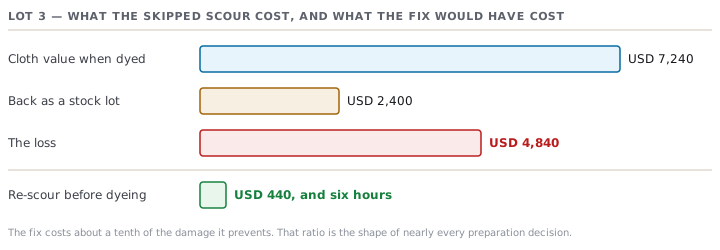
When lot 3 came off the jigger it carried greige at USD 1.28 per m, preparation at USD 0.22 per m and dyeing at USD 0.31 per m. That is USD 1.81 per m, so USD 7,240 on 4,000 m. A reactive dyeing can be stripped, but stripping costs money, costs fibre strength, and rarely gives a cloth you would put under a white shirt front. The realistic outcome is a downgrade to a stock lot at about USD 0.60 per m, or USD 2,400. The loss is USD 4,840. Add the twelve days it takes to weave and prepare a replacement, against a sailing on 6 May.
Re-scouring that batch before it was dyed would have cost about USD 0.11 per m in chemicals, steam and machine time. On 4,000 m that is USD 440, and six hours.
USD 440 against USD 4,840. A preparation correction costs roughly a tenth of the damage it prevents. That ratio is the shape of nearly every decision in this course.
Prompt · Trace a dye fault back to preparation
The morning a lot comes off the machine patchy, streaky or off-shade, while the dyehouse is still re-checking its recipe.
Act as a senior textile processing manager in a cotton dyehouse. A dye lot has come off the machine wrong and I need to know whether the cause is in dyeing or in preparation before anybody re-runs a recipe. Order facts: buyer [BUYER], PO [NUMBER], style [STYLE], fabric [COMPOSITION, CONSTRUCTION, GSM, WIDTH], total fabric [QUANTITY AND UNIT], this lot [QUANTITY], shade [NAME AND REFERENCE], dyestuff class [REACTIVE / DISPERSE / VAT / OTHER], machine [TYPE], liquor ratio [RATIO]. What the fault looks like, described physically rather than named: [DESCRIBE — where it sits on the cloth, whether it follows the warp, the weft, the roll, the width, the edges, and whether the edges of the affected areas are sharp or soft]. Preparation records for this lot and for the lots that dyed correctly: [PASTE SINGEING, DESIZING, SCOURING, BLEACHING, MERCERISING AND WASHING-OFF PARAMETERS, WITH TEMPERATURES, TIMES AND pH]. Any test results taken on the prepared cloth: [PASTE ABSORBENCY, TEGEWA, WHITENESS, pH]. Do the following. First, tell me which preparation faults could produce a fault of this exact geometry and which could not, and say why the geometry rules the others out. Second, compare this lot's preparation parameters against the lots that dyed correctly and list every difference, however small, in a table. Third, name the single most likely cause and the one measurement that would confirm or eliminate it today. Fourth, tell me what can still be done to this cloth and what cannot. Do not offer a dyeing explanation without first saying what in the preparation record makes it more likely than a preparation one.
AI can make mistakes — check anything you act on.
Check yourselfA knitted cotton jersey comes to the dyehouse. Which preparation step from the woven route does it not need, and which one becomes more important?Show the answer
It does not need desizing. Knitted fabric is not sized, because the yarn never faces the loom shed. What becomes more important is scouring. Knitting oils and the paraffin wax on the yarn are on that cloth in quantity, typically 0.5 to 1.5 percent. They are the classic cause of oil spots — invisible on greige, then showing up as darker marks after heat setting or dyeing. A mill that scours a jersey with the same recipe it uses for a scoured-and-bleached poplin, without adjusting for the oil load, will produce spots it cannot explain.
Check yourselfLots 1, 2 and 4 of BS-3308 all matched the lab dip. Lot 3 did not. Does that make it a dyeing problem or a preparation problem, and how would you tell in an hour?Show the answer
The consistency of the other three lots is evidence for preparation, not against it. A dye recipe that produced three matching lots is a recipe that works. What differed on lot 3 was the cloth it was applied to. To tell in an hour: pull the preparation log for all four batches. Compare scouring temperature, scouring time and the absorbency result, batch by batch. If lot 3 is the odd one out in that table — and here it was, at 88 °C, 25 minutes and 9 seconds against under 1 second — the question is answered before the dyehouse has finished re-weighing its dyestuff.