Lessons · Lesson 2 of 3
Digital, and where the two lines cross
Choose between screen and digital on arithmetic — ink class, coverage, colour count and run length — not on which machine sounds modern.
Lesson 2 of 3 · 40 min
The situation
Most people assume digital printing is the cheaper way of doing what screens do. It is not cheaper. It is cheap somewhere else. Screens cost a lot to prepare and little to run. An inkjet is the other way round. The two answers swap over at a certain length of cloth. This lesson works out where.
It is 4 April, and Sonnenberg's buying office sends a two-line email. They want a fourth colourway of AW-2210, a soft sage green, for a market test in fourteen stores. Quantity: 350 m. They would like it shipped with the main order.
Ashraf's minimum is 800 m a colourway. So the rotary answer is: matching the six pastes USD 270, make-ready USD 300, start-up wastage USD 234, and 800 m of running charged at USD 0.82 whether it runs or not, USD 656. USD 1,460 for 350 usable metres. That is USD 4.17 a metre, on a cloth whose printed cost in the main colourways is under a dollar.
The digital answer is USD 180 to prepare the file and set up the colours, then USD 2.40 a metre for 350 m. USD 1,020, or USD 2.91 a metre. Same design, same cloth, same buyer, USD 440 cheaper. And no screen has to be found or mounted.
At 26,000 m the same comparison goes the other way — so hard it is not a comparison at all. Knowing where the two answers swap is the whole of this lesson.
Digital is a family, not a machine
A digital textile printer fires drops of dye or pigment onto cloth from print heads. What happens after that depends entirely on which chemistry is in the tank. And the chemistry is chosen by the fibre, exactly as it is in dyeing.
| Ink class | Prints on | How it is fixed | Wet processing after | Hand | Typical digital cost a metre |
|---|---|---|---|---|---|
| Pigment | Anything — cotton, viscose, polyester, blends | Dry heat cure at around 150 to 170 degrees | None. No steam, no wash off | Stiffer as coverage rises | USD 1.35 |
| Reactive | Cellulosics — cotton, viscose, linen, modal | Saturated steam, then the dye bonds to the fibre | Pre-treat and dry before printing; steam and wash off after | Soft, unchanged | USD 2.40 |
| Acid | Wool, silk, nylon | Steam | Pre-treat, steam, wash off | Soft | USD 2.65 |
| Disperse, by sublimation transfer | Polyester and high-polyester blends | Printed to paper, then heat pressed at around 200 degrees | None. No water at all | Unchanged | USD 1.60 plus paper |
Three consequences of that table are worth carrying around.
Digital does not remove the wet processing. It removes the screens. A digital reactive print on our viscose is padded with alkali and thickener, dried, printed, steamed, washed off, dried and stentered. That is exactly the same finishing chain as the rotary print. It is why digital reactive costs USD 2.40 a metre and digital pigment costs USD 1.35. The difference is not the printing. It is the water.
Sublimation only goes one way. The dye moves into the polyester and stays there. That is why the fastness is excellent and there is no wash-off. But it cannot be laid onto a dark ground. There is no white sublimation ink, and nothing you print will sit on top of a navy polyester. Sublimation designs are drawn for a white or pale base, always.
Pigment is the cheapest route, and the one that fails a rub test. Pigment sits on the surface, under a binder film. On a pale scattered print at low coverage it works perfectly well — and that is what most short-run digital in the region actually is. On a dark, heavy, near-solid design it is a wet-rub failure and a cracking complaint waiting for a wash. Lesson 3 puts numbers on that.
No limit on how many colours. A real limit on which ones
The thing everybody knows about digital is true: there is no colour count. There are no screens. So a seventh colour costs nothing, a gradient costs nothing, a photograph costs nothing. The design can carry two hundred shades as cheaply as it carries two. For an artwork with soft blending — a watercolour floral, a photographic placement — screen printing has to separate the shades and fake them with dots. Digital simply prints them.
The thing fewer people know is the other side. A digital machine has a fixed ink set, usually six to ten inks. It can only mix what those inks reach. Some colours are outside that range and cannot be hit at all. Bright oranges and reds, fluorescents, and a deep neutral black on reactive are the usual casualties. A screen printer simply mixes that exact paste in the colour kitchen and prints it. So the honest sentence is: digital has no limit on how many colours, and a real limit on which colours. If a Pantone in the artwork is critical to the brand, have it printed digitally on the actual cloth before anybody promises it.
Where the lines cross
Put the two cost structures side by side. Rotary carries USD 1,944 of fixed cost for this six-colour design, then USD 0.82 a metre. Digital carries USD 180 of fixed cost, then USD 2.40 a metre. One is a big entry fee and a cheap ride. The other is almost no entry fee and an expensive ride.
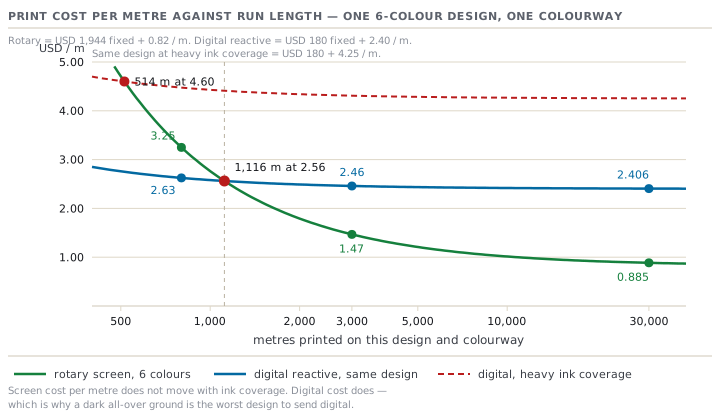
The two lines cross at about 1,116 m, where both routes cost USD 2.56 a metre. Below that, digital. Above it, rotary — and the gap widens fast.
| Run on this colourway | Rotary, USD a metre | Digital, USD a metre | Who wins |
|---|---|---|---|
| 800 m | 3.25 | 2.63 | Digital |
| 1,116 m | 2.56 | 2.56 | Neither |
| 3,000 m | 1.47 | 2.46 | Rotary, by about a dollar a metre |
| 30,000 m | 0.885 | 2.406 | Rotary, by more than a dollar and a half |
On the main order that arithmetic is brutal. Printing 26,000 m digitally instead of rotary would cost roughly USD 39,300 more, on an order whose whole value is USD 100,800. Digital is not the cheap modern option, and screen is not the old expensive one. Digital is the option that wins on short runs. And there it wins decisively.
Two things that move the crossing point
Colour count moves it up. The crossing is the fixed cost divided by the gap in the running rates. And rotary fixed cost rises with every screen. At six colours the crossing is 1,116 m. At fourteen colours the fixed cost is USD 3,824 and the running rate has climbed two bands, so the crossing moves out past 2,000 m. The more colours a design has, the longer the run must be before screens are worth cutting.
Ink coverage moves it down — and only for digital. This is the trap that catches people. A rotary screen lays what it lays. Whether the design covers a quarter of the cloth or three quarters, the paste is cheap and the rate card does not change. Digital cost is ink, and ink is coverage. AW-2210 covers about a quarter of the ground and costs USD 2.40 a metre. Its companion design, a near-solid dark ground, covers roughly three quarters and costs USD 4.25 a metre — the dashed line on the diagram. That drags the crossing back to about 514 m.
So here is the rule of thumb that survives contact with a real order: the darker and heavier the design, the shorter the run at which screens win. A pale scattered print is the friendliest thing you can send to a digital machine. A black all-over is the worst.
The decision on SB-4471
Three main colourways go rotary. The sage market test goes digital. That is the right answer on both cost and calendar. And it comes with a condition that has to be written down.
A digital colourway and a rotary colourway of the same design are not the same product. They are printed with different ink systems, and they will not land on the same shade without their own matching. If the digital route is pigment rather than reactive, they will not have the same hand or the same rub fastness either. So Sonnenberg get a separate strike-off for the sage, approved separately, and a note in the file saying which colourways were printed by which route. Two of those dresses will meet on one rail in one store. Somebody will have that conversation. It is better to have it in April.
Check yourselfA six-colour design is wanted in two colourways: 9,000 m of one and 400 m of the other. What is the cheapest sensible route, and why is it not the same route for both?Show the answer
Rotary for the 9,000 m and digital for the 400 m. At 9,000 m rotary costs about USD 1.04 a metre against USD 2.42 digital. So printing that colourway digitally would cost roughly USD 12,400 more. The 400 m colourway on rotary pays a full colourway make-ready, its own colour matching, its own start-up wastage, and the 800 m minimum whether it runs or not. That is about USD 1,460, which is USD 3.65 for every metre you can actually cut. Digital delivers the same 400 m at about USD 2.85. The design does not care which machine prints it. The run length does. One thing does have to be handled: the two colourways then need separate strike-offs and a note in the file, because they are not the same print.
Check yourselfYour buyer says digital is cheaper because there are no screens to pay for. On a 26,000 m order for a six-colour design, what is the one number that settles it?Show the answer
The running rate. Screens are USD 1,140 of the USD 1,944 rotary fixed cost, and over 26,000 m that entire fixed block is under USD 0.08 a metre. It is noise. The difference that matters is USD 0.82 a metre against USD 2.40 a metre, which over 26,000 m is about USD 39,300. Fixed cost is what the eye sees on a quote, and it is the part that stops mattering as the run grows. Run length is what decides.
Prompt · Choose the print route for this design and this run
When somebody has said the word digital and nobody has yet worked out where the two cost lines cross for your own run length.
Act as a senior textile printing technologist advising a garment exporter. Help me choose between rotary screen, flat screen and digital for one design. The design: [NAME], [NUMBER] colours, repeat [SIZE], approximate ink coverage [PERCENT], any gradients or photographic areas [YES OR NO], any critical brand Pantone references [LIST]. The cloth: [COMPOSITION, WEIGHT, WIDTH]. The order: colourways and metres for each [PASTE], ship date [DATE], today is [DATE]. The rotary quote: engraving [PRICE] per screen, colour matching [PRICE] per colour, make-ready [PRICE], start-up wastage [METRES] at [PRICE] per metre, running rate bands [PASTE], minimum yardage per colourway [METRES]. The digital quote: set-up [PRICE], running rate [PRICE] per metre at [PERCENT] coverage, ink class offered [PIGMENT / REACTIVE / ACID / DISPERSE]. Do the following. First, tell me which ink classes are chemically possible on this fibre and rule out the ones that are not, saying why. Second, build the total cost for each route for EACH colourway separately, not for the order as a whole, and give cost per metre and per garment. Third, calculate the run length at which the screen and digital lines cross for this colour count, and tell me how far each colourway sits from that crossing. Fourth, tell me what higher ink coverage would do to the digital number and what it would do to the screen number, and re-state the crossing at the real coverage. Fifth, check whether any named Pantone is likely to be outside a digital ink set and say what to do about it. Sixth, lay out the calendar for each route from artwork to first bulk metre, and say which route I should take if the decision is made on lead time rather than on cost. Seventh, if you recommend splitting the order between routes, state exactly what extra approvals and documents that creates. Show every calculation.
AI can make mistakes — check anything you act on.