Lessons · Lesson 1 of 3
Screens, colours and the engraving bill
Take a rotary print quote apart line by line, and know what every extra colour costs before the artwork is signed.
Lesson 1 of 3 · 42 min
The situation
A printed cloth starts as a drawing. The person who approves the drawing is almost never the person who finds out what it cost. This lesson shows why those two things are one decision. A design is built one colour at a time. So counting the colours is also counting the cylinders. And the price does not rise smoothly with that count. It rises in steps.
It is 17 March, 07:40, in the sample corridor at Nasr Printing in El-Mahalla El-Kubra. On the light box is design AW-2210. The studio that drew it calls it Meadow: scattered flowers, for the German retailer Sonnenberg. PO SB-4471, style VD-206, 12,000 women's viscose challis midi dresses. FOB USD 8.40. Order value USD 100,800. Consumption is 2.05 m per dress. So 26,000 m of printed cloth is booked, on a 130 gsm challis, 1,450 mm usable width, in three colourways.
The buyer's designer signed the artwork nine days ago. Nobody in that meeting counted the colours.
Ashraf, the printer's colour manager, counts them now. Out loud, with a loupe — a small magnifying glass. Eight. He writes a number on the back of the layout and pushes it across the table. The number is USD 26,854. That is what it costs to print this order as drawn. Then he draws a line under it and writes a second number: USD 23,264. Same design, same cloth, same buyer, two fewer colours.
The gap is USD 3,590. On 12,000 dresses that is USD 0.30 a garment, on a style quoted at USD 8.40. Nothing about the dress changes. What changed was a decision, taken by somebody who did not know they were taking it.
How a rotary machine spends your money
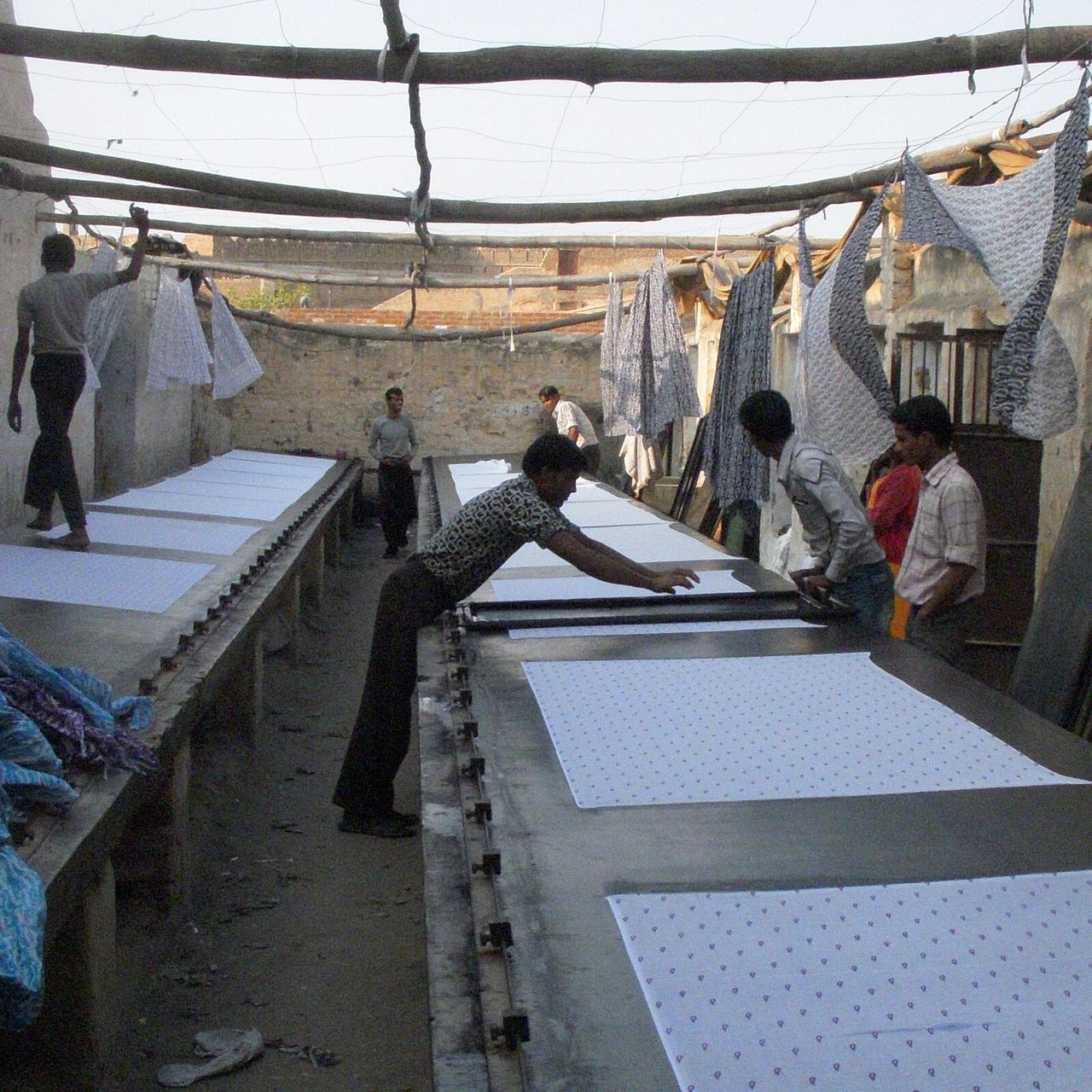
A rotary printing machine is a row of stations. At each station a hollow nickel cylinder turns against the cloth. That cylinder is the screen. Print paste is pumped inside it. A magnetic rod or a rubber blade presses the paste out through the holes engraved in the cylinder, and only through those holes. One screen carries one colour. Eight colours means eight cylinders standing in a row. The cloth passes under all of them in one run, at 40 to 80 m a minute.
After printing, the cloth is dried. For a reactive print on viscose it is then steamed, to fix the dye. Then it is washed off, to remove the thickener and the dye that did not react. Then it is dried and finished again. When the quote says a rate per metre, that whole chain is what you are buying.
A flat screen machine does the same job with flat frames. Each frame drops onto the cloth while the cloth stands still. Then the cloth moves forward one step. It runs at 8 to 20 m a minute. So it is far slower, and dearer per metre. It is chosen for one of three reasons. The repeat is too long for any rotary cylinder. The run is too short to justify rotary make-ready. Or the design needs an effect a rotary screen cannot lay down.
The quote, line by line
Here is Ashraf's quote for AW-2210 as drawn: eight colours, one colourway of 26,000 m. Every printer's quote in the world is this same list, under different headings.
| Line | What it pays for | Rate | Eight colours |
|---|---|---|---|
| Screen engraving | A nickel cylinder engraved, developed, lacquered and end-ringed, one per colour | USD 190 a screen | USD 1,520 |
| Colour matching | Matching each paste to the standard and writing the recipe | USD 45 a colour | USD 360 |
| Machine make-ready | Mounting, seating and lining up the screens on the line | USD 300 a run | USD 300 |
| Start-up wastage | The first 120 m, printed while the screens are brought into line, at USD 1.95 a metre | — | USD 234 |
| Running rate | Print, dry, steam, wash off, dry, finish | USD 0.94 a metre | USD 24,440 |
| Total | USD 26,854 |
Two things in that table deserve more attention than the total.
Engraving is charged per design. Everything else is charged per colourway. The same eight cylinders print the ecru ground, the ink ground and the coral ground. You engrave once. But each colourway needs its own eight paste recipes, matched and approved. It needs its own wash-up and make-ready on the line. And it needs its own start-up wastage. So across the three colourways of AW-2210, the engraving is USD 1,520 once. The matching, make-ready and wastage are USD 894, three times over.
The running rate comes in bands, not in a straight line. Ashraf's rate card reads USD 0.82 a metre up to six colours, USD 0.94 from seven to ten, and USD 1.08 from eleven to fourteen. More colours means more stations to set up, more paste, a slower safe line speed, and more chance of colours landing out of place. Printers price all that in steps, not per screen.
What a colour really costs
Put the fixed charges and the banded rate together over the 26,000 m. You get the whole picture in one number per colour count.
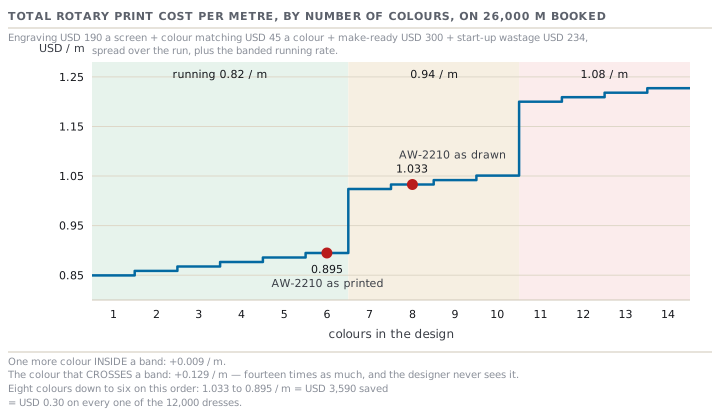
Read the two heights that matter. One more colour inside a band adds USD 0.009 a metre. That is the engraving and the matching spread over the run, and almost nothing else. The colour that crosses a band adds USD 0.129 a metre. Fourteen times as much, in a single step. A designer adding an eighth colour to a seven-colour design spends nine tenths of a cent a metre. A designer adding a seventh colour to a six-colour design spends thirteen cents.
That is why the question is never how many colours does this design have. It is which side of the boundary does it sit on, and what would it cost to move it.
Moving AW-2210 across the boundary
Ashraf and the buyer's designer spent forty minutes at the light box. They took two colours out.
The first was free. Two of the greens, a leaf green and a shadow green, were closer than the eye can tell apart at arm's length. One screen engraved with a halftone can print a single green at two depths, and it reads as both. The designer did not have to take anyone's word for that. It was shown to her on a table print before she agreed.
The second was a judgement. A fine warm grey sat under the flower heads to lift them. On a table print at 200 mm it looked like drawing. On a metre of cloth at arm's length it looked like soil marking. That is exactly what a returns desk in Hamburg would have called it. Taking it out improved the design, and paid for itself twice over.
Six colours. The running rate drops back to USD 0.82. Fixed charges fall from USD 2,414 to USD 1,944. Total USD 23,264. The saving of USD 3,590 is real money, and it appears in nobody's costing sheet — because nobody costed the eight colours in the first place.
The two constraints that are not money
Repeat. The repeat is the distance after which the design starts again. A rotary screen is a cylinder, so the design's vertical repeat has to close exactly around it. Cylinders come in fixed circumferences: 640 mm is the workhorse, then 820, 914 and 1,018 mm. A repeat of 640 mm works. So does 320 mm, and 213.3 mm, because they divide into 640 exactly. A 700 mm repeat works on none of them. It must be redrawn to a size that closes. Or engraved on a bigger, dearer cylinder, if one exists that closes it. Or printed flat, where the repeat can run to two metres and beyond. Large florals, engineered borders and big geometric designs go flat for exactly this reason.
Minimum yardage. Nasr's minimum is 800 m per colourway. It is charged whether it is used or not, because the make-ready and the wash-up cost the same for 300 m as for 3,000. AW-2210's three colourways are 13,200 m, 8,600 m and 4,200 m. So the minimum does not matter here. It starts to matter the moment a buyer asks for a fourth colourway as a market test. That is the next lesson.
Check yourselfA design has seven colours and the printer's bands are one to six at USD 0.82, seven to ten at USD 0.94. The run is 26,000 m in one colourway. What is removing the seventh colour worth, and where does the money come from?Show the answer
About USD 3,590 on this run. And almost all of it comes from the band, not from the screen. Dropping the seventh colour saves USD 190 of engraving and USD 45 of matching. That is USD 235 in total, which over 26,000 m is nine tenths of a cent a metre. It also drops the running rate from USD 0.94 to USD 0.82. That is USD 0.12 a metre, or USD 3,120. The screen is the visible saving, and it is the small one. The band is the invisible saving, and it is the large one.
Check yourselfThe same design is ordered in three colourways instead of one. Which lines of the quote multiply by three, and which do not?Show the answer
Engraving does not. The cylinders are cut from the design, and every colourway prints from the same cylinders. Colour matching, machine make-ready and start-up wastage all multiply, because each colourway is a fresh set of recipes, a wash-up, a fresh line-up and a fresh run-in. On this quote that is USD 894 each time. The running rate applies to whatever metres each colourway actually runs, subject to the minimum yardage. A merchandiser who assumes the whole quote triples over-prices the order and loses it. A merchandiser who assumes nothing triples under-prices it, and pays the difference personally.
Prompt · Take a print quote apart before the artwork is signed
The day the artwork arrives, when the colour count is still movable and nobody has told the buyer a price yet.
Act as a senior fabric and printing merchandiser in a garment export factory. I have a print quote and an artwork that has not been finally approved. Order facts: buyer [BUYER], PO [NUMBER], style [STYLE], [QTY] pcs, FOB [PRICE] per piece, fabric consumption [METRES] per piece, total metres booked [METRES], base cloth [COMPOSITION, WEIGHT, WIDTH]. The design: [NAME OR REFERENCE], [NUMBER] colours as drawn, repeat [SIZE], colourways and metres each: [PASTE]. The printer's quote, exactly as sent: [PASTE THE QUOTE]. If you have them, the printer's running-rate colour bands are [PASTE], the screen circumferences the machine holds are [PASTE], and the minimum yardage per colourway is [METRES]. Do the following. First, restate the quote as five lines — screen engraving, colour matching, machine make-ready, start-up wastage, running rate — and say for each whether it is charged once per DESIGN or once per COLOURWAY, then give me the total for the order as quoted. Second, tell me the cost per metre and per garment. Third, work out what each colour is costing me: the amount one more colour adds inside the current band, and the amount the colour that crosses a band adds, both per metre and per garment. Fourth, tell me whether the repeat closes on one of the machine's screen circumferences, and if it does not, name the options and price them. Fifth, check every colourway against the minimum yardage and tell me which ones are paying for metres they will not use. Sixth, list the questions I should ask the printer before I quote, and the numbers I should put on the artwork sign-off sheet. Do not assume any rate I have not given you; where a number is missing, say so and tell me who to ask for it.
AI can make mistakes — check anything you act on.