Lessons · Lesson 3 of 3
On the garment, and what the print must survive
Price a placement print and an engineered print properly, recognise the four faults that come back to the print room, and hold a strike-off approval that is worth something.
Lesson 3 of 3 · 38 min
The situation
Up to here the cloth was printed by the metre and then cut. The pattern had no idea where the garment was. This lesson is about the prints that do know where they are. One must land in the middle of a chest on every piece. One must rise out of the hem. Both arrive sounding like artwork. Both are really costings.
It is 21 April, and SB-4471 has grown two limbs. Sonnenberg have added a companion style, VD-211: a navy single-jersey tee, 4,600 pieces, with a six-colour chest print. And they have asked whether the Meadow floral on the dress can become an engineered border that grows up from the hem.
Both requests sound like artwork. Both are actually costings. And one of them is about to eat most of the margin on the dress.
Printing cloth and printing a garment are different trades
Everything in the first two lessons was piece-goods printing: cloth printed continuously, in metres, and then cut. The print does not know where the garment is. You buy metres, you pay per metre, and consumption is whatever the marker says.
A placement print is different. It is positioned on a garment part — a chest, a pocket, a back yoke — and it has to land in the same place on every piece. So it is printed one piece at a time, after cutting, and it is bought per piece. There are two moments to do it.
- Panel print — print the cut panel before it is sewn. The positioning is excellent, and the print can be planned to cross a seam. But panels are cut oversize and re-cut afterwards, which adds handling and a few percent of consumption on that panel.
- Garment print — print the finished garment on a carousel. No extra cutting and no re-handling. But the print cannot cross a seam, and the printing pallet has to clear collars, plackets and side seams.
Three routes onto a made garment
| Route | What it is | Fixed | Per piece | Total on 4,600 | Notes |
|---|---|---|---|---|---|
| Screen on garment | One flat screen per colour, plus a white underbase for the dark ground — seven screens on a carousel | USD 241 | USD 0.39 | USD 2,035 | Minimum 300 pieces a design |
| Heat transfer | The design printed to a carrier sheet, then heat pressed onto the garment | USD 60 | USD 0.44 | USD 2,084 | No colour limit, heavier hand |
| Direct to garment | Digital, printed straight onto the tee over a pre-treatment | none | USD 1.85 | USD 8,510 | No minimum, no colour limit |
Read the first two rows again. On 4,600 pieces, screen and transfer are USD 49 apart. Neither is cheaper than the other in any sense a merchandiser should act on. The decision between them is made on hand, on wash durability and on lead time — not on price. Anybody who tells you otherwise has not done the arithmetic.
Direct to garment is four times either of them here. It stops being the wrong answer only at low volume. On a 250-piece repeat, screen costs USD 358, because it is charged against the 300-piece minimum. Transfer costs USD 170. Direct to garment costs USD 463.
The white underbase in the first row is not a detail. Ink is see-through, so on a navy ground six colours printed direct would read as six shades of navy. A white layer must be laid first, dried with a flash of heat, and printed over. That means an extra screen, an extra flash, a heavier hand — and the single biggest cause of cracking complaints on dark tees.
What an engineered print does to the marker
Now the hem border. An engineered print is positioned relative to the pattern piece: the border has to land at the hem, at the right height, on every size. That forces three things on the cutting room at once. The marker becomes one-way: no piece may be turned. It becomes position-locked: pieces cannot slide freely along the length. And the printed cloth becomes size-specific, because each repeat carries the placement for one particular size.
Marker efficiency pays for all three.
| Print type | Marker | Efficiency | Consumption a dress | Extra cloth | Extra cost a dress |
|---|---|---|---|---|---|
| Non-directional all-over | Two-way | 78 percent | 2.05 m | — | — |
| Directional all-over | One-way | 74 percent | 2.16 m | 0.11 m | USD 0.34 |
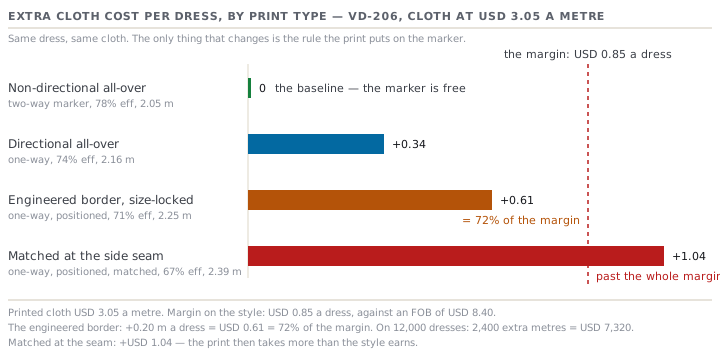
| Engineered border, size-locked | One-way, positioned | 71 percent | 2.25 m | 0.20 m | USD 0.61 |
| Engineered and matched at the side seam | One-way, positioned, matched | 67 percent | 2.39 m | 0.34 m | USD 1.04 |
The engineered border costs USD 0.61 a dress. On 12,000 dresses that is 2,400 extra metres of printed cloth, and USD 7,320. The margin on VD-206 is USD 0.85 a dress, against an FOB of USD 8.40. So the border, priced as though it were an ordinary all-over, would have taken seventy-two percent of the margin on the style. And the only document that would ever have shown it is a marker report, produced weeks after the price was agreed.
There is a second cost with no line on any quote. Size-locked cloth cannot be re-cut to a different size ratio. If Sonnenberg move a thousand pieces from small to large in June, the cloth printed for the small becomes dead stock. An engineered print freezes the size breakdown weeks earlier than a plain print does.
Prompt · Cost what this print does to the marker
Before a directional, engineered or repeat-matched print is priced at the plain-fabric consumption and quietly eats the margin.
Act as a senior cutting-room and costing manager in a garment factory. I need to know what a print is about to cost me in cloth, not in printing. Style [STYLE], buyer [BUYER], [QTY] pcs, FOB [PRICE] per piece, my cost per piece [COST], margin per piece [VALUE AND PERCENT]. Size breakdown: [PASTE]. Cloth: [COMPOSITION, WEIGHT], usable width [MM], printed cloth cost [PRICE] per metre. The plain-fabric marker: consumption [METRES] per piece at [PERCENT] efficiency, two-way. The print: [DESCRIBE IT — non-directional all-over, directional all-over, engineered placement, engineered and matched at a seam], repeat [SIZE], and any placement that must land at a fixed point on the garment [DESCRIBE]. Do the following. First, tell me which marker constraints this print imposes — one-way, position-locked, size-locked, matched — and say plainly which of them the artwork forces whether anybody intended it or not. Second, estimate the marker efficiency under each constraint and convert it to consumption per piece, showing the arithmetic. Third, price the extra cloth per piece, for the whole order, and as a percentage of the margin per piece. Fourth, tell me what the print does to flexibility after cutting: whether the printed cloth becomes size-specific, what happens if the buyer moves quantity between sizes later, and what that exposure is worth in dollars. Fifth, list what I must ask the buyer or the studio for before I quote — repeat size, placement tolerance, whether the border may be re-scaled per size. Sixth, give me the single sentence I should put in the cost sheet so that whoever reads it later knows this consumption is print-driven and not padding. Be explicit where you are estimating rather than calculating.
AI can make mistakes — check anything you act on.
The four faults that come back to the print room
Misfit, or out of register. Each colour is laid by a different screen. So each colour can land in the wrong place relative to the others. It shows as a white hairline along one edge of a motif, and a doubled edge on the other. The causes: the cloth creeping on the blanket because the gum let go, a screen not seated, a cylinder out of round, or the fabric stretching. That last one is why viscose and jersey misfit far more easily than a stable poplin. The defence is designed in: a trap, an overlap of two tenths to four tenths of a millimetre where two colours meet, so a small misfit hides. Traps are decided in the separation, before engraving, and agreed at the strike-off.
Ghosting. A faint second image where there should be none. A screen re-deposits onto the blanket and prints it back onto the next metre, or a blanket was not washed clean. It is a machine fault, not a design fault. And it usually affects part of a batch, not all of it. That is why cloth has to be inspected from the start, middle and end of a roll — not from the outside of it.
Poor penetration on a heavy ground. The paste stays on the tops of the yarns, and the spaces between them keep the ground colour. So the print looks solid when it lies flat on the table, and shows white speckle the moment the garment is folded or worn. It is worst when a light print goes onto a dark, heavy cloth. In that case the right answer is often not to print on top at all, but to discharge: destroy the ground colour chemically and lay the new colour into the space.
Cracking after wash. A pigment or plastisol print is a film. Films crack when they are thick, when the fabric stretches, or on a dark garment over a white underbase. It shows at five washes as fine lines across the print. Every cure is a specification, not workmanship: a softer binder, a thinner film, a stretch additive, or a different route.
The fastness a print still has to pass
Shade approval and fastness approval are separate events. And the second one fails after the first one has passed — because shade is judged on a strike-off, and fastness is judged on bulk print at bulk paste depth.
| Test | Standard | Requirement | Comment |
|---|---|---|---|
| Colour change, domestic wash | ISO 105-C06 | Grade 4 | Reactive passes comfortably; pigment at depth does not |
| Staining onto adjacent fabric, wash | ISO 105-C06 | Grade 3-4 | Watch the white ground beside a dark motif |
| Dry rubbing | ISO 105-X12 | Grade 4 | |
| Wet rubbing | ISO 105-X12 | Grade 3 | The one that fails. Pigment on a dark heavy design is marginal here |
| Perspiration, acid and alkaline | ISO 105-E04 | Grade 4 change | |
| Light | ISO 105-B02 | Grade 4 | A summer print in a window |
| Dimensional stability, three washes | ISO 6330 | Within 3 percent | On an engineered print, shrinkage moves the placement |
Wet rubbing is the test to put in front of a buyer early. If a design is dark, heavy and pigment-printed, agree the achievable grade in writing, before bulk. Or move it to a route that reaches the grade the manual asks for. Agreed after a failed report, it is a negotiation. Agreed before, it is a specification.
The strike-off, and the one thing it does not carry
A strike-off is a length of the actual cloth, printed with the actual design, offered for approval. Two kinds exist, and they are not interchangeable.
- A lab or table strike-off is printed by hand on a flat table. It is fast and cheap — USD 260 here. It is the right tool for agreeing the separation, the scale and the placement.
- A production strike-off is run on the production machine, with the bulk screens and the bulk cloth. It costs USD 480, because it costs a make-ready. And it is the only one that commits anybody to anything.
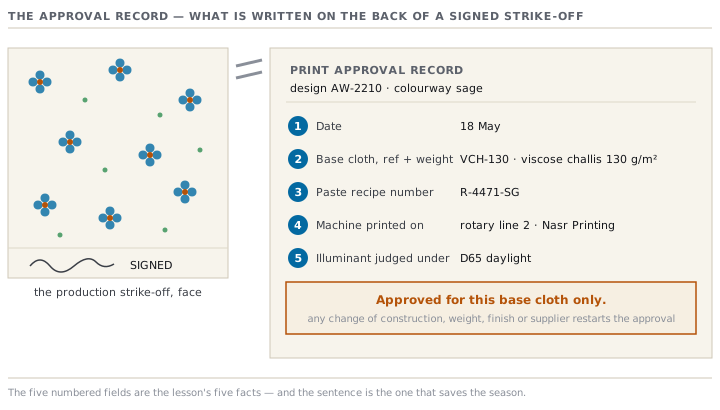
A production strike-off, once signed, commits the colour, the scale and repeat, the placement, the hand and the register tolerance — for that cloth, on that machine, with that paste system. It does not commit bulk shade consistency across the run; that is the continuity card's job. It does not commit fastness; that is a test report. It does not commit shrinkage. And it says nothing at all about a different base cloth.
That last one is where SB-4471 nearly came apart. The sage colourway was approved on the 130 gsm viscose challis. The mill, short on challis, offered a 155 gsm viscose-linen for the second delivery. Somebody accepted it as an equivalent cloth. It is an equivalent cloth for a dress. It is a different cloth for a print: heavier, more absorbent, with a linen slub that scatters light differently. So the same paste at the same depth came up deeper and duller — grey scale 3 against the approved strike-off, which is a rejection. There were 4,200 m of it, about USD 12,810 of printed cloth. It was found only because a QC held a roll against the signed strike-off, rather than against the shade band.
Check yourselfA buyer approves a strike-off, then the mill substitutes a heavier cloth of the same fibre and the same shade. Is the approval still good?Show the answer
No. And the fibre and the shade being the same is exactly what makes it dangerous — everyone believes nothing changed. A print's colour is the paste, the cloth's absorbency, its construction and its surface, all acting together. A heavier, more absorbent cloth takes more paste and reflects light differently. So the same recipe at the same depth gives a different colour, and often a different hand. The approval was of a print on a cloth, never of a print. Re-strike, or you are shipping against a standard nobody has approved.
Check yourselfA 4,600-piece order needs a six-colour chest print on navy jersey. Screen quotes USD 2,035 and transfer quotes USD 2,084. Which do you take?Show the answer
Not on those numbers. They are USD 49 apart, which on 4,600 pieces is a rounding error. Decide on the three things that actually differ. Hand: the screen print with a flashed white underbase and the transfer both build a film, so ask for both on the real garment and feel them. Durability: wash and wet-rub both samples, because a dark ground with an underbase is where cracking and wet-rub failures live. Lead time and repeats: transfer has almost no set-up cost, so if this style is likely to repeat at low volume, transfer stays cheap — where screen re-charges a make-ready and a minimum.
Prompt · Write the strike-off brief and the approval record
When a strike-off is about to be sent, and again when one comes back signed and has to become a document somebody can hold a bulk roll against.
Act as a senior print and colour manager. I am sending a strike-off for approval and I want the brief and the approval record to be worth something six weeks from now. Design [NAME OR REFERENCE], [NUMBER] colours, colourway [NAME], buyer [BUYER], style [STYLE], PO [NUMBER]. Base cloth as it will be in bulk: [COMPOSITION, WEIGHT, CONSTRUCTION, FINISH, MILL, QUALITY REFERENCE]. Route: [ROTARY / FLAT / DIGITAL], ink class [PIGMENT / REACTIVE / ACID / DISPERSE], machine [NAME]. Strike-off type: [LAB TABLE PRINT / PRODUCTION RUN]. The buyer's standards: illuminants [LIST], grey-scale tolerance [GRADE], fastness requirements [PASTE THE TABLE], register tolerance [MM], placement tolerance [MM]. Do the following. First, write the brief that goes out with the strike-off: exactly what I am asking the buyer to judge, and in what light. Second, write the list of what this strike-off will and will NOT commit once signed — separate the colour, scale, repeat, placement, hand and register tolerance from bulk shade consistency, fastness, shrinkage and garment fit, and say which document carries each of the ones it does not cover. Third, tell me which of my numbers are missing or self-contradictory and what to ask for. Fourth, write the approval record to be attached to the signed strike-off: date, base cloth reference and weight, recipe number, machine, illuminant judged under, and the sentence that limits the approval to this base cloth. Fifth, list every change — construction, weight, finish, mill, ink class, machine — that would invalidate this approval and require a re-strike, and say what I should do if a substitution is offered mid-order. Sixth, tell me how many strike-off rounds my ship date can absorb, given a round takes [DAYS], and on what date the fabric booking slips. Do not tell me an approval covers something it does not.
AI can make mistakes — check anything you act on.