Lessons · Lesson 2 of 3
Every chemical finish is a trade
Price what each chemical finish gives against what it takes, and write a finishing specification that names both instead of only the property somebody asked for.
Lesson 2 of 3 · 34 min
The situation
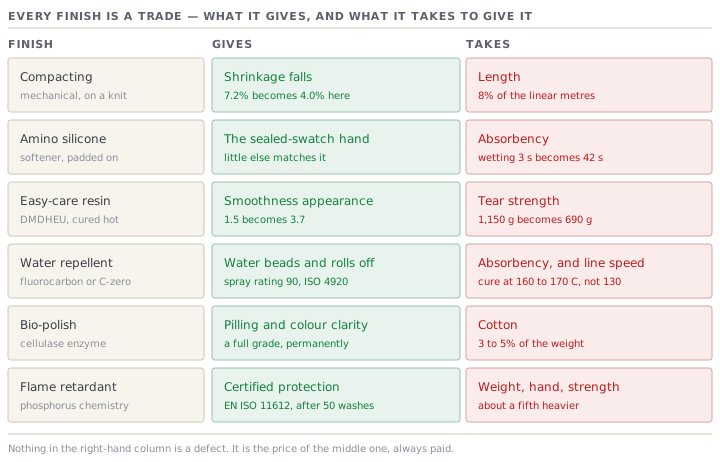
A finishing chemical is bought for one property and paid for with another. The second half of that sentence almost never appears on the specification. Make a towel as soft as the approved sample, and it can stop absorbing water. Make a shirt come flat out of the machine, and it tears more easily. This lesson names, for each treatment on the shelf, the thing it gives and the thing it takes.
Two failures land at Nile Finishing Mills in the same week. They are the same failure in different clothes.
Monday. 6,400 bath towels for the British buyer Trelawney Home, 70 by 140 cm, 550 g/m² terry — 3,450 kg of cotton. The buyer's specification carries two clauses, and nobody read them side by side: hand to the sealed swatch, and absorbency to AATCC 79, wetting time not more than 5 seconds. The wetting test is simple: drop water on the fabric and count the seconds until it soaks in. To reach the hand, the mill padded on an amino-functional silicone softener at 32 g per litre. The hand is beautiful. The wetting time went from 3 seconds to 42 seconds. A towel that takes forty-two seconds to accept a drop of water is not a towel.
Thursday. 9,500 men's shirts for the French brand Aubertin, in 100 percent cotton poplin, 120 g/m². The specification asks for two things. Smoothness appearance 3.5 minimum after five home launderings, to AATCC 124 — a graded score of how flat the shirt looks after washing. And tear strength 800 g minimum in both directions, Elmendorf, to ISO 13937-1. The mill applied a DMDHEU easy-care resin at 55 g per litre, with a magnesium chloride catalyst, and cured it at 160 degrees Celsius. Smoothness came out at 3.7 — a clear pass. Tear strength fell from 1,150 g warp and 1,080 g weft to 690 g and 740 g. Both directions fail.
Nothing went wrong on the floor in either case. Both recipes did exactly what they are for.
Nothing is applied to cloth for free
Start with how a chemical finish actually gets onto fabric. This is the arithmetic every merchandiser should be able to do in their head.
The cloth runs through a pad bath — a trough of the chemical solution — and then between two squeeze rollers. What matters is not how strong the bath is. It is how much of the bath the cloth carries out of the rollers. That amount is called the wet pick-up.
add-on percent = wet pick-up percent × bath concentration in grams per litre ÷ 1,000
Nile's terry line runs at 68 percent wet pick-up, with the bath at 32 g per litre. So each kilogram of cloth leaves the rollers holding 0.68 litres of liquid, carrying 0.68 × 32 = 21.8 g of product. That is an add-on of 2.18 percent. Across 3,450 kg of towels, about 75 kg of softener is sitting on the goods.
Two things follow at once. First, a mill can halve the strength of the bath and keep the same add-on by raising the pick-up. So a recipe quoted only in grams per litre tells you nothing. Second, 2.18 percent by weight of a water-repelling film is more than enough to close a cotton surface to water. That is exactly what happened on Monday.
Softeners, and the property they quietly cost
A softener works by putting a slippery layer on the fibre, so that fibres slide over one another instead of gripping. That is what "soft" is, mechanically.
| Family | Hand it gives | What it takes | Notes |
|---|---|---|---|
| Cationic | Full, waxy, very soft | Absorbency; yellows on heat; shade shift on whites | Cheapest, substantive to cotton, hardest to wash out |
| Non-ionic | Moderate, smooth | Little absorbency, little durability | Compatible with most bath partners |
| Silicone, amino-functional | Slippery, elastic, the premium hand | Absorbency, badly | Can yellow, needs care with whites |
| Silicone, hydrophilic | Close to amino, slightly less slip | Costs more per kilogram | Keeps the surface open to water |
The Monday failure sits in the fourth row of that table — the row nobody used. The mill reached for the amino silicone because it is what the sealed swatch feels like. And the sealed swatch was approved on a fabric that had no absorbency clause on it.
The recovery is worth studying. An alkaline wash at 60 degrees Celsius stripped part of the finish and brought the wetting time to 7 seconds — still a fail. A second wash reached 4 seconds and passed. By then the hand was below the swatch, and the shade had moved enough to need re-approval. Reprocessing 3,450 kg at USD 0.85 per kilogram cost USD 2,932 and five days.
Doing it right on Monday morning meant one change: a hydrophilic silicone instead. About 75 kg of product, at roughly USD 1.20 per kilogram more than the standard grade — USD 90. The choice was never between a good towel and a cheap one. It was USD 90 against USD 2,932, decided by whoever wrote the recipe without reading the second clause.
Easy-care resin, and the strength it eats
Why does cotton crease? The fibre is cellulose. When the fibre is bent while wet, the hydrogen bonds between its chains break and re-form in the new position. The crease is remembered. An easy-care resin — DMDHEU is the workhorse — links those chains together with permanent chemical bonds. Now the fibre remembers its flat state and springs back.
It is a genuinely excellent finish. And it works by making cotton stiffer at the molecular level. A stiffer fibre absorbs less energy before it breaks. Tear strength is exactly a measurement of energy absorbed before breaking. So the loss is not a side effect that better process control could remove. It is the same property, measured twice.
| Measurement | Unfinished | Finished at 55 g per litre | Clause |
|---|---|---|---|
| Smoothness appearance, AATCC 124 | about 1.5 | 3.7 | 3.5 minimum |
| Tear, warp, ISO 13937-1 | 1,150 g | 690 g | 800 g minimum |
| Tear, weft, ISO 13937-1 | 1,080 g | 740 g | 800 g minimum |
The warp lost 40.0 percent of its tear strength, and the weft lost 31.5 percent. Four options exist. Only one of them is really an answer.
- Drop the resin to about 38 g per litre. Tear recovers towards 860 g. Smoothness falls to roughly 3.2, and the buyer's clause is missed. This is a request for a waiver, not a fix.
- Add a polyethylene or silicone extender at around 20 g per litre. It lubricates the stiffened structure and typically buys back a tenth to a fifth of the tear — call it 790 g. Still short, and it softens the hand.
- Change the base cloth. A 45s by 45s construction tears at about 1,340 g unfinished, and lands near 810 g at the same resin level. It costs about USD 0.14 a metre more. It is the only route that satisfies both clauses.
- Renegotiate the tear clause. Sometimes right, always slow. Argue it with the ladder data in hand, not with an apology.
The real lesson is the timing. The two clauses were never compatible on that base cloth. The place to discover that is fabric development, months before the bulk order. The tool is a finish ladder: three resin levels crossed with two catalysts, on the actual cloth, with every point tested for smoothness and tear.
The rest of the chemical shelf
Water repellents put a low-energy surface on each fibre, so water beads up and rolls off. Modern C6 fluorocarbons reach spray rating 90 to ISO 4920 and hold it through washing. Non-fluorinated chemistries — dendrimers and silicones — are under regulatory pressure to replace them, and they generally give up durability and all oil repellency. The trade nobody prices is the machine: a repellent needs curing at 160 to 170 degrees Celsius, against a softener's 130. The stenter slows down, and the batch takes longer. And note one contradiction: a repellent and a wicking finish on the same face are opposite instructions. One keeps water out; the other pulls it in.
Antimicrobials — silver, silane quaternary ammonium, zinc pyrithione — control odour, not infection. The claim is only as good as the test behind it: AATCC 100 or ISO 20743 for a quantitative reduction, stated after a named number of washes. They are regulated as biocides, under the EU Biocidal Products Regulation and by the Environmental Protection Agency in the United States. An unregistered claim on a label is a legal problem, not a quality one. And anionic softeners or ordinary detergent will deactivate a cationic antimicrobial — so the finish and its own care instructions can fight each other.
Flame retardants on cotton mean a phosphorus chemistry cured onto or into the fibre. They are a different order of intervention. The cloth can gain around a fifth of its weight. The hand goes stiff and papery. Tear and tensile drop. The performance must survive fifty industrial washes to hold a certification such as EN ISO 11612. They also need a dedicated line, because cross-contamination in the other direction is a real risk. And price the weight gain — you are buying it and shipping it.
Enzyme finishing, or bio-polishing, uses a cellulase enzyme to digest the tiny fibre ends standing off the yarn surface. Pilling improves by a full grade or more. The surface looks cleaner. Colours read brighter. The hand softens without a single gram of softener. What it takes is cotton: 3 to 5 percent weight loss, permanently, with a matching share of the strength. On 4,120 kg, that is well over a hundred kilograms of fibre that you bought and then paid somebody to remove. Worth doing, worth knowing — and worth putting in the consumption calculation rather than discovering in the weight sheet.
Prompt · Price what a finish gives against what it takes
Before you agree to a performance clause, when you want the property the chemistry will remove written down beside the one it delivers.
Act as a textile chemist advising a merchandiser. A buyer has asked for these finishes and performance clauses on one fabric: [PASTE EVERY CLAUSE, INCLUDING TEST METHOD, TARGET AND WASH DURABILITY]. The base cloth is [COMPOSITION, CONSTRUCTION, WEIGHT] and the garment is [PRODUCT]. For each requested finish, tell me: the chemistry normally used, the property it delivers and the test that proves it, and the property it REMOVES, quantified as a typical range on this base cloth. Then do three things. First, list every pair of clauses on this specification that fight each other, and say why in physical terms rather than commercially. Second, for each conflict, give me the options in order of cost: change the recipe, add an extender, change the base cloth, or renegotiate the clause, with the likely result of each. Third, design the finish ladder I should run at development to settle it, naming the levels, the variables and the tests at each point. Do not tell me a finish is free of cost; if you believe one is, say what you would measure to prove it.
AI can make mistakes — check anything you act on.
Check yourselfA mill quotes a softener recipe as '25 grams per litre'. What must you ask before that number means anything?Show the answer
The wet pick-up. Add-on is pick-up multiplied by concentration. 25 g per litre at 50 percent pick-up puts 12.5 g on each kilogram of cloth. The same bath at 80 percent pick-up puts 20 g on it — sixty percent more finish from an identical recipe. Two mills quoting the same grams per litre can be applying quite different amounts. That is why a specification should state the add-on, and why a mill that cannot tell you its pick-up is not controlling the finish at all.
Check yourselfA buyer asks for an antimicrobial finish on a cotton jersey and, on the same page, a hydrophilic wicking finish for moisture management. What is your answer?Show the answer
Both can be applied — but the antimicrobial has to be one that survives an anionic bath partner. The two must be laddered together, not approved separately. A cationic antimicrobial and an anionic wicking agent will precipitate each other in the pad bath, and you will get neither. Then ask the harder question: what wash durability does the antimicrobial claim carry, tested to AATCC 100 or ISO 20743, and is the claim registered where the goods are sold? An unregistered biocidal claim is not a quality debate.