Lessons · Lesson 3 of 3
Testing the finish, and why the roll lies
Specify each finishing test with its method and its conditions, and explain why a fabric that passed on the roll can fail on the garment three weeks later.
Lesson 3 of 3 · 33 min
The situation
A shrinkage figure looks like a quality result — something that passes or fails. It is really an instruction to the pattern room. Every panel is cut larger by exactly the amount the cloth is expected to lose. So a figure that is wrong by a few points does not fail an inspection. It makes every garment the wrong size after its first wash, weeks before anybody can see it.
2 April, 16:40. Kellermann's laboratory report on PO KM-4417 arrives. By now, 11,400 of the 18,000 KT-220 T-shirts are already sewn, and the rest are cut.
| Measurement | Nile Finishing Mills, 11 March | Kellermann laboratory, 2 April | Clause |
|---|---|---|---|
| Length shrinkage | 4.0 percent | 7.2 percent | maximum 5 percent |
| Width shrinkage | 2.5 percent | 3.1 percent | maximum 4 percent |
| Spirality | 2 percent | 6.5 percent | maximum 5 percent |
| Weight | 174 g/m² | 174 g/m² | 180 g/m², plus or minus 5 percent |
The weight passes. The width passes. The two that fail are the two that decide whether a T-shirt still fits after it has been washed. And both of them were measured as passing by the mill, three weeks earlier.
Nobody falsified anything. The mill's figure of 4.0 percent was measured, written down and signed. It was simply measured in a way that could only produce an optimistic answer.
The pattern was cut to a number that was not true
This is why a shrinkage figure is not a quality statistic. It is an input to the pattern.
The buyer's specification is an after-wash body length of 71.0 cm, tolerance plus or minus 1.0 cm. The pattern room worked from the mill's declared 4.0 percent. So it cut the body at 71.0 ÷ 0.96 = 73.96 cm, so that after washing it would land on 71.0 cm exactly.
At the true 7.2 percent, that panel washes to 73.96 × 0.928 = 68.6 cm — 2.4 cm short, against a tolerance of 1.0 cm. Every one of the 18,000 shirts is out of specification after its first wash. And the fault was locked in the moment the marker was made.
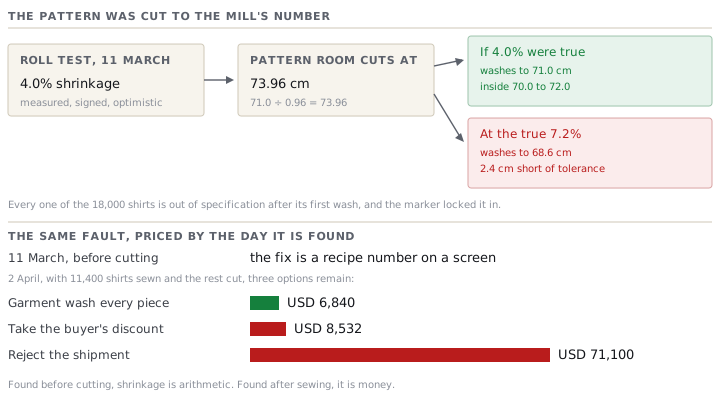
Fabric shrinkage found before cutting is an arithmetic problem. Found after cutting, it is not a fabric problem any more. It is a garment problem, and the only tools left are a garment wash or a discount.
The four measurements, and the conditions that make them mean anything
A test method without its conditions is not a specification. Two laboratories can both run "ISO 6330", disagree by three percentage points, and both be correct — because the standard is a family of procedures, not one test.
Dimensional stability to washing
The wash procedures live in ISO 6330 (and AATCC 135 in the United States). The specimen preparation, marking and measuring live in ISO 3759. The specification has to name five things, or it names nothing: the procedure, the temperature, the number of cycles, the drying method, and whether the test is on fabric or on the garment.
The drying method is where most of the disagreement hides. A knit dried flat on a line reads one to two points lower than the same cloth tumble-dried. Tumbling supplies the mechanical shaking that lets the loops collapse back to their relaxed shape. A mill that tests flat-dried and a buyer who tests tumble-dried will argue for a month and never converge.
And the conditioning is not optional housekeeping. Conditioning means letting the specimen settle in a standard atmosphere — 20 degrees Celsius and 65 percent relative humidity, per ISO 139 — before it is marked, and again before it is measured after washing. ISO 3759 requires it. Cotton changes length with the moisture it holds. Measure a warm specimen and you measure the wrong fabric.
Spirality
Single jersey wants to twist, because the yarn in it wants to untwist. AATCC 179 measures the change in skew after home laundering, reported as a percentage of the garment or specimen length.
KM-4417 read 2 percent on the roll and 6.5 percent after three washes. That is not a finishing failure, and finishing cannot fix it. Spirality is stored in the twist liveliness of the yarn, and in the geometry of the knitting machine — the number of feeders and the direction of rotation. A compactor's skew adjustment can straighten how the cloth looks on the roll. The wash undoes it, because the wash is when the yarn finally gets to relax. The permanent answers are upstream: a lower twist multiplier, a plied or compact-spun yarn, or a fabric fully relaxed before it is set.
Hand
The only honest reference for hand is a sealed swatch, signed and dated by both parties, kept in a closed bag away from light. Instruments exist and are used in research. But no buyer's quality manager rejects a shipment on an instrument reading.
Two practical points. Hand keeps developing for a day or two after finishing, as a silicone film settles into place — so a swatch judged straight off the stenter is not the hand the buyer will feel. And a sealed swatch ages. A two-year-old reference has stiffened, and the mill is quietly being asked, season after season, to match something that has moved.
Absorbency, and the two structural tests
AATCC 79 drops water on the surface and records the seconds until it is absorbed. Five seconds is a common ceiling for a towel — and it is the clause the softener broke in the last lesson. For sportswear, the more relevant test is vertical wicking: how far water climbs up the fabric in a fixed time.
Two more tests belong on any knit specification. Bursting strength to ISO 13938-2, on a pneumatic diaphragm, because a knit has no useful straight direction to pull — a 180 g/m² single jersey should hold well above 250 kPa. And pilling to ISO 12945-2 on a Martindale machine, at a stated number of rubs. Grade 3 to 4 at 7,000 rubs is an ordinary requirement — and it is exactly the number a bio-polish is bought to move.
Why a fabric that passes on the roll fails on the garment
Five mechanisms. All of them push the answer the same way: the roll reads better than the truth.
- The specimen was not conditioned. It was cut warm off a machine, marked within the hour, and measured before the moisture settled. This alone is worth one to two points on a cotton knit.
- The roll was under tension. Tightly wound cloth is being held longer than it wants to be. A specimen cut from the outer wraps of a hard roll has been stretched by the winding. Relax the cloth flat, for the period the standard asks, before touching it.
- Compaction relaxes back. Mechanical compaction is set with steam and heat, and it is not permanent. A knit tested ninety minutes after compacting has not yet given back what it will give back over three weeks in a warehouse.
- The garment has seams, and a garment is pressed. Seams hold the fabric in one direction and free it in another. The final press at the garment stage stretches panels back out. A fabric test measures cloth; a buyer measures a shirt.
- The sample came from one place. Weight, width and overfeed all vary across the width of a stenter and along a batch. One cut from the middle of one roll is not the batch. And a mill testing the first roll of a shift is testing the roll that was set up most carefully.
The root cause, and it explains both failures
Nile's route card for the KT-220 quality calls for 8 percent compaction. The operator loaded the stored recipe for the mill's regular 160 g/m² jersey, which is set to 5 percent, and ran the whole batch on it.
Three points of length that should have been taken out mechanically stayed in the cloth. Those three points are the difference between 4 percent and 7 percent shrinkage.
And it explains the weight too. Recall the arithmetic from the first lesson. The cloth arrived at the compactor carrying 278.4 g in every linear metre. At the correct 8 percent, 278.4 ÷ 0.92 = 302.6 g/m, which at 168 cm is 180.1 g/m². At the 5 percent that was actually run, 278.4 ÷ 0.95 = 293.1 g/m, which is 174.4 g/m² — the exact figure on both test reports.
The batch was light and it shrank, and it was light because it shrank. The weight was inside a plus or minus 5 percent tolerance, so nobody called. A single number, three points off, sat in plain sight on every roll ticket for three weeks — and told the whole story to anyone doing the arithmetic.
What it costs, and what can still be done
| Option | Cost | Time | Risk |
|---|---|---|---|
| Garment wash all pieces to pre-shrink | USD 6,840 | 7 days | Shade and hand move, needs re-approval; width may go out |
| Take the discount the buyer offers | USD 8,532 | none | Sets a precedent on the next order |
| Re-cut the balance on a corrected pattern | not possible | — | There is no fabric left |
| Reject the shipment | USD 71,100 | — | Plus replacement and air freight |
Garment washing at USD 0.38 a piece — 18,000 × 0.38 = 6,840 — is the cheapest route that still delivers a shirt that fits. It only works if the wash lands the measurement, and if the washed shade gets re-approved. Notice how small the whole argument is against the USD 71,100 on the water. And notice how much smaller still it would have been on 11 March, when the fix was a recipe number on a screen.
Prompt · Find out why the roll passed and the garment failed
The day a buyer's laboratory report contradicts your mill's own test, before anybody argues about the fabric.
Act as a knit fabric technologist investigating a dimensional stability failure. The mill's own test reported [NUMBER] percent length and [NUMBER] percent width shrinkage on [DATE], tested as follows: [METHOD, PROCEDURE, TEMPERATURE, CYCLES, DRYING METHOD, CONDITIONING, HOW LONG AFTER FINISHING, HOW MANY ROLLS]. The buyer's laboratory reported [NUMBER] percent length and [NUMBER] percent width on [DATE], tested as follows: [SAME LIST]. The fabric is [COMPOSITION, CONSTRUCTION, FINISHED WEIGHT AND WIDTH] and the garment is [PRODUCT] with an after-wash specification of [MEASUREMENT] and a tolerance of [NUMBER]. Do the following. First, list every difference between the two test conditions and say, for each, which direction it pushes the result and roughly by how much. Second, separate the differences that are test artefacts from the ones that indicate a real process fault. Third, if the finished weight is also below target, tell me whether the two symptoms could share one cause and show the arithmetic that would confirm it. Fourth, given the garments are already [CUT / SEWN / PACKED], list the remaining options with a cost per piece and the risk of each. Do not conclude that the fabric is at fault until the conditions have been reconciled.
AI can make mistakes — check anything you act on.
Prompt · Write the finishing clauses into the fabric specification
When a fabric specification names a target with no method or condition behind it, which is most of them.
Act as a quality manager writing the finishing section of a fabric specification. The fabric is [COMPOSITION, CONSTRUCTION, FINISHED WEIGHT, FINISHED WIDTH] for [PRODUCT], sold in [MARKET], and the finishes applied are [LIST]. Produce a table with one row per acceptance test and these columns: property, test method with its standard number, the full condition set the method requires me to choose, target, tolerance, sampling frequency and how many rolls, who measures and who witnesses. Cover at minimum dimensional stability to washing, spirality if the fabric is a knit, hand, weight, width, bursting or tensile strength, pilling and any absorbency or repellency clause the finishes imply. For every row, state explicitly the condition that most often causes two laboratories to disagree, and pick one. Then list separately the clauses that CANNOT both be met on this cloth and say what evidence would settle each. Do not write a target without a method, and do not write a method without its conditions.
AI can make mistakes — check anything you act on.
Check yourselfYour mill reports 3.5 percent length shrinkage. The buyer's laboratory reports 6.0 percent. Before you argue about the fabric, what four things do you compare?Show the answer
The procedure and wash temperature, the number of cycles, the drying method, and the conditioning. Drying is the usual culprit: flat-dried against tumble-dried on a cotton knit will separate two honest laboratories by one to two points on its own. Conditioning is the second, since an unconditioned specimen reads optimistically. Only when all four match are you allowed to conclude anything about the cloth. Write the full condition set into the fabric specification, and both laboratories will at least be measuring the same thing.
Check yourselfA finisher offers to fix a spirality complaint by adjusting the skew on the compactor. Do you accept?Show the answer
Only as cosmetics on the roll — never as a fix. Spirality comes from twist liveliness in the yarn and from the knitting geometry. The wash is precisely the moment the yarn gets to relax and take its twist back. So a skew correction set into the cloth is undone by the first laundering, which is where the buyer measures. Accepting it means the roll looks straight, the test still fails, and you have spent the time you needed to change the yarn or the knitting.