Lessons · Lesson 1 of 3
The stenter decides three things at once
Back-calculate a finishing route from the finished weight and width, and set the stenter and the compactor so that weight, width and shrinkage all land together instead of fighting each other.
Lesson 1 of 3 · 35 min
The situation
When cloth leaves the dyehouse, it has its colour and almost nothing else it was promised. Its weight, its width and its shrinkage are all still open. Two machines decide them within a few hours. This lesson shows that those three properties are not three separate dials. The cloth holds a fixed amount of material in every metre. Stretch it wider, and it only gets lighter.
It is 11 March, 06:20, at Nile Finishing Mills in 10th of Ramadan City. Batch NF-2291 came off the dyeing floor overnight: 4,120 kg of 100 percent combed cotton single jersey, 30/1 Ne, dyed in three shades. Navy 1,650 kg. White 1,380 kg. Olive 1,090 kg.
It is for PO KM-4417 from the German retailer Kellermann, style KT-220: 18,000 men's short-sleeve T-shirts at FOB USD 3.95. Order value USD 71,100. The fabric cost USD 6.40 per kilogram. So USD 26,368 of cotton is sitting on those trolleys.
Right now that cotton has the correct colour and none of its other numbers. It is wet. It is limp. Its width is anywhere between 150 cm and 200 cm, depending on which trolley you measure. Wash a metre of it today and it loses eleven percent of its length. Every promise in the tech pack — the weight, the width, the shrinkage, the hand — is decided in the next four hours, by two machines and about six settings.
Meet the two machines. The stenter is a long hot-air oven. Two chains of clips or pins grip the fabric by its edges and carry it through. The distance between the chains sets the width, and the hot air dries and sets the cloth. The compactor comes after it. It pushes length back into the cloth — the section below explains how.
The tech pack asks for:
| Property | Target | Tolerance | Method |
|---|---|---|---|
| Weight | 180 g/m² | plus or minus 5 percent | ISO 3801, conditioned |
| Finished open width | 168 cm | plus or minus 2 cm | measured flat, relaxed |
| Shrinkage, length | maximum 5 percent | — | ISO 6330 procedure 4N, tumble dry, three cycles |
| Shrinkage, width | maximum 4 percent | — | ISO 6330 procedure 4N, tumble dry, three cycles |
| Spirality | maximum 5 percent | — | AATCC 179, three cycles |
| Hand | to sealed swatch | — | approved swatch, signed and dated |
The one number that runs the whole machine
One quantity makes finishing arithmetic simple. Most merchandisers have never written it down: mass per linear metre. That is how many grams of material sit in one running metre of cloth, across its full width.
grams per square metre × width in metres = grams per linear metre
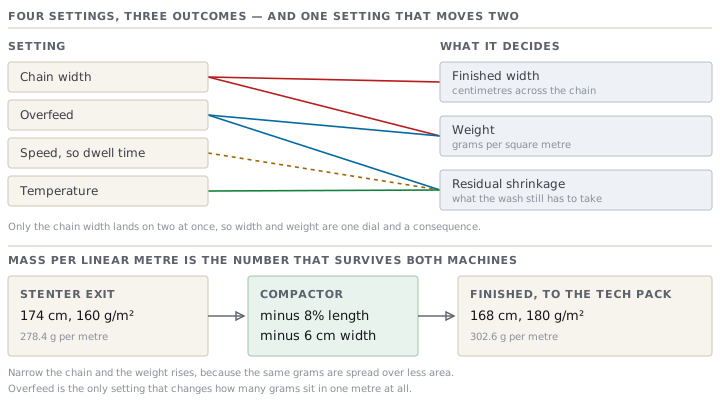
A stenter cannot create cotton, and it cannot destroy it. What goes in comes out, minus a little moisture and plus whatever chemical was padded on. So the mass in one running metre is fixed by how the machine was fed. The width setting only decides how thinly that mass is spread.
That gives you the two rules this whole lesson rests on.
- Narrow the chain and the weight goes up. Same mass, less area.
- Only overfeed changes the mass per linear metre. Overfeed means feeding cloth into the frame faster than the chain carries it away. The extra cloth is pushed into the fabric as length. That puts more grams into every finished metre — and leaves less length for the wash to take out later.
So width and weight are not two independent dials. They are one dial and its consequence. An operator who hits the weight by narrowing the chain has just moved the width off spec. An operator who hits the width by widening the chain has just made the fabric light.
Working the real batch backwards
You do not set the stenter from the tech pack. You set it from the compactor. The compactor is the last machine on the route, and it is the machine that hands shrinkage back.
Nile's compactor, on this quality, takes 8 percent out of the length and 6 cm out of the width. So work backwards.
Finished target: 180 g/m² at 168 cm. Mass per linear metre needed at the end: 180 × 1.68 = 302.4 g/m.
One finished metre came out of the compactor from a feed metre that was 8 percent longer. So the cloth arriving at the compactor carries 302.4 × 0.92 = 278.4 g in each of its metres. It also arrives 6 cm wider, at 174 cm. Therefore:
The stenter must deliver 160 g/m² at 174 cm. Check it: 160 × 1.74 = 278.4 g/m. After the compactor, 278.4 ÷ 0.92 = 302.6 g/m at 168 cm. And that is 302.6 ÷ 1.68 = 180.1 g/m².
That is the route card — the finisher's own instruction sheet for the batch. Two numbers at the stenter exit. And they are not the tech pack's numbers.
The wrong fix and the right one
06:55. The first roll off the stenter reads 154 g/m² at 174 cm — six grams light. The shift supervisor's instinct is to narrow the chain. On paper it works: 154 × 1.74 = 267.96 g/m, so at 167 cm the meter would read 267.96 ÷ 1.67 = 160.5 g/m². Target met, in sixty seconds of work.
It is the wrong fix. The reason is the compactor. The compactor takes width out. It cannot put width back without stretching the cloth. And stretching at the compactor puts back exactly the shrinkage the machine is there to remove. If the cloth arrives at 167 cm, the compactor must still deliver 168 cm finished. So it runs the fabric out under tension, and the shrinkage number quietly goes back up. You hit the weight and you lose the shrinkage clause. Nobody finds out for three weeks.
The right knob is overfeed. The mass per linear metre has to rise from 267.96 to 278.4 g/m. That is 3.9 percent more cloth in every metre. Going from 6 percent overfeed to 10 percent gives 267.96 × 1.10 ÷ 1.06 = 278.1 g/m. That is 159.8 g/m² at the unchanged 174 cm. Weight met. Width untouched. And the extra overfeed makes the shrinkage number better, not worse.
What the compactor is actually for
A woven fabric is a grid of crossing yarns. A knit is a chain of loops. A loop is free to change shape — it can get longer and narrower, or shorter and wider, without a single yarn breaking. That freedom is why jersey drapes so well. It is also why a knit walks out of the dyehouse holding ten or eleven percent of hidden length shrinkage, while a woven of the same fibre holds three.
Every drying and setting step makes it worse, because a stenter dries fabric while pulling on it. Compacting is the only step on the route that hands that length back. The cloth is fed against a moving rubber belt, or a thick felt blanket, that runs slower than the feed. The belt is squeezed at the contact point and expands as it leaves it. The fabric riding on it is pushed back on itself and shortened mechanically. Then steam and heat set it in that shorter state.
Sanforising is the same idea on a woven fabric: compressive shrinkage on a rubber blanket. Same physics, gentler numbers. The name is a trademark, not a process. Cloth may only carry it if the remaining shrinkage stays inside one percent.
This is why compacting is the single most important finish on a knit. No chemical can do its job. A softener changes how cloth feels. A resin changes how it creases. A repellent changes what runs off it. None of them removes a centimetre of hidden length. Only mechanical work does. And if the compactor is set wrong, everything downstream inherits the error. The pattern is cut to a shrinkage that is not true, and the mistake only shows up after the garment has been sewn. That is the most expensive moment for it to appear.
The rest of the mechanical route, in one line each
Calendering presses cloth between heated rollers under pressure. It gives flatness, shine, a closed surface and a lower air flow through the cloth. It takes bulk — and on a knit, a good deal of the hand you paid for. On a downproof shell it is not decoration. It is the reason the feathers stay inside.
Raising, or napping, drags wire points across the surface to pull fibre ends out of the yarn. It gives loft, warmth and the fleece face on a hoodie. It takes tensile strength, because a lifted fibre no longer carries load. It also raises pilling.
Shearing cuts that raised pile to one height. It gives evenness. It takes weight — a heavily sheared fleece can lose several percent, and that comes off your kilograms.
Tumbling in a hot airflow drum breaks the cloth's set mechanically instead of chemically. It gives a soft, lived-in, slightly fuller hand and better relaxation. It takes throughput, and it can rub a printed or delicate face.
Sueding, or emerising, runs the fabric over abrasive rollers to raise a very short, even nap. It gives a peach-skin surface and a matte look. It takes strength and weight. On a dyed cotton it also lightens the shade, because the cut surface scatters more light.
Every one of these has the same shape as the chemical finishes in the next lesson. Something is given and something is taken. The only question worth asking a finisher is: which?
Buying by the kilogram and buying by the metre
One last piece of arithmetic. It decides how you write the fabric purchase order.
Nile delivers the batch at 174 g/m² instead of 180. That is 3.33 percent light — comfortably inside the plus or minus 5 percent tolerance. So nothing fails, and nobody is called.
You bought 4,120 kg. At the spec weight, that is 4,120,000 ÷ 302.4 = 13,624 linear metres. At 174 g/m², the mass per metre is 174 × 1.68 = 292.3 g/m, so the same kilograms are 4,120,000 ÷ 292.3 = 14,094 metres — 470 metres more.
The marker uses 0.688 linear metres per shirt, whatever the weight. So those 470 metres are about 684 extra shirts' worth of cloth. Bought by the kilogram, light fabric is a windfall in pieces and a quality problem in the hand. Bought by the metre, it is a pure loss: you pay for 13,624 metres, and every one of them carries 3.33 percent less cotton.
Prompt · Check the finishing route card before the batch runs
The day a dyed batch is handed to finishing, when you want the stenter and compactor settings back-calculated from the tech pack rather than taken from a stored recipe.
Act as a senior fabric technologist in a knit finishing house. Here is the fabric specification: composition [FIBRE AND BLEND], construction [KNIT OR WEAVE, YARN COUNT], finished weight [NUMBER] g/m2 with a tolerance of [NUMBER] percent, finished open width [NUMBER] cm with a tolerance of [NUMBER] cm, maximum length shrinkage [NUMBER] percent and maximum width shrinkage [NUMBER] percent to [TEST METHOD, PROCEDURE, CYCLES, DRYING METHOD]. The finishing house says its compactor on this quality takes [NUMBER] percent out of the length and [NUMBER] cm out of the width. Do the following. First, compute the mass per linear metre the finished cloth must carry, showing the arithmetic. Second, back-calculate the weight and width the stenter must deliver at its exit, and state them as the two numbers to write on the route card. Third, list every setting on the stenter that can change each of those two numbers, and say which setting changes both at once. Fourth, tell me what to do if the first roll comes off the stenter light at the correct width, and what NOT to do, with the reason. Fifth, tell me which single number on the roll ticket would reveal a compactor running the wrong recipe, and what value it would show. Do not assume any setting I have not given you; where you need a number I have not supplied, ask for it by name.
AI can make mistakes — check anything you act on.
Check yourselfYour compactor takes 7 percent out of the length and 5 cm out of the width. The tech pack wants 200 g/m² at 150 cm finished. What must the stenter deliver?Show the answer
Finished mass per linear metre: 200 × 1.50 = 300 g/m. One finished metre came from a metre that was 7 percent longer. So the cloth entering the compactor carries 300 × 0.93 = 279 g/m, at 155 cm. That is 279 ÷ 1.55 = 180 g/m² at 155 cm. Notice that neither number looks like the tech pack's. That is exactly why route cards are written by the finisher and read by nobody else — and why a merchandiser who can do this arithmetic can tell in one minute whether the route card matches the order.
Check yourselfA roll comes off the stenter three grams light and two centimetres wide. Which setting do you move first, and why not the other one?Show the answer
Move the chain width in by two centimetres. Narrowing raises the weight, so one adjustment fixes both faults at once: the fabric was too wide, and being too wide is exactly why it read light per square metre in the first place. Do not reach for overfeed. Overfeed would raise the weight and leave the width still wrong — and every point of overfeed you spend is length you no longer have. Save overfeed for the case where the width is right and the weight is light. That is the only fault it fixes cleanly.