Lessons · Lesson 2 of 3
Balancing: whole people, one bottleneck, and two piles
Man a line from a bulletin, put a number on the balance loss, and find the station that is setting the speed by measuring two piles instead of arguing about them.
Lesson 2 of 3 · 50 min
Whole people
Work arrives in fractions. People arrive in whole numbers. Balancing a line is the arithmetic of fitting one to the other. This lesson mans a line from a bulletin and puts a number on what the fit costs.
Line 6 carries 14.64 minutes of work per garment and has twenty-four operators. Suppose every operator could be loaded with exactly the same amount. Each would hold 0.61 of a minute, and the line would pass a garment every 0.61 minutes. At the standard pace that is 98 garments an hour. At the operators' real 91% it is 89 an hour, or 712 a day.
Line 6 makes 464.
Nothing in that gap is laziness. Every operator on the line is working at between 88% and 108% of standard. The gap is balance. And balance is a property of the manning plan, not of the people standing in it.
The manning plan as it stands
| St | Operation | Machine | SMV | Ops | Cycle | Per hour |
|---|---|---|---|---|---|---|
| 1 | Crease and hem chest pocket mouth | Lockstitch | 0.55 | 1 | 0.55 | 109 |
| 2 | Attach chest pocket | Lockstitch | 0.72 | 1 | 0.72 | 83 |
| 3 | Hem two lower pocket mouths | Lockstitch | 0.68 | 1 | 0.68 | 88 |
| 4 | Attach two lower pockets | Lockstitch | 1.35 | 2 | 0.68 | 89 |
| 5 | Prepare and join neck binding | Lockstitch | 0.30 | 1 | 0.30 | 200 |
| 6 | Attach V-neck binding | Lockstitch | 1.48 | 2 | 0.74 | 81 |
| 7 | Close and topstitch V-point | Lockstitch | 0.95 | 2 | 0.48 | 126 |
| 8 | Join shoulders | Overlock | 0.62 | 1 | 0.62 | 97 |
| 9 | Set two sleeves | Overlock | 1.28 | 2 | 0.64 | 94 |
| 10 | Close side and underarm seams | Overlock | 1.42 | 2 | 0.71 | 85 |
| 11 | Hem two sleeves | Coverstitch | 0.74 | 1 | 0.74 | 81 |
| 12 | Finish two side vents | Lockstitch | 0.86 | 2 | 0.43 | 140 |
| 13 | Hem bottom | Coverstitch | 1.12 | 1 | 1.12 | 54 |
| 14 | Attach main and size labels | Lockstitch | 0.40 | 1 | 0.40 | 150 |
| 15 | Bartack pockets and vents | Bartack | 0.55 | 1 | 0.55 | 109 |
| 16 | Thread trim and turn | No machine | 0.90 | 2 | 0.45 | 133 |
| 17 | Inspect at line end | No machine | 0.72 | 1 | 0.72 | 83 |
Cycle is the minutes of work that station holds per garment. It is the operation's SMV divided by the number of operators on it. Per hour is what that station can put out at the standard pace: sixty divided by the cycle.
Read the last column, and one number is not like the others.
The bottleneck, and what it does to everything else
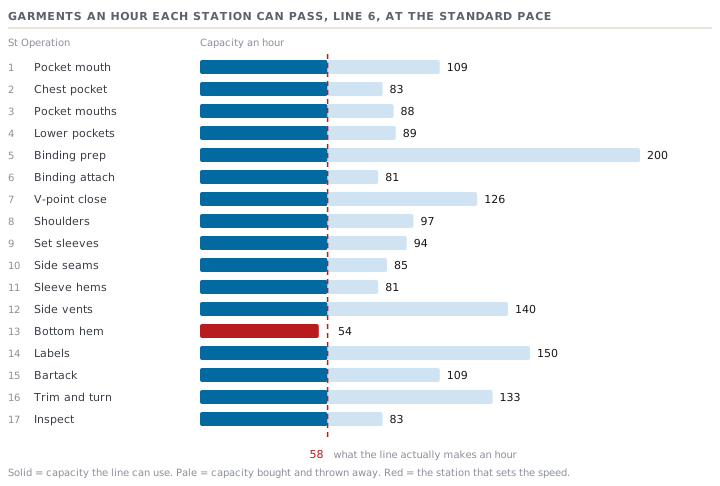
Station 13 can pass 54 garments an hour at the standard pace. Every other station on the line can pass between 81 and 200. The line makes what station 13 makes, and no more. The other sixteen stations have nowhere to put the work they are capable of.
The operator on station 13 is Wafaa, and she is one of the fastest on Line 6. She runs at 108% of standard. That is why the observed rate is 58 an hour rather than 54, and why the line makes 464 a day rather than 429. Her performance is the only individual performance on the line that has any effect on the output at all.
That is worth saying plainly, because it is the opposite of how factories manage people. On a line with a hard bottleneck, twenty-three operators' performance is invisible in the output, and one operator's performance is the output. The efficiency board on the wall is measuring twenty-four people and reporting one.
Balance loss, as a number
The line buys twenty-four operators for as long as the slowest station takes. Station 13 takes 1.12 minutes a garment. So the line pays for 26.88 operator-minutes for every garment it makes, which is twenty-four multiplied by 1.12, and puts 14.64 of them into the garment. The rest is idle time built into the plan.
Balance loss is 45.5%: 12.24 idle minutes in every 26.88 bought.
Two stations show what that means in people. Station 5 prepares the neck binding, 0.30 of a minute. Station 14 attaches the labels, 0.40. Together that is 0.70 minutes of work occupying two operators who are each bought for 1.12. Those two people are, between them, about 70% air. And they are not the problem, because moving them changes nothing.
The identity worth memorising
Line efficiency equals the bottleneck operator's performance multiplied by one minus the balance loss.
Line 6: 108% multiplied by 0.545 gives 59%. The line's measured efficiency for the week of 2 March was 59.0%. The plan promised 69.5%. Nobody was slacking by ten points. The manning plan was.
The mistake nobody made
On 4 March the supervisor, Nagwa, did a completely reasonable thing.
The largest pile of work in progress on Line 6 was in front of station 6, the V-neck binding: 940 garments in four trolleys, blocking the aisle. It was the obvious constraint. Anyone walking the line would have said so. She took an operator off station 12, the side vents, which had two people and was visibly the least busy station on the line, and put her on the V-neck binding, making it three.
The pile stopped growing. It had already stopped growing, but nobody knew that yet.
Output on 5 March: 464. Exactly what it was on 4 March, and on 3 March, and on 2 March.
Here is why, in the two columns of the table above. Station 6 went from 81 an hour to 122. Station 12 went from 140 an hour down to 70. Neither number crossed 54. So neither station was the constraint before the move, and neither is after it. The line's output did not change by one garment, because nothing that happened touched station 13.
The move was not neutral, though. Station 12 now runs on one operator with 70 an hour of capacity, against a line running at 58. Its cushion has gone from 82 garments an hour to 12, and a single absence there will now stop the line. A correct diagnosis of the wrong pile bought no output and sold some of the line's protection.
The two piles, measured twice
Sameh, the industrial engineer, did the only diagnostic that separates the two. It takes two hours and a notebook.
| Pile | 08:30 | 10:30 | Change |
|---|---|---|---|
| In front of station 6, V-neck binding | 940 | 940 | none |
| In front of station 13, bottom hem | 312 | 350 | up 38 |
Thirty-eight garments in two hours is 19 an hour. Stations 6 and 11 feed the bottom hem at about 77 an hour. Station 13 passes 58. The difference goes on the floor. That single piece of arithmetic names the constraint without a single opinion in it: the growth rate of a pile equals the rate in minus the rate out.
The size of a pile tells you where the constraint has been. The rate a pile grows tells you where it is.
Sameh then re-timed the bottom hem and found 1.12 against the bulletin's 0.78. That explained the whole thing: one operator, one coverstitch machine, and an operation that had been costed as though the garment had no vents.
What it is worth to fix, in dollars
Line 6 costs USD 0.042 per attended operator-minute, fully loaded. Twenty-four operators for eight hours is 11,520 attended minutes, so a day on Line 6 costs USD 483.84. With a twenty-fifth operator it costs USD 504.00.
By the end of 7 March the line had made 4,458 garments in eleven working days, leaving 19,542 to go. Four options were on the table that evening.
| Option | What it needs | Rate a day | Working days in total | Line cost for the order | Days over the booking |
|---|---|---|---|---|---|
| Do nothing | nothing | 464 | 54 | USD 26,127 | 11 |
| Third coverstitch machine and a twenty-fifth operator | a machine standing idle on Line 9 | 592 | 45 | USD 22,798 | 2 |
| Two hours of overtime a day | the operators' agreement | 580 | 45 | USD 27,942 | 2 |
| Ask Marrable to approve a twin-needle lockstitch hem | the buyer's written approval, expected in six working days | 464 then 592 | 46 | USD 22,841 | 3 |
Two things in that table are worth more than the numbers.
The first is that the machine was in the building. Line 9 finished the WS-2255 run on 7 March, and its third coverstitch went idle that afternoon. For eleven working days the ceiling on Line 6's output was a machine standing two aisles away. No document in the factory would ever have said so. The bulletin lists minutes, the maintenance register lists assets, and nothing joins them.
The second is that the fourth option costs the same as the second and carries a risk the second does not. A twin-needle lockstitch hem on a woven poplin scrub top is a perfectly ordinary construction, and Marrable might well approve it. But they might not, and then the sealed sample would have to be redone. Take the machine. Then put the hem question to Marrable anyway, because WS-2262 ships in June with the same hem and the same two coverstitch machines.
The size of the original error
Had the bulletin been right, Line 6 would have been manned with twenty-five operators and three coverstitch machines from 24 February. The order would have taken 43 working days at a line cost of USD 21,672. That is exactly the number of days the planner booked. His total was right and every figure inside it was wrong. He underestimated the line's capacity with a copied SMV, then ignored the ramp entirely, and the two errors very nearly cancelled. A plan whose total is right for two wrong reasons gets audited by nobody.
Against that baseline:
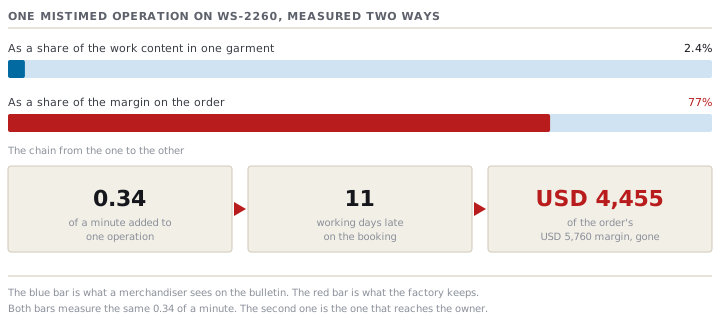
- Left alone, the defect costs USD 4,455, which is 77% of the order's USD 5,760 of margin.
- Found on the tenth working day and fixed on the twelfth, it costs USD 1,126, which is 20%.
- Finding it when they did was therefore worth USD 3,329, and every further working day of not knowing was worth another 128 garments.
Here is the arithmetic that ought to change how you read a bulletin. 0.34 of a minute across 24,000 garments is 8,160 standard minutes. That is a little over one day of what Line 6 earns. It cost eleven. A mistimed operation costs its own size in work and the whole line's speed in output, and the second number is the one that reaches the buyer.
What eleven late days then do to the next order booked on Line 6 is a different arithmetic, and course 7.4 does it properly.
Prompt · Find the station that is setting the line's speed
When a line has been stuck on the same daily figure for three days, and everybody is pointing at a different station.
Act as a production engineer diagnosing a sewing line that is under its target. Work only from evidence, and refuse to name a constraint that the numbers do not support. Line facts: [NUMBER] operators, [MINUTES] minute shift, target [PIECES] a day, actual output for the last [DAYS] days [LIST THEM], and the hourly board for the two most recent days [LIST EACH HOUR]. Manning: [FOR EVERY STATION, THE OPERATION, THE MACHINE CLASS, THE SMV AND THE NUMBER OF OPERATORS ON IT]. Work in progress: [FOR EVERY PILE I COUNTED, THE STATION IT SITS IN FRONT OF, THE COUNT AT THE FIRST READING, THE COUNT AT THE SECOND, AND THE TIME BETWEEN THEM]. Absences today: [STATION AND WHO]. Do the following. First, work out each station's cycle time per garment and its capacity per hour at the standard pace, and rank them. Second, tell me from the pile readings which pile is GROWING and at what rate, and name the station immediately downstream of it — that is the candidate constraint, and say whether the ranked capacities agree. Third, tell me whether any pile is large but static and explain what that means about the past rather than the present. Fourth, compute the balance loss and the line efficiency the manning plan can deliver, and compare that with what the line is actually achieving. Fifth, tell me whether the hourly board says this line is still learning or is at a wall, and give the evidence. Sixth, if the numbers do not identify a single constraint, say so and tell me exactly which two measurements would settle it and how long they take to collect. Do not tell me to motivate the operators.
AI can make mistakes — check anything you act on.
Check yourselfYour line makes 58 garments an hour. Six operators are absent tomorrow. How much output do you lose?Show the answer
Anything between nothing and all of it, and the manning table tells you which before the shift starts. Absence at a station whose capacity stays above the current bottleneck rate costs zero output, because that station was never the thing setting the speed. Absence at the bottleneck costs the whole difference between the bottleneck operator's rate and the relief operator's rate, multiplied by the shift. So the question is never how many are absent. It is which stations they are on, and what each of those stations' capacity becomes without them. Print the manning table with a spare column for the day's absences, work out each station's capacity as it will actually be manned, and find the new lowest number. That is tomorrow's output, and you know it at seven in the morning rather than at seven at night.
Check yourselfA line has 45.5% balance loss. Your factory manager says the operators need to work harder. What does the arithmetic say?Show the answer
That effort can recover almost none of it. Line efficiency is the bottleneck operator's performance multiplied by one minus the balance loss. So on this line every point of extra performance from the bottleneck operator is worth about half a point of line efficiency. Every point of extra performance from the other twenty-three operators is worth nothing at all. It produces work that piles up in front of a station that cannot take it. Pushing the whole line harder here converts wages into work in progress. Balance loss is recovered by changing the manning plan, the machine list, or the method. The first two are decisions somebody in an office makes, not things an operator can do at a machine.