Lessons · Lesson 3 of 3
The line in motion: the constraint moves, and day one is not capacity
Read a line's daily output as a sequence of different constraints, tell a line that is still learning from a line that has hit a wall, and put a number on absence, changeover and moving an operator.
Lesson 3 of 3 · 45 min
Twelve days of one line
A line that is slow in its first week is said to be learning. A line still slow in its third week is said to be still learning. Only one of those is usually true. Telling them apart is the job of this lesson, and a daily output sheet cannot do it. The lesson then follows the obstacle, because the thing holding a line back keeps moving.
Here is what Line 6 actually did, garment by garment, with the station that was setting the speed written beside each day.
| Working day | Date | Garments | Per hour | The constraint that day |
|---|---|---|---|---|
| 1 | 24 February | 218 | 27 | Close and topstitch V-point |
| 2 | 25 February | 272 | 34 | Close and topstitch V-point |
| 3 | 26 February | 344 | 43 | Close and topstitch V-point |
| 4 | 27 February | 400 | 50 | Attach V-neck binding |
| 5 | 28 February | 440 | 55 | Attach V-neck binding |
| 6 | 2 March | 464 | 58 | Hem bottom |
| 7 | 3 March | 464 | 58 | Hem bottom |
| 8 | 4 March | 464 | 58 | Hem bottom |
| 9 | 5 March | 464 | 58 | Hem bottom |
| 10 | 6 March | 464 | 58 | Hem bottom |
| 11 | 7 March | 464 | 58 | Hem bottom |
| 12 | 9 March | 592 | 74 | Hem two sleeves |
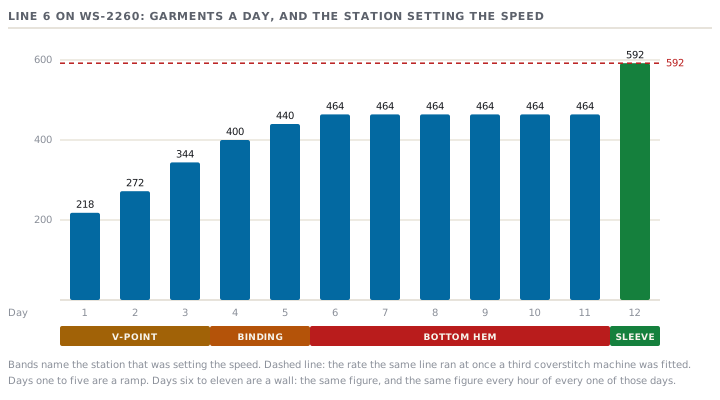
Everybody in the building called the first six days "the learning curve" and the next five "still settling in". Both descriptions are wrong, and the difference between them is the whole of this lesson.
Day one is not capacity, and neither is day six
A new style does not start at its rate, because the operators are doing operations they have not done before. But they are not all doing new operations, and they do not learn at the same speed. On WS-2260 the two neck operations were the whole of the ramp:
| Working day | Close V-point | Attach V-neck binding | Hem bottom | Line, per hour |
|---|---|---|---|---|
| 1 | 22% | 44% | 108% | 27 |
| 2 | 27% | 52% | 108% | 34 |
| 3 | 34% | 58% | 108% | 43 |
| 4 | 40% | 62% | 108% | 50 |
| 5 | 47% | 68% | 108% | 55 |
| 6 | 53% | 72% | 108% | 58 |
The V-point starts at 22% and is still under 55% on the sixth day. The binding starts at 44% and is at 72% on the sixth. The bottom hem never learns anything at all. Its operator had been sewing the same hem on WS-2255 for two years, so what changed on WS-2260 was the operation's content, not her skill.
Three things follow, and only the first is obvious.
Operations learn at different speeds, and the difference is what kind of work they are. Attaching a binding is feeding. The operator learns a hand position and a speed, and four days does most of it. Closing a mitred V-point is judgement. Every garment presents a slightly different notch, and the operator has to decide, every time, where the point lands. Judgement operations climb slowly, flatten low, and are where the variation between operators is largest even after everybody is trained.
The constraint moved twice in six days. On days 1 to 3 the line ran at the V-point. On days 4 and 5 the V-point had passed the binding, so the binding was the constraint. From day 6 the binding passed the bottom hem, so the bottom hem was the constraint, and it stayed the constraint for the rest of the order. Anybody managing "the bottleneck" on day 2 was managing a station that would not be the bottleneck on Friday.
On day 6 two stations were within a garment an hour of each other. The binding was at 58.4 an hour and the bottom hem at 57.9. On a line in that state your output is set by whichever of the two has a bad morning, and the daily figures look erratic for no reason anybody can name. A near-tie is worth finding. It means you are one small improvement away from a completely different answer to "where is the constraint".
Ramp or wall: read the hourly board, not the daily one
A ramp fixes itself and a balance fault never does. So the only question that matters on the morning of day seven is which one you are looking at. The daily figures cannot tell you: 464 six days running looks like a curve that has flattened, and also like a line that hit a wall on day six.
The hourly board can tell you, and Wardan had one on the wall the whole time.
| Hour | 1 | 2 | 3 | 4 | 5 | 6 | 7 | 8 |
|---|---|---|---|---|---|---|---|---|
| 25 February, day two | 27 | 30 | 32 | 35 | 36 | 37 | 37 | 38 |
| 4 March, day eight | 57 | 59 | 58 | 58 | 57 | 59 | 58 | 58 |
On 25 February the last hour is 41% above the first. That is a line learning. Every hour is better than the one before it, because the operators are better than they were an hour ago.
On 4 March the whole day sits inside two garments. Eight identical hours is not a line that is still settling in. It is a line against a wall, and it will read exactly the same on the ninth day and the fortieth. That board had been saying so since 2 March, in numbers, on the wall, at the end of the line.
Moving your best operator to the bottleneck
When Sameh named the bottom hem on 6 March, the first suggestion was the obvious one: put Rania on it. Rania is the fastest operator on Line 6 and runs the overlock side and underarm seam at 140% of standard.
Sameh priced the move before it happened, from a document the factory already had. Wardan's skill matrix scores every operator from one to four on every operation. Rania is a four on overlock and a two on coverstitch. On the bottom hem she runs at 74%.
- Wafaa at 108% makes 58 garments an hour on that station, and 464 a day.
- Rania at 74% would make 40 an hour, and 317 a day.
- Moving the fastest operator on the line onto the constraint would have cost 147 garments a day.
And the side seam gains nothing by losing her. Her replacement there runs at 96%, so station 10 drops from 96 garments an hour to 78. That is still comfortably above a line running at 58, so there is no gain, no loss, and no visible effect at all.
"Fastest" is not a property of an operator. It is a property of an operator and an operation together, and the document that records it is the skill matrix.
Run the same arithmetic the other way and you get the version worth acting on. Find the operator with the highest score on the constraint operation and move that person there, whatever they are doing now. Every point of their performance is a point of the line's output, and every point of anybody else's is nothing.
Which three per cent
Line 6 runs at about 3% absence, which on twenty-four operators is roughly seven-tenths of a person a day. That number predicts nothing, because the cost of an absence is not an average.
On 12 March, after the third coverstitch was in, Wafaa was absent. Her station now had two operators and two machines. The relief operator is a two on coverstitch and runs at 78%, and she joined the other hem operator. Between them the station made 100 garments an hour against a line running at 74. The absence cost nothing.
Had she been absent on 5 March, one week earlier, the same relief operator on the same operation would have produced 42 an hour instead of 58, and the line would have made 334 instead of 464. That is 130 garments from one person being away for one day, with no way to cover it. The second coverstitch machine was on the sleeve hems, and the third did not exist.
Same absence rate, same person, same operation, and two answers a hundred and thirty garments apart. What changed was not attendance. It was whether the station had a second machine.
What a changeover costs, and why the answer is not a number
On 24 April Line 6 changes from WS-2260 to WS-2262, the long-sleeved version. Setting folders, guides and machine positions takes the equivalent of three and a half hours of full-line stoppage, which at Line 6's loaded rate is USD 211.68. That is the part everybody counts.
The part that costs more is the ramp on the far side of it, and it is not a fixed property of the line. WS-2262 shares fourteen of its seventeen operations with WS-2260, including both neck operations. Nobody has to learn a mitred V-point again. Wardan's own record on a style sharing that much is one day of ramp and about 180 garments, against the 1,286 garments Line 6 lost in the first five days of WS-2260. That is 2.2 working days of output, and every plan in the building had assumed it away.
A ramp is a property of the operations that changed, not of the line. Two styles with the same total SMV can have completely different ramps. The question to ask about a new style is never "how long does this line take to settle". It is "which operations on this bulletin has this line never done". What that ramp then costs an order book, and why it hurts a short run far more than a long one, is course 7.4.
So what was Line 6's capacity?
Never 560, which was a plan built on a copied minute. Never 464, which was the wall. With twenty-four operators and the two coverstitch machines bolted to the floor, the honest answer for WS-2260 was 58 an hour. With a third coverstitch machine it was 74.
And with a fourth? Only about 76. As soon as the sleeve hem stops being the constraint, attaching the chest pocket and inspecting at the line end are waiting two garments an hour behind it. The third machine was worth sixteen garments an hour. The fourth is worth two. The fifth is worth nothing at all.
That is what a balanced line looks like from the inside. It is not a line with no constraint. It is a line where the constraint is only just the constraint, and the next four candidates are so close behind it that no single change buys much. Getting there is the job. The constraint never goes away. The only question is whether you can name this week's one, and whether you found it by measuring or by pointing at the biggest pile.
Prompt · Re-balance the line, and price every way out
Once you know which station is the constraint, and you have to choose between a machine, an operator, overtime and a phone call to the buyer.
Act as a planning manager re-balancing a sewing line against a delivery, and price every option in pieces, days and money. Facts: order [QTY] pieces, [MADE] already made in [DAYS] working days, booked for [DAYS] working days in total, ship date [DATE]. Line: [NUMBER] operators, [MINUTES] minute shift, loaded cost [AMOUNT] per attended operator-minute, and the making charge for this style is [AMOUNT] a piece of which [AMOUNT] is margin. Manning: [EVERY STATION WITH OPERATION, MACHINE CLASS, SMV AND OPERATORS]. Machines available elsewhere in the factory, with the date each frees up: [LIST]. Skill matrix scores for the operators you may move: [OPERATOR, OPERATION, SCORE, AND THEIR MEASURED PERFORMANCE ON IT IF KNOWN]. Overtime rules and premium: [STATE THEM]. Do the following. First, confirm the constraint from the manning table and give the line's current rate a day. Second, produce a re-balanced manning plan that does NOT need any new machine — combining or splitting operations only — and give its new bottleneck and rate; say plainly if the answer is that no re-balance helps, and why. Third, produce a second plan using one machine moved from elsewhere, with the earliest date it can run. Fourth, price at least four options — do nothing, the machine, overtime, and a construction change that needs the buyer's approval — each with a rate a day, total working days, line cost for the whole order, and days over the booking. Fifth, for any option that depends on somebody else saying yes, state the risk and what happens if the answer is no. Sixth, before you recommend moving any operator, check the skill matrix and tell me what that person's performance on the CONSTRAINT operation is, and what the move costs if it is lower than the current operator's. Rank the options by cost, not by how quickly they can be started.
AI can make mistakes — check anything you act on.
Check yourselfYour line has made the same output for four days running. How do you tell a ramp that has flattened from a balance fault, without waiting another week?Show the answer
Look at the hourly board rather than the daily total. A line that is still learning improves within the day. The last hour beats the first, usually by a wide margin early in a style, because the operators at the end of the shift are better than the same operators were at the start of it. A line at a wall produces the same figure every hour, because the constraint station's cycle time does not change with practice. It is set by the work content and the number of machines. If the day's best and worst hours are within a few per cent of each other, stop waiting. Nothing is going to improve by itself, and the answer is in the manning table or the machine list.
Check yourselfYour bottleneck operator is off sick tomorrow and you have one relief operator who is weak on that operation. What do you do before the shift starts?Show the answer
Work out the station's capacity with the relief operator on it, compare it with the capacity of every other station, and decide whether the constraint is still where it was. If the relief operator's rate is still above the next-lowest station, put her on and lose nothing. If it is not, you have three real options and one false one. The real ones are these. Move the strongest operator on that operation from wherever they are, and check the skill matrix rather than your memory of who is quick. Or split the operation so two people can do it, if a second machine exists. Or accept the day's loss and tell the planner the number now rather than at six o'clock. The false one is to put your fastest operator on it because she is fast. Fast at what she does is not fast at this, and you can lose more than the absence was going to cost you.