Lessons · Lesson 1 of 3
The bulletin: seventeen operations, four machine classes, one wrong minute
Read an operation bulletin the way the floor has to read it, operation by operation and machine by machine, and find the two lines in it that are not true.
Lesson 1 of 3 · 45 min
The order
Sewing a garment is not one job. It is a run of small jobs, each on a different machine. Before any of them starts, somebody writes the sequence down: what is done, in what order, on what machine, and how long it takes. That list decides how big the line is, what the buyer is promised, and what the operators are paid. This lesson reads one list, line by line, looking for the entries that are not true.
Wardan Apparel is a sewing unit in Damanhour with nine lines. It has purchase order MU-4417 from Marrable Uniforms, a British supplier of healthcare workwear. The order is 24,000 unisex V-neck scrub tops, style WS-2260, in poly-cotton poplin, three colours and six sizes. The FOB price is USD 4.95. Inside that price sits the making element, which is the part Wardan controls with people and machines. It is USD 1.68 a garment, and USD 0.24 of it is margin. On 24,000 pieces that is USD 5,760 of margin. This course is the story of where most of it went.
The order goes to Line 6: twenty-four operators, an eight-hour shift, a six-day week. Sewing starts on 24 February.
Between the tech pack and the first bundle there is one document. Everything the floor does for the next two months is built on it. It is the operation bulletin.
What a bulletin is, and what it is for
A bulletin breaks the garment into pieces of work. Each piece is what one person can do at one workplace. Each line carries three things, and only these three matter:
- The operation — what is done, in the order it must be done.
- The machine class it needs — single-needle lockstitch, overlock, coverstitch, bartack, or no machine at all.
- The standard minute value (SMV) — how long the operation takes a trained operator working at a normal pace, with allowances included.
Where an SMV comes from is course 5.4: the time study, the rating, the allowance, and why two honest analysts get different numbers for the same operation. Here the SMVs simply arrive on a sheet as given data. That is exactly how they arrive on a real floor. Your job is to read them critically, not to produce them.
The bulletin is the input to a problem. Assign every operation to a station so that no station takes longer than the target cycle, and do it without breaking the sequence. That is a genuinely hard problem. It is why the work is done by judgement, and why the document that feeds it has to be right.
The bulletin as issued
Wardan's industrial engineering office issued this for WS-2260 on 19 February. The picture below is the sheet itself, as it lands on the desk.
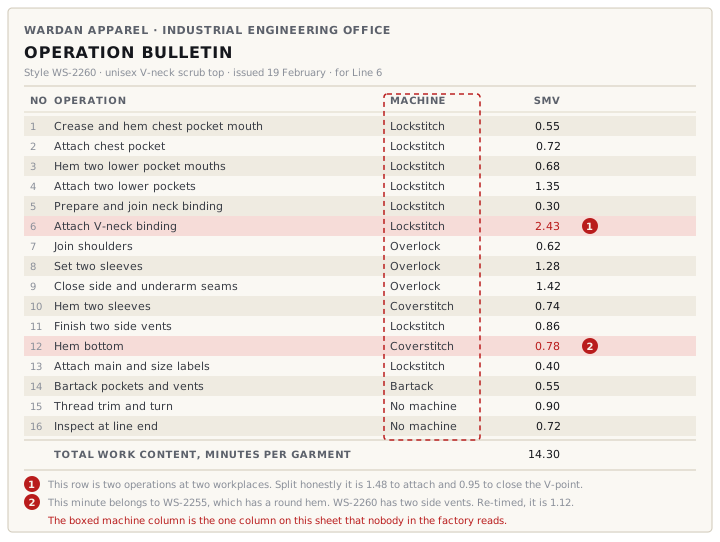
| No | Operation | Machine | SMV |
|---|---|---|---|
| 1 | Crease and hem chest pocket mouth | Lockstitch | 0.55 |
| 2 | Attach chest pocket | Lockstitch | 0.72 |
| 3 | Hem two lower pocket mouths | Lockstitch | 0.68 |
| 4 | Attach two lower pockets | Lockstitch | 1.35 |
| 5 | Prepare and join neck binding | Lockstitch | 0.30 |
| 6 | Attach V-neck binding | Lockstitch | 2.43 |
| 7 | Join shoulders | Overlock | 0.62 |
| 8 | Set two sleeves | Overlock | 1.28 |
| 9 | Close side and underarm seams | Overlock | 1.42 |
| 10 | Hem two sleeves | Coverstitch | 0.74 |
| 11 | Finish two side vents | Lockstitch | 0.86 |
| 12 | Hem bottom | Coverstitch | 0.78 |
| 13 | Attach main and size labels | Lockstitch | 0.40 |
| 14 | Bartack pockets and vents | Bartack | 0.55 |
| 15 | Thread trim and turn | No machine | 0.90 |
| 16 | Inspect at line end | No machine | 0.72 |
| Total | 14.30 |
The planner then did the arithmetic every planner does. Line 6's operators average 91% of standard on repeat scrub work. The longest station he could build came to 0.78 minutes a piece. That is 76.9 garments an hour at standard pace, and 70.0 an hour at 91%. Eight hours is 560 a day. 24,000 pieces is 42.9 days, so he booked 43 working days and told the merchandiser the order would clear the line on 21 April.
Every number in that paragraph is arithmetically correct. Two of the inputs are not.
Reading a bulletin critically
There are three questions to ask of any bulletin. None of them is "does the total look about right".
One: which line is quietly two operations?
Line 6 of the bulletin says Attach V-neck binding, 2.43. On the floor that is not one operation. It is two, and they are not even the same kind of work:
- Attach the binding around the neckline. You feed a folded strip against a curve. It is a feeding operation, and an operator learns it in three or four days.
- Close and topstitch the V-point. The mitre has to land on the notch. The two legs of the V have to meet at the same angle every time. The topstitching has to cross the joint without a step. It is a judgement operation. Operators take a week or more, and some never get there.
Merging the two hides two things. It hides the fact that the second half is the hardest operation in the garment, so nobody staffs it on purpose. And it makes the manning meaningless. You cannot put five operators on a single 2.43-minute operation. You can put three on one half and two on the other, and that is a different plan with a different capacity.
Split honestly, the two lines are 1.48 and 0.95. The total does not change. Nothing on the summary sheet moves, and that is exactly why nobody noticed.
Two: which SMV came from a different style?
Line 12 says Hem bottom, 0.78, coverstitch. That is the same figure, to the second decimal, as the bottom hem on WS-2255. WS-2255 is the round-hem scrub top Wardan has been making for Marrable for two years.
WS-2260 is not round-hemmed. It has two side vents. So the hem is not one continuous run. It is two runs. Each one starts and stops at a vent, with a turn, a backtack and a thread trim at each of the four vent corners. When the industrial engineer, Sameh, finally re-timed it on 6 March, he got 1.12.
The difference is 0.34 of a minute. Hold that number. It is the whole course.
The tells were all on the sheet:
- An SMV identical to another style's, to two decimals. Real operations almost never tie.
- A description that does not mention a feature the tech pack draws. The word "vent" appears in operation 11 and nowhere else.
- A hem that costs less than the sleeve hems above it, on a garment where the bottom hem is longer and interrupted.
Three: does the bulletin fit the machines the line actually has?
This is the question that gets skipped. A bulletin is a list of minutes. A line is a list of machines. The two documents live in different offices.
So add the SMVs up by machine class instead of by sequence:
| Machine class | Minutes per garment | Machines needed at a 0.78 minute cycle | On Line 6 |
|---|---|---|---|
| Lockstitch | 7.29 | 10 | 10 |
| Overlock | 3.32 | 5 | 5 |
| Coverstitch | 1.86 | 3 | 2 |
| Bartack | 0.55 | 1 | 1 |
| No machine | 1.62 | — | — |
| Total | 14.64 |
There it is. The two hemming operations are both coverstitch: sleeve hems at 0.74 and bottom hem at 1.12. Together they are 1.86 minutes of work per garment. To pass a garment every 0.78 minutes you need 1.86 divided by 0.78, which is 2.38 coverstitch machines. You cannot have 0.38 of a machine, so you need three. Line 6 has two.
Now run the same sum on the bulletin as issued, with the bottom hem at 0.78. Coverstitch content is 0.74 plus 0.78, which is 1.52. And 1.52 divided by 0.78 is 1.95. Two machines. Exactly what Line 6 has.
The corrected bulletin
| No | Operation | Machine | SMV |
|---|---|---|---|
| 1 | Crease and hem chest pocket mouth | Lockstitch | 0.55 |
| 2 | Attach chest pocket | Lockstitch | 0.72 |
| 3 | Hem two lower pocket mouths | Lockstitch | 0.68 |
| 4 | Attach two lower pockets | Lockstitch | 1.35 |
| 5 | Prepare and join neck binding | Lockstitch | 0.30 |
| 6 | Attach V-neck binding | Lockstitch | 1.48 |
| 7 | Close and topstitch V-point | Lockstitch | 0.95 |
| 8 | Join shoulders | Overlock | 0.62 |
| 9 | Set two sleeves | Overlock | 1.28 |
| 10 | Close side and underarm seams | Overlock | 1.42 |
| 11 | Hem two sleeves | Coverstitch | 0.74 |
| 12 | Finish two side vents | Lockstitch | 0.86 |
| 13 | Hem bottom, two runs round the vents | Coverstitch | 1.12 |
| 14 | Attach main and size labels | Lockstitch | 0.40 |
| 15 | Bartack pockets and vents | Bartack | 0.55 |
| 16 | Thread trim and turn | No machine | 0.90 |
| 17 | Inspect at line end | No machine | 0.72 |
| Total | 14.64 |
Seventeen operations instead of sixteen, and a total of 14.64 instead of 14.30. A merchandiser looking at the two totals would call the difference immaterial: 2.4% on the work content of a garment that sells for USD 4.95.
It cost Wardan USD 4,455 on this order, which is 77% of the margin. The next two lessons are how.
Prompt · Audit an operation bulletin before the first bundle
The day a bulletin lands for a style your line has never sewn, and before anybody books days against it.
Act as an industrial engineer auditing an operation bulletin before it goes to the floor. Do not re-study any operation and do not invent a standard minute value; work only from what I give you. Style facts: style [CODE], [GARMENT DESCRIPTION], order quantity [QTY], buyer [BUYER], target output [PIECES] a day on a [HOURS] hour shift. Here is the bulletin, one row per line: [PASTE OPERATION NUMBER, DESCRIPTION, MACHINE CLASS AND SMV FOR EVERY OPERATION]. Here is the machine list actually bolted to that line: [MACHINE CLASS AND HOW MANY OF EACH]. Here are the bulletins for the two nearest styles this line has already run: [PASTE THEM]. Here is the tech pack's construction list: [LIST EVERY FEATURE — VENTS, PLACKETS, BINDINGS, TAPES, ELASTICS, BARTACKS, LABELS]. Do the following. First, total the SMVs and state the work content per garment. Second, re-total them BY MACHINE CLASS, divide each class by my target cycle time, round up to whole machines, and compare with the machine list — name any class where the bulletin needs more machines than the line has, because that is a cap no manning change can lift. Third, list every operation you believe is really two operations at one workplace, and say what kind of work each half is — feeding, judgement, or handling. Fourth, list every SMV that matches a value in the neighbouring bulletins to two decimal places, and every operation whose description does not name a construction feature the tech pack lists, and rank those suspects by how much line output rides on them. Fifth, name the three operations most likely to be the constraint once this line is manned, and say why. Sixth, tell me exactly which numbers you had to assume. Give me the machine-class table first; it is the part nobody else in the building will produce.
AI can make mistakes — check anything you act on.
Check yourselfA bulletin for a new style has a total of 14.30 minutes. Your planner has used it to book a line for 43 days. What do you check first: the total, the sequence, or the machine column?Show the answer
The machine column. The total is the only figure with three independent readers, so it is the least likely to be wrong and the most likely to be checked anyway. The machine column has none. The bulletin is written in the industrial engineering office, the machine list lives with the maintenance department, and no document in the factory puts them side by side. Add the minutes by machine class, divide each class by your target cycle time, round up to whole machines, and compare with what is bolted to the floor of that line. A shortage in one class caps the whole line, and it is the one error that no amount of moving operators can repair.
Check yourselfYou suspect an SMV has been copied from another style. Before asking for a re-study, what evidence can you gather from the paperwork alone?Show the answer
Three things, all available in an afternoon. First, put the two bulletins side by side and look for values that agree to two decimal places on operations the tech packs describe differently. Two operations studied independently almost never tie exactly, so a match is a signal. Second, read each suspect description against the drawing and list every construction feature the description does not name. A vent, a mitre, a taped seam or a bar of elastic that appears in the garment and not in the wording is usually a minute that was never studied. Third, check the internal ordering. An operation that is cheaper than a shorter, simpler operation elsewhere in the same garment is either a real method advantage somebody can describe to you, or a copy. Bring all three to the re-study request. A floor that is asked to re-time an operation on a hunch will re-time it and confirm the old number.