Lessons · Lesson 2 of 3
Allowances: the part of the SMV nobody audits
Build a relaxation allowance from its parts for two real workplaces, measure a contingency instead of guessing it, and see what a copied percentage does to a price, a target and a pay packet.
Lesson 2 of 3 · 48 min
One number, no working
Nobody can work a whole shift without a break. So the time a job is allowed is longer than the time the work takes. The difference covers rest, personal needs, and the small interruptions a machine brings. Most factories apply one percentage to every job in the building, copied from a report nobody has read. This lesson builds that figure from the room the person is actually standing in.
Lesson 1 left the shirt at 17.24 basic minutes, and probably 18.43 once the rating bias is taken out.
Halwagy's system holds 19.31. The distance between 17.24 and 19.31 is the allowance. At Halwagy the allowance is a single figure, 12%, applied to every operation in the factory: sewing, cutting, pressing, packing, the buttonhole automat, the fusing press. It came from a consultant's report that predates everyone now working in the building. Nobody has opened the report. Nobody can say what is in the twelve.
This is normal. In most factories the allowance is the only part of the standard with no working behind it. The elements are argued over. The ratings are argued over. Then a percentage nobody has ever recomputed is applied to the lot. It is also, point for point, the most powerful number in the whole calculation, because it multiplies everything.
Three different things wearing one name
"Allowance" is used for at least three quantities. They are arrived at differently and they belong to different work.
Relaxation allowance is time added so a worker can recover from the physical and mental effects of the work, and attend to personal needs. It is a percentage of basic time. It is a property of the workplace. And it is the only one of the three that is built rather than measured. A worker standing over a steam press in August needs more of it than a seated operator under a fan, and the difference is not a matter of opinion.
Contingency allowance is time for small, irregular, legitimate items of work or delay. They happen too rarely to be worth timing as elements: changing a bobbin, replacing a needle, resetting a tension, handing a piece back for a re-check. It is measured, by a production study that runs for hours rather than cycles, and then expressed per cycle.
Unoccupied time, also called machine-interference allowance, applies only where the operator genuinely waits on a machine and cannot fill the wait. It is a property of the machine cycle and the number of machines. It is zero for a seated single-needle operator, who is occupied throughout.
Three sources, three methods, three different answers per workplace. Halwagy has one number.
Building the relaxation allowance instead of quoting it
A relaxation allowance is assembled from parts, each one assessed against the workplace. Here are two workplaces at Halwagy, on the same order, on the same day.
| Component | Sewing seat, collar setting | Final press table |
|---|---|---|
| Personal needs | 5 | 5 |
| Basic fatigue | 4 | 4 |
| Standing | 0 | 2 |
| Abnormal posture | 1 | 2 |
| Use of force | 0 | 2 |
| Air conditions | 2 | 7 |
| Close visual attention | 2 | 0 |
| Noise | 1 | 2 |
| Monotony | 0 | 1 |
| Relaxation allowance | 15 | 25 |
Read the two columns as descriptions of two rooms.
Naglaa sits. Her machine is under a fan. The section runs at about 28 degrees Celsius. The light is good, the work is fine but not straining, and the noise comes and goes. Fifteen.
Sayed stands at a final press. He is bent over the buck. He handles a head weighing several kilogrammes, moves a garment, and holds a position. The air around a steam press is hot and wet. The section reads about 34 degrees Celsius on an August afternoon, and the noise never stops. Twenty-five.
The gap is not a preference. It is the difference between the recovery two bodies need to hold the same working rate for eight hours. A factory that applies one number to both is not making a simplification. It is making a specific error, and the error always runs one way: it underpays recovery to the hardest workplace, because a single blanket number is set by whichever section is easiest to defend.
Measuring the contingency instead of guessing it
Amira ran a two-hour production study on operation 26. Not a cycle study. A study of what interrupts the cycle. Every occurrence was timed and counted, then divided by the number of cycles it spanned.
| Occurrence | Time when it happens, min | Happens every | Per cycle, min |
|---|---|---|---|
| Change bobbin | 0.42 | 32 cycles | 0.0131 |
| Change or replace needle | 1.80 | 500 cycles | 0.0036 |
| Change thread cone | 0.90 | 600 cycles | 0.0015 |
| Reset tension or adjust folder | 1.35 | 220 cycles | 0.0061 |
| Hand back for a quality re-check | 0.30 | 140 cycles | 0.0021 |
| Total | 0.0265 |
Basic time for the operation is 0.8822 minutes, so the contingency is 3.0% of it. Not a guess, not a convention. A number with a study behind it, which means anyone who can show a better bobbin can argue it down.
That is the point of measuring it. A contingency you measured tells you something: the bobbin change is half of it. A larger bobbin, or a machine with an under-bed thread monitor, is now a costed proposal rather than a preference. A contingency buried inside a blanket percentage tells you nothing at all, and it hides the one item you could remove.
What the two workplaces should carry
| Sewing seat | Final press | |
|---|---|---|
| Relaxation | 15% | 25% |
| Contingency | 3% | 1% |
| Unoccupied time | 0% | 0% |
| Total allowance | 18% | 26% |
| In force today | 12% | 12% |
The sewing seat is six points short. The press table is fourteen.
Two complaints, one cause
Now the mistake nobody made.
Sayed's operation is final press and fold. Its basic time is 1.86 minutes. Under the blanket allowance it carries a standard time of 2.08. Under the allowance its own workplace justifies, 2.34.
A 480-minute day at 2.08 means a presser reaching standard performance does 230 shirts. At 2.34 it means 205. Sayed does 198 on a good day.
- Measured against the standard in the system, Sayed runs at 86.1%.
- Measured against the standard his workplace justifies, he runs at 96.6%.
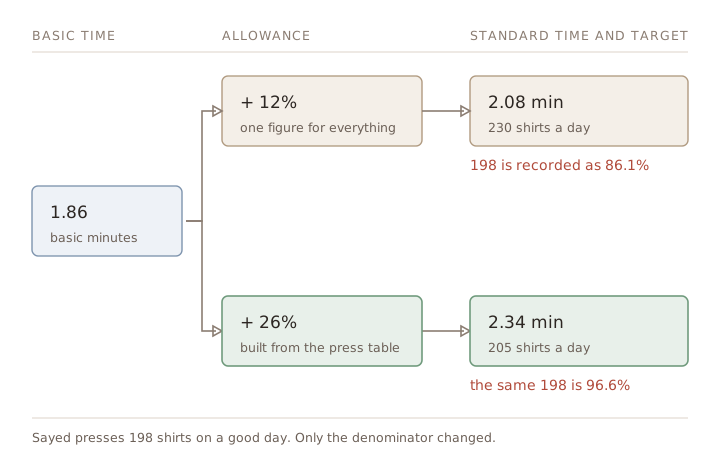
Halwagy pays an incentive above 100% performance. No presser has earned it in two years. Turnover in the pressing section runs at 41% a year against 14% on the sewing floor. The factory has reorganised pressing twice: once by re-laying the tables, once by adding a supervisor. Both times the numbers came back the same, because both times the problem was in the denominator.
Two complaints, a section that cannot hit its targets and a section nobody will stay in, with one cause. The cause is a percentage copied from a report nobody has read. Every individual action taken about it was reasonable. Nobody made a mistake.
What the allowance does to the money, and what it does to everything else
Back to the sewing floor. On the recorded basic time of 17.24 minutes:
- at the blanket 12%: SMV 19.31
- at the rebuilt 18%: SMV 20.34
The difference is 1.03 standard minutes a shirt, which across TP-4417 is 43,260 standard minutes. Halwagy costs a standard minute at USD 0.0696, so the making cost moves from USD 1.34 to USD 1.42. That is USD 0.07 a shirt and USD 3,011 on the order, against an order value of USD 413,700.
Take that seriously, because it is the number people expect to be large and it is not. Six points of allowance is 0.7% of the order value. If the only question you ever ask an SMV is what it does to the price, you will conclude the allowance does not matter much, and you will be roughly right.
It is everywhere else that it matters.
The target. A line running TP-2280 has to be given an hourly output figure. At 19.31 the target is higher than the work justifies, all day, every day.
The pay. Add lesson 1's rating bias and the defensible SMV is 21.75 rather than 19.31. The number in the system is 11.2% low. An operator working at genuine standard performance is recorded at 88.8% and paid as though she were falling short.
The comparison. Halwagy benchmarks its lines against each other and against the sister plant. Both sides of every comparison rest on allowances nobody has rebuilt. So the comparison is measuring the two IE departments as much as the two floors.
And the capacity, which is the largest of the four and gets its own lesson.
Where the number stands now
| Basic time, min | Allowance | SMV, min | |
|---|---|---|---|
| In the system | 17.24 | 12% | 19.31 |
| Correct allowance, uncorrected rating | 17.24 | 18% | 20.34 |
| Correct allowance and rating | 18.43 | 18% | 21.75 |
Lesson 3 takes 21.75 and asks the only question the factory is actually paid to answer: how many of these can we make, and by when.
Check yourselfA buyer's technical team gives you an SMV for a jacket and says allowances are excluded so the number is clean and comparable. What do you do with it?Show the answer
Treat it as a basic time and add your own allowances, workplace by workplace. It is genuinely more comparable that way, which is why they did it. But it is not a standard, and you cannot cost, target or plan against it until your workplaces are in it. The trap is accepting it as an SMV. You then apply your capacity arithmetic to a number with no recovery time in it, and quietly promise output nobody can produce. Ask which of the three allowances is excluded, too. "Excluded" usually means relaxation only, and the contingency may or may not be inside.
Check yourselfYour factory uses one allowance everywhere. Where does the error land first?Show the answer
On the hardest workplace, always, and it shows up as a performance problem rather than a measurement problem. A blanket allowance is set by argument, and the argument is won by the sections that are easiest to stand in. So pressing, fusing, heavy handling and anything outdoors carry standards that are too tight. Look for a section that misses target permanently, has high turnover, and has already been reorganised at least once. That is not a coincidence. It is the signature.
Prompt · Rebuild an allowance from the workplace
Before you accept a single factory-wide percentage, and especially for the section that never hits its target.
Act as an industrial engineer building relaxation and contingency allowances from first principles. I will describe a workplace and you will build its allowance component by component, then tell me what changes when the standard is recomputed. Workplace: [OPERATION], [SEATED OR STANDING], machine [TYPE], posture [DESCRIBE], forces handled [WEIGHT AND HOW OFTEN], ambient temperature [DEGREES] and humidity [DESCRIBE], light [DESCRIBE], noise [DESCRIBE], visual attention required [DESCRIBE], and how repetitive the cycle is [CYCLE LENGTH]. The allowance currently applied is [PERCENT], and it is applied to [WHICH SECTIONS]. Basic time for the operation is [MINUTES], measured output is [PIECES PER SHIFT] over a [MINUTES] attended shift. Do the following. First, build the relaxation allowance component by component — personal needs, basic fatigue, standing, posture, use of force, air conditions, light, visual attention, noise, mental strain, monotony, tedium — giving each a figure and one sentence of justification, and total it. Second, tell me which items you cannot assess from what I have given you and exactly what I should go and measure or observe. Third, treat contingency SEPARATELY: list the irregular items I should time and count in a production study, with a suggested study length, and warn me about anything I have described that is actually frequent work belonging in the basic time rather than in a contingency. Fourth, say whether any unoccupied or machine-interference allowance applies here and why or why not. Fifth, recompute the standard time under the current allowance and under yours, and convert both into pieces per shift at one hundred per cent performance and into the performance my measured output actually represents under each. Sixth, tell me who in the factory will object to this change and what the honest answer to each objection is. Keep every figure explicit and never give me a range where a single number is possible.
AI can make mistakes — check anything you act on.