Lessons · Lesson 1 of 3
The study: from a stopwatch reading to a basic time
Break an operation into elements, choose a cycle count and say why, rate what you watched, and defend the answer to somebody who disagrees.
Lesson 1 of 3 · 52 min
The order, and the number underneath it
Everything a factory promises rests on one figure. It is the number of minutes of work in a garment. The price comes out of it. So does the delivery date, the size of the line, and the operators' pay. Somebody produces that figure by standing beside an operator with a stopwatch. This lesson is about doing that honestly, and about where real judgement enters.
Tuesday 3 March, 09:40. Halwagy Manufacturing, Kafr Saqr. Four sewing lines, 192 machines, 180 of them manned this morning.
Purchase order TP-4417 from Thrapston Workwear, a British workwear and uniform retailer: 42,000 men's long-sleeve cotton-twill work shirts, style TP-2280. Two-piece collar, full front placket, two flapped chest pockets, sleeve plackets, nine buttons down the front. FOB Alexandria USD 9.85. Order value USD 413,700. Bulk on Line 2 from Monday 6 April, ex-factory 4 June.
Every commitment in that paragraph rests on one number that does not appear in it. Halwagy quoted the making cost, promised the date, loaded the plan, and will pay its operators. All of it rests on a standard minute value of 19.31 minutes for TP-2280. A standard minute value, or SMV, is the work content of one garment expressed in minutes.
Where did 19.31 come from? And how much of it would survive twenty minutes of argument with a competent industrial engineer?
This lesson is the first half of the answer: how a stopwatch reading becomes a basic time. Lesson 2 is the second half, the allowances. Lesson 3 is what the finished number lets you promise, and what it does not.
A study measures a method, not a garment
Start here, because everything else follows from it.
A time study does not measure how long a work shirt takes. It measures how long this method took, on this machine, with this folder, performed by this operator, over the cycles you watched. A folder is the metal attachment that folds the cloth as it feeds into the needle. A garment has no built-in duration. Change the folder on the placket operation and the number is void. Not stale. Void.
So an SMV has a shelf life measured in method changes, not in months. That is why the first line of a study sheet is not a time at all. It is the method: machine type, needle, thread, attachment, workplace layout, where the input bundle sits, where the output bin sits, and the operator's grade. A study sheet without those is a set of readings, not a standard.
Elements, and the break points between them
An operation is broken into elements. An element is a piece of work you can time on its own. It has to be described so clearly that a second analyst would break at the same instant.
Halwagy's operation 26 is set collar to neck and close stand, single needle, on the shirt. Amira Roushdy, the factory's industrial engineer, broke it into five.
| El | Description | Type | Break point |
|---|---|---|---|
| 1 | Pick up body, find centre-back notch, offer collar to neck | Manual | The needle enters the cloth |
| 2 | Sew right shoulder to centre back | Machine | The foot leaves the pedal at centre back |
| 3 | Reposition, sew centre back to left shoulder | Machine | The thread trimmer fires |
| 4 | Trim ends, check collar points match | Manual | The shirt leaves the table |
| 5 | Dispose to bin | Manual | The hand touches the next body |
Three rules do all the work in that table.
A break point is an event, not a moment. "About when she finishes sewing" is not a break point. "The thread trimmer fires" is. It is audible, it is instantaneous, and two analysts standing side by side will thumb the watch within a tenth of a second of each other. Most arguments about a time study are really arguments about break points. You settle those by watching together.
Manual and machine elements are always separated. Not for tidiness. Element 2 is controlled by the machine's stitch rate and the seam length, and no amount of operator willingness changes it. Element 1 is entirely the operator. In a moment you are going to multiply some of these numbers by a judgement and not others. This is the row that decides which.
Elements are what you will actually reuse. If a study only ever produces one total, the breakdown is wasted effort. It is not wasted. The elements are what you compare when a method changes, what you hand to whoever is balancing the line, and what tells you which part of a slow operation is slow.
How many cycles, and the question that answers it
Amira took twenty cycles. Everybody takes twenty. There is no reasoning behind that number, and the reasoning is easy.
The number of cycles you need depends on how much the work varies, and it is set element by element. A machine element barely varies. A manual element where the operator hunts for a notch varies a lot. Take the standard deviation of each element across the cycles you have. Divide it by that element's mean. That gives you the coefficient of variation, and the cycles needed for a given precision follow from it.
| El | Mean observed, min | Coefficient of variation | Cycles for a five per cent precision | Precision actually achieved at twenty cycles |
|---|---|---|---|---|
| 1 | 0.176 | 0.152 | 36 | ±6.7% |
| 2 | 0.238 | 0.028 | 2 | ±1.2% |
| 3 | 0.221 | 0.031 | 2 | ±1.4% |
| 4 | 0.128 | 0.184 | 53 | ±8.1% |
| 5 | 0.064 | 0.096 | 15 | ±4.2% |
| Whole operation | 0.827 | 0.045 | — | ±2.0% |
Two findings, and the second one is the useful one.
The study is set by its worst element. To know element 4 to five per cent you need fifty-three cycles, not twenty. Everything else is good enough after fifteen. A blanket "take twenty" over-measures the machine elements and under-measures the fiddly manual one. That is exactly backwards.
But the operation total is far more precise than any element in it. The errors are independent and partly cancel out. So twenty cycles give the whole operation ±2.0%, even though one element inside it is ±8.1%.
So the honest answer to "how many cycles?" is a question back: what is the number for? If you want a total to cost and book with, twenty cycles is plenty, and the table above proves it. If you are going to hand element 4 to somebody balancing a line, or use it to justify buying a thread trimmer, twenty cycles is nowhere near enough. And you would not know, because nobody computed the variation.
Rating: the only judgement in the whole method
Everything up to here is observation. Rating is not.
An operator can work fast or slowly. A stopwatch cannot tell a hard operation done at a normal pace from an easy one done slowly. Rating is the analyst's assessment, made while watching, of how fast the operator is working against a defined standard rate. The standard rate is the pace a qualified, motivated worker keeps up through a full shift without extra incentive.
On the scale Halwagy uses, that standard rate is 100. An operator judged to be working half as fast again as standard is rated 150. The rating turns the observed time into the time the work would have taken at standard rate:
basic time = observed time × rating ÷ 100
A fast operator gives you a short observed time and a rating above 100, and the multiplication pushes the answer back up. That is the whole mechanism. It is also why a study on a fast operator is not automatically a problem: rating is supposed to correct for exactly that.
A machine element is not rated. Element 2 takes 0.238 minutes because the machine sews at a fixed rate over a fixed seam. Rating it at 115 would be a claim that the operator made the motor turn faster. Machine-controlled elements pass through the rating step untouched, at 100. An analyst who rates the whole cycle with one number is applying a judgement about a person to a motor, and the answer is wrong in a direction nobody can see.
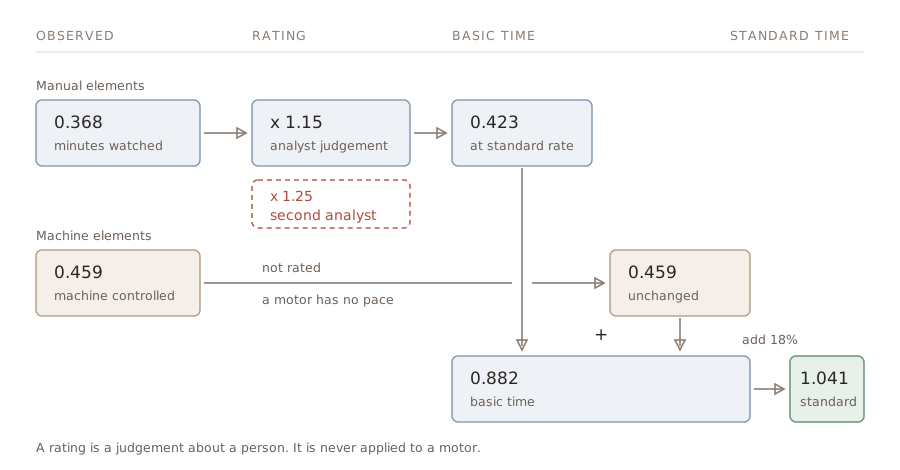
Amira watched Naglaa, the most consistent of the six collar setters, and rated the manual elements at 115.
| El | Type | Observed, min | Rating | Basic, min |
|---|---|---|---|---|
| 1 | Manual | 0.176 | 115 | 0.2024 |
| 2 | Machine | 0.238 | 100 | 0.2380 |
| 3 | Machine | 0.221 | 100 | 0.2210 |
| 4 | Manual | 0.128 | 115 | 0.1472 |
| 5 | Manual | 0.064 | 115 | 0.0736 |
| Total | 0.827 | 0.8822 |
Two honest analysts, and what the gap is worth
Tarek is the industrial engineer at Halwagy's sister plant. He watched the same operator on the same morning and rated 125.
Neither of them is wrong in any way you can prove. Rating is a trained judgement, and a rater who is accurate to within five points counts as competent. Ten points apart is two competent people disagreeing, and that happens constantly.
What is the disagreement worth?
- On operation 26: basic time 0.8822 against 0.9190. A gap of 4.2%.
- On operation 34, trim, tack down and inspect, which has no machine content at all: the same ten points is 8.7%.
The difference between those two numbers is the most useful thing in this lesson. Machine content dilutes rating error. Operation 26 is 55.5% machine time, so half the rating judgement never applies. An all-manual operation takes the error at full strength.
That tells you where to spend your care. Rate the hand work slowly and carefully, and stop agonising over the machine elements, because your judgement about them is not being used.
The study that was done perfectly
Now the part worth the price of the course.
Amira's studies are textbook. Elements described. Break points that hold. A rating for each element. Machine elements at 100. A method header on every sheet. Her standing instruction to herself, written on the first page of her own file, is study the operator who does the job best, so that the study describes the method properly rather than somebody's improvisation.
That instruction is defensible. It also produced an SMV nobody on Line 2 can reach, by two routes a perfect study cannot see.
Rating accuracy falls away from standard. Raters are trained and tested at around 100, because that is where the reference films sit. Nobody tests a rater at 130. A human rater compresses towards the middle, so a genuinely fast operator gets under-rated. Naglaa was working at about 128. Amira wrote 115. On operation 26 that understates the basic time by 5.1%. The mechanism is systematic, so it understates every operation Amira studied, in the same direction.
And rating corrects effort, not method. Naglaa developed a two-handed feed for the collar. It gets the centre-back notch onto the needle without a second look. The other five collar setters use the folder as it was issued. A rating of 128 says "she worked 28% faster than standard". It does not say "and she used a technique the rest of the section does not have". No rating, however accurate, turns a study of Naglaa's method into a standard for somebody else's method.
Nothing in the study procedure catches either one. The elements were right. The break points held. The cycles were adequate for a total. The machine elements were untouched. The method was flawless and the answer is low.
What it is worth across the garment
Halwagy's bulletin for TP-2280 has 34 operations. An operation bulletin is the list of every operation in a garment with its time. Here it is grouped, with the manual content shown in its own column, because that is the column the rating bias lands on.
| Operation | Basic, min | Of which manual |
|---|---|---|
| Fuse collar, stand and cuffs | 0.62 | 0.34 |
| Run-stitch collar, trim, turn, press point | 1.42 | 0.79 |
| Attach and top-stitch collar stand | 1.28 | 0.71 |
| Left front placket, folder | 0.94 | 0.58 |
| Right front placket | 0.71 | 0.44 |
| Make and attach chest pockets, pair | 1.66 | 1.12 |
| Attach and top-stitch back yoke | 1.05 | 0.63 |
| Sleeve plackets, pair | 1.88 | 1.28 |
| Join shoulders | 0.62 | 0.35 |
| Set sleeves, pair | 1.23 | 0.74 |
| Close side and sleeve seams, pair | 1.18 | 0.72 |
| Make and attach cuffs, pair | 1.79 | 1.09 |
| Set collar to neck and close stand | 0.88 | 0.42 |
| Hem bottom | 0.48 | 0.24 |
| Buttonholes and buttons, automat | 1.06 | 0.62 |
| Trim, tack down, inspect | 0.44 | 0.44 |
| Total | 17.24 | 10.51 |
Manual content is 10.51 of 17.24 basic minutes, which is 61.0% of the garment. Carry the same 115-against-128 bias across all of it and the manual content should read 11.70 minutes. The basic time becomes 18.43 rather than 17.24.
The recorded basic time is understated by 6.4%, and it is understated because a sensible instruction was applied consistently.
Where this leaves you
Nineteen point three one is not yet in sight. What you have is 17.24 basic minutes, probably 18.43, and a study method whose weakest joint is a human judgement made in about four seconds while watching a hand move.
The step from basic time to standard time is the allowances, and that is where the number moves further than anything in this lesson. That is lesson 2.
Check yourselfA supplier hands you an SMV of 14.6 for a polo and says the study was done on their best operator so the method would be clean. Is that a problem?Show the answer
It is two problems, and they point the same way. Rating error is not random. Raters compress towards standard, so a genuinely fast operator is under-rated and the basic time comes out low. And rating corrects pace, not technique: if the best operator has a method the rest of the section does not use, no rating turns her study into their standard. Ask what rating was recorded. If it is above about 120, ask who else was studied. A study on one exceptional operator with no cross-check is a number that will be missed every day, and the line will get the blame.
Check yourselfYour analyst rated a whole cycle at 118. The operation is a lockstitch seam with 62% machine content. What is wrong, and by how much?Show the answer
Rating has been applied to the motor. Only the manual 38% should have been extended. The machine time is fixed by the stitch rate and the seam length. Rating the whole cycle at 118 inflates the machine portion by 18% of 62% of the cycle, which is about 11% of the total, in the direction of a standard that is too generous. The fix is not a better rating. It is a study sheet with a type column, and it costs nothing.
Prompt · Defend an SMV, or take one apart
When a number is quoted at you as a fact and nobody in the room can say where it came from.
Act as an experienced apparel industrial engineer who has run time studies and has no stake in the answer. I have an SMV I need to defend or challenge. Style facts: [STYLE], [GARMENT DESCRIPTION], [QUANTITY], machine types available [LIST]. The SMV I have been given is [NUMBER] minutes, from [WHO PRODUCED IT AND WHEN]. If I have a study sheet or an operation bulletin I will paste it here: [PASTE THE OPERATION LIST WITH TIMES, AND ANY ELEMENT BREAKDOWN, RATINGS AND ALLOWANCES]. Do the following. First, tell me what is MISSING before this number can be defended at all — method header, element descriptions, break points, per-element ratings, machine or manual type per element, cycle count, allowance build-up, date of the last method change — and mark each as present, absent or unverifiable. Second, for every element, tell me whether it is machine-controlled or operator-controlled, and flag any case where a rating appears to have been applied to machine time, with the size of the error that introduces. Third, if I have given you observed times and ratings, recompute basic time element by element and show your working. Fourth, tell me what number of cycles this study would need for a five per cent precision on its most variable element, and separately what precision the operation TOTAL has at the cycle count actually used, and explain which of the two I need for the use I have described. Fifth, list the questions I should ask the person who produced this number, in the order that gets the most information from the fewest questions. Sixth, give me a range within which this SMV is probably correct, and say plainly which direction the likeliest error runs and why. Do not tell me the number is fine because it looks reasonable; if there is no evidence, say there is no evidence.
AI can make mistakes — check anything you act on.