Lessons · Lesson 3 of 3
Capacity is a claim, and this is how you check it
Separate installed, manned, attended, on-standard and earned minutes, price the gap between the answer a factory gives and the one it can keep, and name what an SMV can never tell you.
Lesson 3 of 3 · 50 min
The question a factory is actually paid to answer
Ask a factory how much it can make and you will get a number. The number will be true. It will also be one of about five true numbers, and the largest is nearly double the smallest. This lesson takes them apart and shows whose problem each gap is. A promise built on the wrong one reaches the buyer as a date and comes back as a penalty.
Thrapston asked one question in January: how many, and by when.
Magdy answers enquiries at Halwagy. He looked at Line 2, which has 48 machines, a 480-minute day and six working days a week. He gave the answer every part of him believed was conservative. He did not use the machine count. He used the operators actually on the payroll for that line, and he used the real attendance. He came back with 904 shirts a day. That puts 42,000 shirts through in 47 working days: bulk from Monday 6 April, sewing complete Saturday 30 May, ex-factory 4 June.
Line 2 will finish this order on Tuesday 7 July. Thirty-three working days late.
Magdy's arithmetic contains no error. He divided a real quantity of minutes by a real SMV. The problem is that a sewing line's day contains five different real quantities of minutes. They differ from each other by a factor of two, and everybody in the building calls one of them capacity.
Five banks of minutes
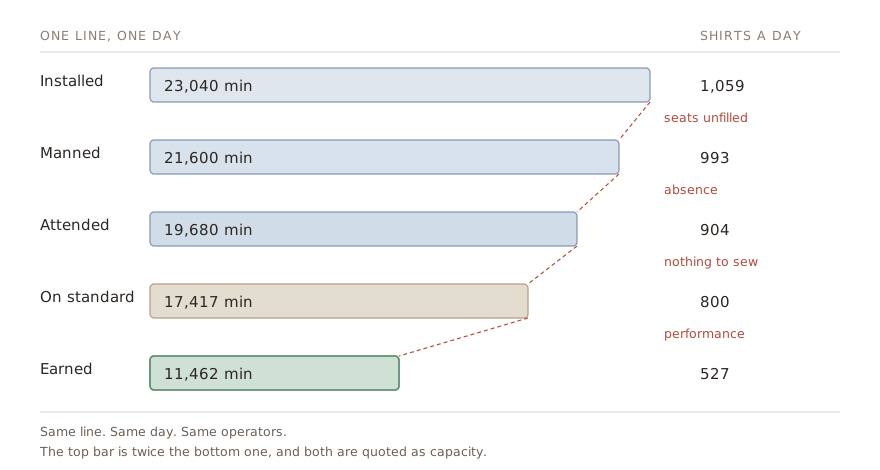
Here is Line 2 on an ordinary day, using the defensible SMV of 21.75 minutes from lesson 2.
| Bank of minutes | How it is arrived at | Minutes | Shirts a day |
|---|---|---|---|
| Installed | 48 seats, 480-minute day | 23,040 | 1,059 |
| Manned | 45 seats have an operator assigned; three machines are down or unfilled | 21,600 | 993 |
| Attended | 41 operators actually clocked in today | 19,680 | 904 |
| On standard | attended, less the time nobody could work standard work in | 17,416.8 | 800 |
| Earned | on-standard minutes, times what the line achieves in them | 11,462.2 | 527 |
Five true statements. The largest is 2.01 times the smallest. Every one of them is quoted as capacity by somebody, and each of the four losses between them has a different owner.
Installed to manned is a human-resources and maintenance number. Three seats have nobody in them, or a machine is waiting for a part. Line 2 runs at 93.8% of its installed seats.
Manned to attended is attendance: 41 of 45, or 91.1%. Absence, lateness, someone moved to another line at 10:00. This is the loss most factories know precisely and then plan as though it were zero.
Attended to on-standard is off-standard time. These are attended minutes in which no standard work was available to do. Halwagy's own record on Line 2 is 11.5% of attended time, and it is itemised:
| Cause | Per cent of attended time |
|---|---|
| Waiting for cut parts or trims | 3.1 |
| Style changeover and first-off approval | 2.4 |
| Machine breakdown | 1.9 |
| Rework outside the operator's own standard | 1.6 |
| Meetings, training, cleaning | 1.4 |
| Power interruption | 1.1 |
| Total | 11.5 |
Not one of those six lines is the operator's doing, and not one of them is in the SMV. Look at the top line in particular. The largest single loss on a sewing line is very often the cutting room and the store, and it is charged to sewing.
On-standard to earned is performance: what the line achieves in the minutes it does have standard work. Line 2 runs at 65.8% on standard, which is a good garment line.
Put those together and Line 2's efficiency is 58.2% against attended minutes and 49.7% against installed. Both are correct. They describe the same line on the same day. A supplier quoting one of them to a buyer expecting the other is having a conversation in which neither party knows the number has been redefined mid-sentence.
The whole factory, in one row each
| Bank of minutes | Minutes | Shirts a day |
|---|---|---|
| Installed | 92,160 | 4,237 |
| Manned | 86,400 | 3,972 |
| Attended | 79,200 | 3,641 |
| On standard | 70,092 | 3,222 |
| Earned | 46,128.6 | 2,120 |
Overall the factory turns 50.1% of its installed minutes into earned ones. That is not a scandal. It is roughly what a well-run woven factory does. What would be a scandal is quoting 4,237.
What the claim cost
Sewing had to be finished by 30 May. It will finish on 7 July.
Thrapston's terms cut the order price by 5% for delivery more than fourteen days late. On USD 413,700 that is USD 20,685. TP-4417 was costed to a margin of USD 0.73 a shirt, or USD 30,660 on the order. The late-delivery clause alone takes 67.5% of it, before anyone has bought an air freight or an overtime hour.
What Halwagy does now is a booking problem with six priced answers: a second line, overtime, a split shipment, a renegotiated date, subcontract, or declining part of the order. Course 7.4, Capacity Planning and Order Booking, works all six of them out on a live enquiry. This course stops at the measurement. Which line does the work, and in what order the operations sit on it, is 5.3.
The finding that belongs here is smaller and harder to fix. The answer given in January was produced by dividing the right kind of quantity by the right kind of number, and it was out by a factor of 1.72. No spreadsheet would have flagged it. The only defence is knowing which of the five banks you are standing in.
The SMV cancels out of the cost, and almost nothing else
Here is the result that reframes everything in this course. It is also the reason an advanced course has to turn on its own tool.
Halwagy costed TP-2280 at 19.31 SMV and a cost per standard minute of USD 0.0696, giving a making cost of USD 1.34.
Now compute the same thing from the payroll. Line 2 has 41 operators present, a 480-minute day, and a fully loaded cost of USD 0.0362 per attended operator-minute. The line costs USD 712.42 a day and produces 527 shirts. The direct sewing cost of a shirt is therefore USD 1.35, and no SMV appears anywhere in that sentence.
Watch what happens if you do it properly, with the efficiency you actually measured:
- With SMV 19.31, Line 2's measured efficiency is 527 × 19.31 ÷ 19,680 = 51.7%. Cost per standard minute is 0.0362 ÷ 0.517 = USD 0.0700. Making cost: 19.31 × 0.0700 = USD 1.35.
- With SMV 21.75, the same line's measured efficiency is 58.2%. Cost per standard minute is 0.0362 ÷ 0.582 = USD 0.0622. Making cost: 21.75 × 0.0622 = USD 1.35.
The same answer. It has to be. If you derive the cost of a minute from the efficiency you measured with that SMV, the SMV appears once on the top and once on the bottom and cancels. The making cost of a garment is payroll divided by garments, and it always was.
So a wrong SMV does not, by itself, make your cost wrong. Halwagy quoted USD 1.3440 against a true USD 1.3518 and was under by USD 330 across the whole order, which is a rounding error. And that only because the budget efficiency of 52% used in the quotation happened to sit near the achieved 51.7%.
The escape clause is the whole risk. The cancellation holds only if the efficiency you divide by was measured with the same SMV. The moment you take an efficiency from a budget, from last season, from another line, or from a consultant, the two numbers no longer refer to each other. The error is live again, at full size, in whichever direction the mismatch runs.
That tells you where an SMV error really lands. Not in the price. In capacity, in balance, in pay, and in comparison. Those are the four things nobody audits.
What an SMV cannot tell you
An advanced course owes you the limits of its own tool. Here are seven things a standard minute value does not contain. Somebody will eventually assume it does.
- It is a statement about a method. Change the folder, the attachment, the machine or the workplace layout and the number is void, not merely old. An SMV has no expiry date. It has a method.
- It says nothing about sequence or balance. Total work content is the same whether the line is balanced beautifully or badly. Two lines with identical SMVs can differ by a third in output. That is 5.3's subject, and the SMV is silent on it.
- It is blind to lot size. Changeover, first-off approval, the ramp on a new style and the bundle handling at the start of a run are real minutes. None of them live in a per-piece standard. A 2,000-piece drop and a 42,000-piece order carry the same SMV and are not the same work.
- It assumes the operator is supplied. Every one of the six off-standard lines above sits outside the SMV. A perfect standard on a line waiting for cut parts describes work nobody is doing.
- It contains no quality. Earned minutes are credited on pieces produced, not on pieces accepted. A line running at 110% performance with 6% rework is worse than a line at 100% with none, and the SMV reports the first as better.
- It is an average, and it has thrown away the spread. Lesson 1's element 4 varied by nearly a fifth from cycle to cycle. That variability drives work-in-progress and buffer size, and it is invisible in the mean.
- It does not transfer. Between factories it is nearly meaningless: different machines, different attachments, different allowances, different raters. Between two lines in the same building it needs checking.
What the reader can now do
You can break an operation into elements with break points that hold, and choose a cycle count from the variation rather than from habit. You can rate manual work and leave machine work alone. You can build an allowance from the workplace in front of you instead of from a report. And you can take a factory's capacity claim apart into the five quantities it might have come from.
You can also say the thing that matters most about the number you have just produced. It describes one method, one workplace and one line. It will be wrong the week somebody changes a folder. And it is a measurement, not a promise.
Check yourselfA supplier tells you their factory has a capacity of 4,200 shirts a day. What are the two questions?Show the answer
"At what SMV?" and "which minutes?" Four thousand two hundred is what 192 seats produce if every seat is filled, everybody attends, nothing waits and every minute is earned. That is the machine count wearing a hat. Ask for their attendance rate, their off-standard percentage and their on-standard performance, all three from their own last quarter, and re-derive it. Halwagy's honest figure is half its installed number, and Halwagy is not badly run. A supplier who cannot produce the three losses is not hiding them. They have never measured them, which is a more serious finding than any of the individual numbers.
Check yourselfYour factory rebuilds its SMVs and every one rises by about 11%. Overnight, reported efficiency jumps from 52% to 58%. Has anything improved?Show the answer
Nothing whatever. The same operators made the same shirts in the same minutes. Efficiency is earned minutes over attended minutes, and you have just changed the definition of an earned minute, so the ratio moves without the factory moving. Two things do genuinely change, and both are real. The operators' recorded performance rises to where their work always was. And every capacity figure in the building falls by the same 11%, because the SMV is the divisor. Be ready for the second one. A rebuild that quietly reduces your quotable capacity is exactly the moment a sales department starts asking who authorised it.
Prompt · Take a capacity claim apart
The moment a factory answers how many a day, whether it is your factory or somebody else's.
Act as a production manager who has been caught out by a capacity figure before and now checks every one. Take the claim below apart into the banks of minutes it could have come from. The claim: [FACTORY OR LINE], [PIECES A DAY OR A WEEK], on style [STYLE]. What I know: seats or machines installed [NUMBER], seats with an operator assigned [NUMBER], operators typically present [NUMBER OR ATTENDANCE PERCENT], shift length [MINUTES], working days a week [NUMBER], the SMV being used [MINUTES] and where it came from [DESCRIBE], off-standard time [PERCENT AND ITS CAUSES IF KNOWN], performance on standard [PERCENT], and any figure I have for actual pieces produced on a normal day [NUMBER]. Do the following. First, compute installed, manned, attended, on-standard and earned minutes, show each as pieces a day at the given SMV, and tell me which of the five the claim most likely came from. Second, if I gave you an actual output figure, work backwards from it to the real earned minutes and tell me which of my inputs is inconsistent. Third, list every loss between the banks with its owner — human resources, maintenance, cutting room, store, planning, quality, supervision — because most of them are not the sewing line's. Fourth, state the honest capacity as one sentence I could put in an email, naming the bank of minutes and the SMV it rests on. Fifth, tell me what this factory would have to change, in order of size, to move the honest number, and roughly what each is worth in pieces a day. Sixth, list the questions whose answers would most change your conclusion, so I know what to go and find out. If a figure I gave you is implausible, say so and say why rather than computing with it silently.
AI can make mistakes — check anything you act on.