Lessons · Lesson 1 of 3
What lean claims, and the assumption apparel breaks
Count the work waiting on a real line, price the change to one-piece flow, and find the number of style changes a year above which that change loses money.
Lesson 1 of 3 · 37 min
The two lines
Lean usually arrives in a factory as a set of beliefs, with posters. You cannot argue with a belief. So this lesson treats lean as four plain claims about a production line instead. Each claim is either true in your building or it is not. The claim it tests hardest is the one everybody starts with.
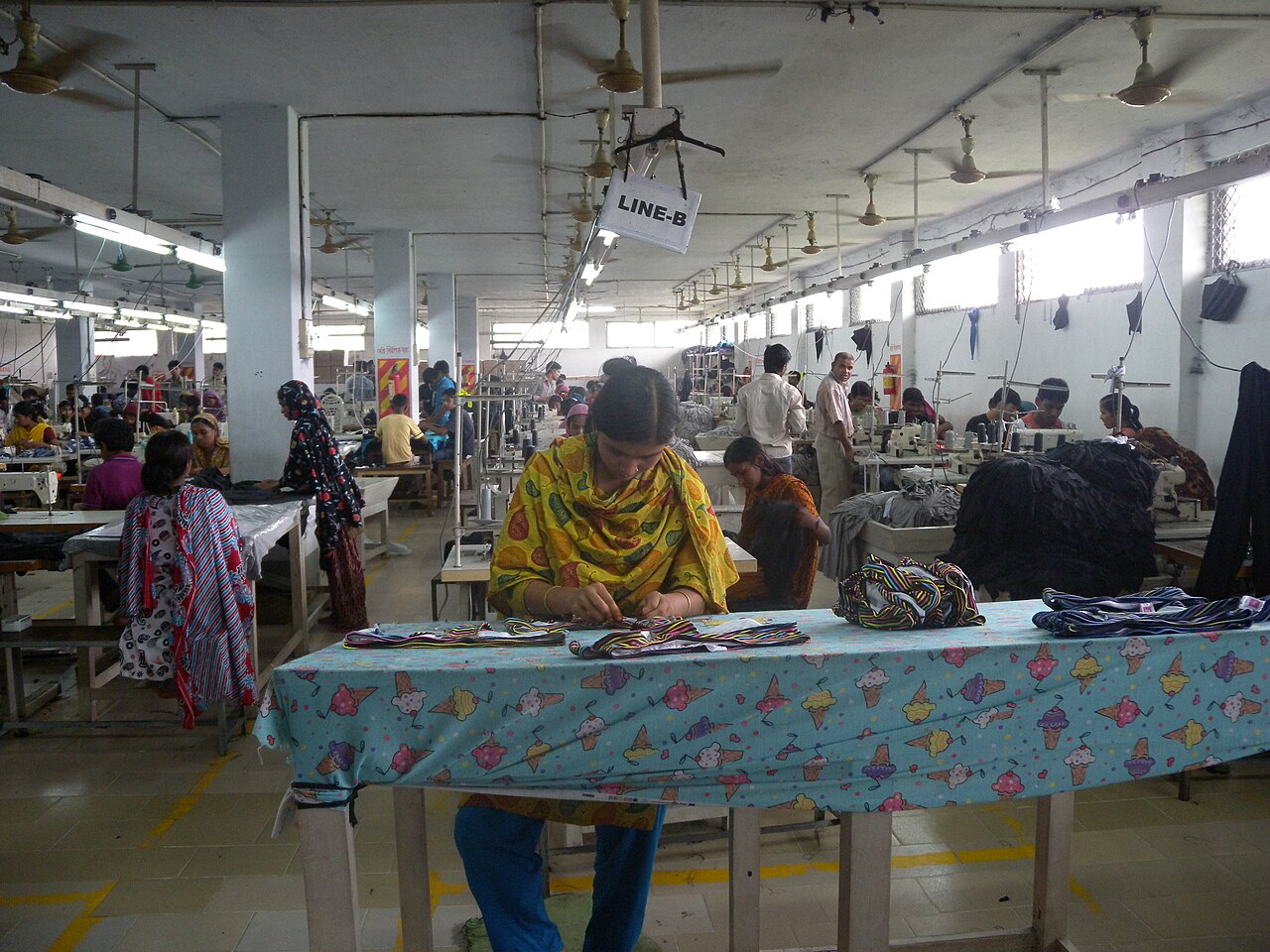
Palugaha Apparel sits outside Kurunegala and runs nine sewing lines. This course lives on two of them. Everything in it turns on the difference between those two.
Line 6 makes style RV-812 for Ravensholt Catering Supply, a British hospitality wholesaler. It is a chef's jacket in a 65/35 poly-cotton twill: three colours, double-breasted, a stand collar, a two-piece sleeve with a thermometer pocket, 26 operations, SMV 14.20. SMV is the standard minute value — the minutes of work inside one jacket. PO RH-4406 is for 24,000 jackets, one call-off inside a rolling annual commitment of 96,000. Ravensholt has bought this jacket, unchanged except for colour, for four years. Line 6 changes style four times a year.
Line 9 makes womenswear for Vendhurst, a British high-street brand. A style runs for about nine working days and then another one starts. Line 9 changes style twenty-seven times a year.
Same factory. Same wage rates. Same mechanics. Same industrial engineer. Almost everything you are about to read is true on one of these lines and false on the other. What separates them is one division.
Four claims, not a philosophy
Lean is not a belief system on this course. It is four claims about a production line. Each one is either true here or it is not.
- Work should move one piece at a time. A piece that is waiting is a piece nobody has been paid for.
- Work in process is a cost. It is cash lying on a table. It delays the discovery of a fault. And it lets a line keep running while something is wrong with it.
- The rate is set by demand, not by the fastest operator. That rate is called takt.
- Set-up time is not a property of a machine. It is work, and work can be re-designed.
Claims 3 and 4 are true almost everywhere. Claim 4 is where the money is on line 6, and it is the whole of the next lesson. Claims 1 and 2 are the ones factories argue about, usually with posters. Here they are argued about with a count.
Counting the line
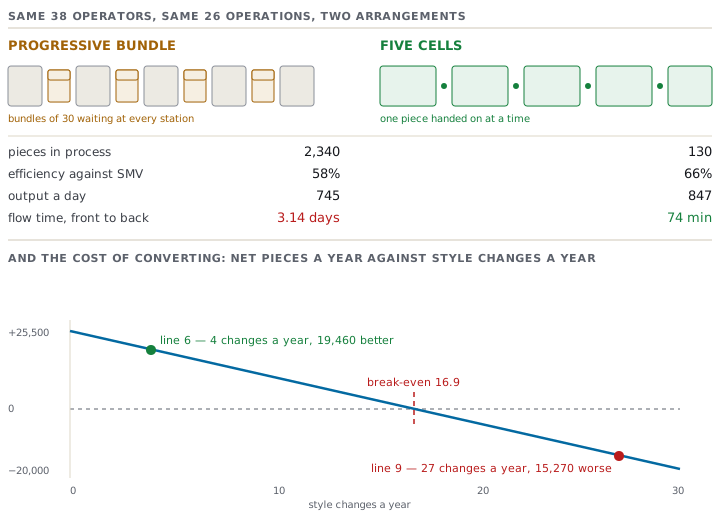
On a Tuesday morning the industrial engineer walked line 6 from the first operation to the last. He counted every panel and every part-made jacket sitting between operations. Bundles of 30, an average of three bundles standing at each of 26 stations: 2,340 pieces.
Line 6 makes 745 jackets a day. That is 38 operators, 480 working minutes each, running at 58% against an SMV of 14.20. The rule you need next is the one 7.4 states as Little's Law: the time a piece spends inside a system is the amount of stuff in the system divided by the rate the system delivers. So a jacket entering line 6 on Tuesday morning leaves it 3.14 days later.
Four weeks earlier the same engineer ran a pilot on line 4. The same 38 people, the same 26 operations, but split into five cells of seven or eight operators. Each cell built a whole jacket. Each operator covered three or four operations. One piece was handed on at a time.
| Progressive bundle, as line 6 runs | Five cells, as the pilot ran | |
|---|---|---|
| Operators | 38 | 38 |
| Operations | 26 | 26 |
| Pieces in process, counted | 2,340 | 130 |
| Efficiency against SMV | 58% | 66% |
| Output, jackets a day | 745 | 847 |
| Flow time, one jacket front to back | 3.14 days | 74 minutes |
Read the last row twice. The same people, the same operations, the same machines — and a jacket gets through in 74 minutes instead of three days and a bit. That is not a rhetorical gain. It is what claim 1 says will happen, and it happened.
Efficiency also rose, from 58% to 66%. It is worth being precise about why, because the reason is dull. It is not motivation. Bundle work carries handling that cell work does not: untying, counting, checking the ticket, tying up again, writing the ticket, waiting for the helper. Take the bundle away and that handling goes with it. Which operation actually sets the line's rate — and what to do when one of them cannot keep up — is 5.3's subject, and this course uses it rather than repeating it.
Takt, and the thing about takt nobody says
Takt is available time divided by demand. Line 6 has 480 working minutes and owes 745 jackets, so its takt is 38.7 seconds. A finished jacket must leave the line every thirty-nine seconds or the ship date moves.
Here is the part that is usually left out. In a car plant, demand is a rate. In apparel, demand is a date. Ravensholt does not want 745 jackets a day. It wants 24,000 jackets on a vessel on a Thursday. The daily rate is something the factory worked out by dividing. So a factory's takt is not handed to it by the customer. It is a result of the ship date, the days booked, and a decision about how many days of margin to leave. The moment the buyer moves the ship date by a week, the takt moves and every balance built on it is wrong. That is not lean failing. It is lean applied to a demand signal that is not the one the method assumes.
The cost nobody puts in the comparison
So convert line 6 to cells. The pilot says it is worth 102 jackets a day, which over 250 working days is 25,500 jackets a year.
Now the other side of the sum. Case studies leave it out because in a car plant it barely exists.
A cell operator covers three or four operations instead of one. When the style changes, that operator has three or four new methods to learn instead of one — and the cell has no bundle stack to hide the difference in speed while they learn. Palugaha has its own record of what a style change costs, from line 9's history and from the pilot. Measured as output lost against steady state before the line is back to rate:
- a style change on a bundle line costs 640 pieces;
- a style change in cells costs 2,150 pieces.
The learning curve underneath those two numbers is 7.4's subject. The method study that resets the operation breakdown is 5.4's. What matters here is the difference — 1,510 pieces per style change — because that is what the conversion has to buy back out of its 25,500.
| Line 6, Ravensholt jacket | Line 9, Vendhurst womenswear | |
|---|---|---|
| Style changes a year | 4 | 27 |
| Working days a style runs | 62 | 9 |
| Steady-state gain from cells, pieces a year | 25,500 | 25,500 |
| Extra recovery loss per change, pieces | 1,510 | 1,510 |
| Extra recovery loss a year, pieces | 6,040 | 40,770 |
| Net, pieces a year | 19,460 better | 15,270 worse |
| Net, USD a year | 23,741 better | 18,629 worse |
A jacket is valued here at USD 1.22: the cut-and-make price of USD 1.28 less USD 0.06 of thread and consumables. Labour is not subtracted. The operators are paid for the day whether the line runs or not. That is the single most important economic fact on a sewing floor, and it is why a stopped line is so expensive.
The break-even, which is one division
Set the two sides equal. The conversion pays until
25,500 divided by 1,510 = 16.9 style changes a year.
Below about seventeen changes a year — a style running longer than 14.8 working days — cells win. Above it they lose, and they lose faster the shorter the runs get. Line 6 changes four times a year and should convert. Line 9 changes twenty-seven times and should not. No amount of commitment, training or culture changes that, because the loss is arithmetic and not attitude.
This is the honest answer to why the famous lean case studies come from places that build the same thing for years. They are not lying. They are describing a line whose style-change count is close to zero, where the whole right-hand side of that division disappears.
But notice which part of the sum you are allowed to attack. The break-even is a fraction. A factory can only move the top of it by buying more efficiency. The bottom — the 1,510 pieces a style change costs — is not a law of nature. Nobody at Palugaha has ever taken a stopwatch to a style change on line 9 and split it the way the next lesson splits a colour change. If that 1,510 could be halved, the break-even moves from 16.9 changes a year to 33.8, and line 9 moves from the wrong side of the arithmetic to the right side without a single new machine. Hold that thought. It is the whole of lesson 2.
What conversion actually costs, before it earns anything
The 23,741 a year on line 6 is not free. Rebuilding the tables and the material handling, six weeks of the industrial engineer, and training thirty-eight people on three operations each came to USD 14,600 at the pilot's own costing. The six weeks of disruption cost about 8,400 jackets of output, worth USD 10,248. Call it USD 24,848 before the first extra jacket exists.
So payback is about 13 months — and only if the order book can absorb 19,460 extra jackets. If Ravensholt's call-off is fixed and no other order is waiting, the conversion produces capacity, not money. Capacity is worth exactly what you sell it for. Say that out loud before the tables are cut, not afterwards.
Prompt · Should this line run in cells? Give me the break-even
Before you agree to a modular or one-piece-flow conversion, and before you refuse one — the answer is a division and almost nobody does it.
Act as an industrial engineer in a garment factory who has converted lines both ways and has no preference between them. I want the break-even for converting one line, expressed in style changes a year. Line facts: [LINE], [NUMBER] operators, [NUMBER] operations, working minutes an operator a day [NUMBER], working days a year [NUMBER]. Current arrangement [PROGRESSIVE BUNDLE OR OTHER], bundle size [NUMBER] pieces. Style [STYLE], SMV [MINUTES], current efficiency [PERCENT], current output a day [NUMBER]. Work in process, counted rather than estimated: [PIECES]. My cut-and-make price is [AMOUNT] a piece and my consumables per piece are [AMOUNT]. Cell pilot results if I have them: efficiency [PERCENT], output [NUMBER], work in process [PIECES]. Style changes on this line in the last twelve months: [NUMBER]. Output lost per style change before the line is back to rate, bundle line [PIECES] and cells [PIECES] — if I do not have these, tell me how to get them from the plan board. Conversion cost estimate: [AMOUNT] plus [WEEKS] weeks of disruption. Do the following. First, compute flow time both ways from the work-in-process count and the output, and say it in days and in minutes. Second, compute the steady-state annual gain in pieces and in money, using contribution and not the full selling price, and say explicitly whether the operators' wages belong in that number. Third, compute the extra recovery loss a year from my style-change count. Fourth, give me the break-even as a number of style changes a year and as a length of style run in working days. Fifth, tell me how far my line sits from that break-even and what single change in my order book would flip it. Sixth, state whether the gain is money or capacity, and if it is capacity, say what I would have to sell to turn it into money. Do not give me a range where a number is possible, and list every assumption at the end.
AI can make mistakes — check anything you act on.
Check yourselfYour line changes style every 20 working days and the cell pilot shows the same 25,500-piece annual gain and the same 1,510-piece extra recovery loss. Convert or not?Show the answer
Convert, but only just. Twenty working days a style is 12.5 changes a year over 250 days, against a break-even of 16.9. So the net is 25,500 less 12.5 times 1,510, about 6,625 pieces a year — roughly USD 8,100 against a conversion cost near USD 24,848. Payback runs past three years. The right answer is not "yes" or "no" but "yes, at a payback you should say out loud". The number is close enough that one change in the order book flips it — a single buyer moving from four drops a year to eight. Recompute it whenever the order book changes shape, not whenever somebody reads a book about Toyota.
Check yourselfSomebody proposes halving the bundle from 30 to 15 pieces on line 6 as a cheap way to get most of the flow benefit. What is your first question?Show the answer
Not "will work in process fall" — it will, by about half. The first question is what the buffer was absorbing. Work in process on a bundle line is not decoration. It is what keeps operations 22 to 26 working while operation 21 has a thread break, a bobbin change or a mechanic. Halve the bundle and you halve the buffer, so every stoppage that used to be invisible now reaches downstream. That is exactly what happened on line 6 the following month. It is the subject of the next lesson, and the output went down.