Lessons · Lesson 3 of 3
Why a gain leaves, and what makes it stay
Follow one measured improvement as it decays over ten weeks, name the four forces that removed it, and price what it costs each year to keep a gain you have already paid for.
Lesson 3 of 3 · 35 min
Ten weeks later
An improvement is not something you install once. It is a way of working that has to be done again every day. The people doing it were not in the room when it was decided. Left alone, it comes undone, through nobody's fault. This lesson follows one proven gain through the weeks in which it quietly disappears.
The changeover work on line 6 was real. It was forecast at 42 jackets a day, it delivered 42, it was measured over 24 days on each side, and the equipment cost USD 1,240 against USD 12,810 a year. Lesson 2 ended with it in place.
In the second week of June the plant manager asked, in passing, how long a colour change was taking. Nobody knew, so somebody timed the next one.
Fifty-one minutes.
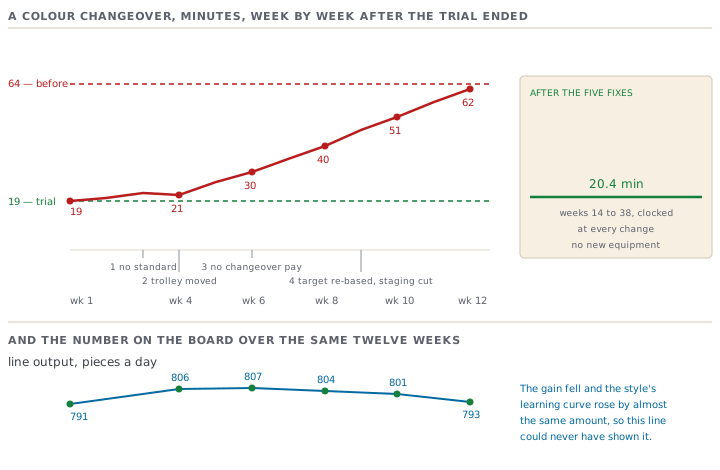
Here is the whole ten weeks, put back together afterwards from the plan board and the overtime book.
| Week | Changeover, minutes | From changeover, pieces a day | From the style's climb, pieces a day | Line output, pieces a day |
|---|---|---|---|---|
| 1 | 19 | 42 | 8 | 791 |
| 4 | 21 | 40 | 25 | 806 |
| 6 | 30 | 32 | 34 | 807 |
| 8 | 40 | 22 | 41 | 804 |
| 10 | 51 | 12 | 48 | 801 |
| 12 | 62 | 2 | 50 | 793 |
By week twelve the colour change took 62 minutes. That is one minute inside the pre-trial mean of 64, which is to say the method was gone. Of the USD 12,810 a year, USD 3,701 survived to week ten and essentially nothing to week twelve. USD 9,109 of it had left the building without a decision, without a meeting, and without anybody doing anything they thought was wrong.
The output figure rose the entire time
Read the last column again. Weeks one to ten: 791, 806, 807, 804, 801. It goes up.
That is the whole reason nobody noticed. The style was in its first ten weeks and the line was still climbing its learning curve — worth 8 jackets a day in week one and 48 by week ten. The changeover gain was falling by almost exactly as much as the climb was adding. The two moved in opposite directions and cancelled out. So the number on the board carried no information about the changeover at all, and against a daily spread of 31 jackets what was left was invisible.
The factory read a rising output as the improvement holding. It was reading the absence of a fall.
An improvement is proved by producing this week's measurement of it. It is never proved by the absence of the old complaint. If you cannot say what the changeover took last Thursday, you do not have the improvement. You have the memory of having had it.
The one number that would have shown the decay in week four is the changeover clock, and after the trial ended nobody was starting it. The trial had a measurement. The standard had none.
Force one: it was never written down
The method was six steps and it existed in the industrial engineer's notebook. In week three he moved to line 9. Nothing was on the machines, nothing was on the tool board, nothing was in the changeover routine.
In week seven the supervisor was asked to describe the changeover. He gave four of the six steps and had two of them in the wrong order. He was not being careless. He had watched it work in March and had never been given anything to read. Written standard work — the method, in order, where the work happens — is 5.4's subject as a work-study output, and it is not paperwork. It is the only form in which a method can survive the person who invented it.
Force two: nobody asked the operators
The pre-wound bobbin trays were staged on a trolley, and the trolley was parked in the aisle behind operations 9 to 14, because that was the nearest floor space to the store.
Six operators there lost about 4 minutes a shift getting round it. That is 120 operator-minutes a week, which is fewer than five jackets, about USD 5.98 a week — against a gain of USD 256 a week. In every arithmetic that matters it is nothing.
It is also the thing that killed the gain. From week four the operators moved the trolley themselves, to the end of the line, forty metres from the machine groups it served. From week five the helper had to walk the trays back before staging them. By week six he was staging two of the four groups and leaving the rest, and by week eight, none.
A nuisance worth USD 5.98 a week ended a gain worth USD 256 a week. A nuisance lands on a specific person every day. A gain lands on a spreadsheet every month. The trolley could have gone at the other end of the same aisle. The cost of finding that out was a twenty-minute conversation with six operators before the trial, and it was not had.
Force three: the method pays four people less
Under the old method every operator threaded their own machine. Sixty-four minutes, and everybody lost the same sixty-four minutes.
Under the new method four people thread all thirty-eight machines while the other thirty-four wait. That is the entire saving. But operators at Palugaha earn a piece rate on their own output, and changeover is unpaid time. So the new method takes 19 minutes of earning from four named people, three times a week. At USD 11.40 a day over 480 minutes that is USD 0.45 a changeover, USD 1.35 a week, 2.4% of a USD 57 week — for the four people the whole method depends on.
Nobody complained, because nobody was asked and the amount is small. They simply drifted. By week six two of the four were going back to their own machines as soon as their own group was threaded, and the last group was left to whoever happened to be free.
The fix is an allowance of USD 0.65 a person a changeover — USD 2.60 a changeover, USD 390 a year, 3.0% of the gain. Without it the gain does not exist, and the four people who dismantled it were behaving correctly for their own pay packet.
Force four: the supervisor's arithmetic
In week seven the planner re-based line 6's daily target from 745 to 808, on the strength of the trial's measured mean.
By week seven the method was already half gone, so the line's real capability was about 806 and falling. From that week the supervisor was under target every day, by a margin that grew, and his monthly target bonus of USD 34 was lost. Nothing in his scorecard told him which of the forces above was responsible, and nobody had left him a standard to restore.
What his scorecard did show him was one line he controlled: the helper's evening staging, booked as overtime at USD 1.32 a changeover — USD 17.16 a month with his name on it. In week nine he stopped authorising it, and the last of the method went with it.
The staging protects a gain worth USD 1,067.50 a month. He saved USD 17.16 and cost the factory sixty-two times that, and by his own measurement he did the right thing.
The target had been set on a measurement of a method, and then the method was allowed to leave while the target stayed. Re-base a target on the level a change has sustained, not on the level it reached in a trial, and only once the standard that holds it exists.
Getting it back cost nothing, which is the finding
In July the whole thing was restored. It took three weeks and USD 0 of new equipment. The second thread sets, the bobbins and the winder had never left the store. Nothing physical had decayed.
Equipment does not decay. Methods do. That is why a factory can have a store full of jigs, folders and trolleys bought for improvements that no longer happen, and it is a reliable thing to walk round and look for.
Weeks fourteen to thirty-eight, with the five things below in place and the changeover clocked at every change: a mean of 20.4 minutes, standard deviation 2.8.
The five things, priced
| What it is | What it costs | |
|---|---|---|
| A written standard | Six lines on the line's tool board, owned by the mechanic by name | 40 minutes, once |
| A measurement that outlives the trial | Changeover minutes on the same board as output, every change | 90 seconds a change |
| The people who do it, in the room | Twenty minutes with the operators before the method is fixed | 20 minutes, once |
| Pay that does not punish it | The changeover allowance | USD 390 a year |
| A target that follows, not leads | Re-based on the sustained level, after the standard exists | Nothing but patience |
Add the staging overtime the method needs anyway and the recurring cost of holding a gain of USD 12,810 is USD 588 a year: 4.6%.
That percentage is the point of this course. Course 6.1 makes the case, correctly, that inspection is a reduction in escapes you rent by the day, while a process change is one you buy once. What line 6 shows is the line that argument leaves out. You buy the process change once and you pay about 4.6% a year to keep it — a written standard, a measurement, a pay line and a target that behaves. It is not rent. It is not free either, and a factory that pays nothing gets ten weeks.
Prompt · Find out why the gain left, and what it costs to keep it
When a change you measured and believed in is quietly back to how it was, and the output figure never showed it.
Act as a factory improvement manager who has seen more gains decay than persist and is not interested in blaming anybody. An improvement of mine has decayed and I want the four forces named against the evidence, not a lecture on culture. The improvement: [DESCRIBE IT], implemented on [DATE] on [LINE]. What it was measured at when it was proved: [NUMBER AND UNIT], measured over [DAYS] days each side. What it measures at today: [NUMBER AND UNIT, OR SAY THAT NOBODY HAS MEASURED IT]. What it was worth a year: [AMOUNT], and how that was computed: [SHOW IT]. Now answer these against evidence I can go and check. First: is the method written down anywhere the work happens, and who by name owns it? If nobody, say what the six-line version of it would contain. Second: who was in the room when the method was designed, and specifically was any operator who does the work? Ask me what physically changed for the people nearest it — where things are parked, stored, carried, reached. Third: is anybody worse off in take-home pay under the new method than the old one, and if so who and by how much a week? Compare that number with the annual gain and tell me the ratio. Fourth: what is the supervisor measured on, what comes out of a budget with their name on it to keep this running, and was any target re-based on the trial's result? Fifth: is there a measurement of the improvement ITSELF, taken this week, or only of output? If only output, tell me what else was moving on that line over the same period that could have masked the decay. Then give me a restoration plan with a cost for each of the five items and a total as a percentage of the annual gain, and tell me plainly which of the four forces will bring it back down if I do not fix it.
AI can make mistakes — check anything you act on.
Check yourselfYour team reports a change that saved 18 minutes a shift, implemented four months ago. How do you check whether you still have it?Show the answer
Ask for this week's measurement of the thing itself — not the output, not the saving, not the person's confidence. If the answer is a number from this week, you have it. If the answer is the original trial's number, or "it is working fine", or "nobody has complained", you have the memory of it and you should go and time it today. Output will not tell you. On a line whose learning curve, absence rate and fabric lot all move by more than 18 minutes a shift, a decayed gain hides inside ordinary variation for months. That is exactly how line 6 lost USD 9,109 a year without a single bad report.
Check yourselfA supervisor quietly stops a step in a new method. What is the first thing to look at?Show the answer
His scorecard and his budget, before his attitude. A step gets stopped when the cost of it lands somewhere the person can see and the benefit lands somewhere they cannot. That is an overtime line with their name on it against an output gain measured at factory level, or a target re-based on somebody else's trial. Find out what he is measured on and what he pays for out of his own line, and you will usually find that stopping the step was the rational move. Then fix the measurement rather than the man: move the cost, or put the thing he protects on the scorecard. Telling him the factory number is 62 times bigger changes nothing, because the factory number was never his.