Lessons · Lesson 3 of 3
A defect is a definition, and every defect has a cause
Turn the adjectives in a tech pack into limits somebody can measure, and walk two unrelated-looking complaints back to the one decision that caused both.
Lesson 3 of 3 · 33 min
The argument on the table
Two experienced people can hold up the same garment and disagree about it. Neither of them has to be wrong. That is not a quality failure. It is a sign that nobody ever wrote down where acceptable stops. This lesson does that writing. Then it walks two complaints back to the one decision behind both.
Week nine. Three hundred CS-260 skirts are laid out in the audit room, and a disagreement is running that has nothing to do with sewing.
The inspector has scored 31 pieces for "shading, panel to panel". On those skirts the front panel reads slightly lighter than the back. The factory's quality manager picks one up, turns it in the light, and says the thing every corduroy factory says. Corduroy does this. The pile catches the light differently depending which way it lies, and under the shop lights nobody will ever see it.
He may be right. The inspector may be right. Neither of them can win, because nobody wrote down a limit.
This is the most common quality dispute in the trade, and it is almost never a quality problem. It is a specification problem wearing a quality problem's clothes. Two competent people are looking at the same garment and disagreeing about whether it is acceptable. That means acceptability was never defined, and a disagreement about a definition cannot be settled by looking harder at the garment.
What a defect actually is
The definition that ends the argument is the boring one. A defect is a departure from an agreed requirement. Not "something wrong with the garment". Something different from what was written down.
Three consequences follow, and all three are practical.
No requirement, no defect. If the tech pack does not say how much panel-to-panel variation is acceptable, then a skirt with panel-to-panel variation is not defective. It may be unsellable. It may be a disaster. But it is not defective, and the factory has a real argument that it built what it was asked to build. Buyers hate this sentence, and it is true anyway. That is why good buyers write good specifications.
A requirement that cannot be measured is not a requirement. "No visible shading" is not a limit. Visible to whom, at what distance, under what light, compared with what? Every one of those is a decision. If you do not make it, the inspector makes it for you on the day, in your audit room, with your vessel booked.
The requirement has to exist before the goods do. A limit agreed after bulk is not a limit. It is a negotiation. The whole value of writing it down is that both sides bound themselves before either knew which way it would go.
Turning adjectives into numbers
Here is the quality-notes page from the CS-260 tech pack as it arrived, next to what it should have said. This is the single most useful hour a merchandiser can spend on a new style.
| As the tech pack says it | Why it settles nothing | What makes it a requirement |
|---|---|---|
| "No visible shading between panels" | Visible is a judgement, not a measurement | All panels of one garment cut from one dye lot; assessed against a sealed three-piece shade band under the illuminant named in the manual |
| "Seams to be clean and even" | Two people will not agree on even | 11 to 13 stitches per 3 cm; no skipped stitches; a sealed acceptable-limit and reject-limit pair for seam appearance |
| "Wale to run straight" | Straight over what length, within what | Wale deviation at the centre back not more than 5 mm over the seam length, measured against the edge |
| "Corduroy nap consistent" | Consistent is not a number and nap is not a defect | All panels cut in one nap direction, direction named on the marker; a sealed limit sample showing the maximum acceptable difference |
Notice that only one of the four right-hand entries is a pure number. The others are sealed limit samples. These are physical garments or swatches, signed and dated by both parties: one shows the worst thing that is acceptable, the other shows the best thing that is not. For anything visual, a limit sample is a better specification than a sentence. It survives translation, it survives a new inspector, and it cannot be argued into a different meaning.
A defect catalogue is just those decisions collected. One row per defect the style can actually produce, and five columns.
| Column | Why it is there |
|---|---|
| Defect name | So the log, the inspector and the mechanic use one word |
| Photograph | Because the word is not enough for anything visual |
| The limit | Where acceptable stops, as a number or a sealed sample |
| Class | Critical, major or minor, from the buyer's manual |
| Signed by, and when | So a dispute is settled by a date rather than by seniority |
Here is one entry drawn as it really sits in a folder on the audit-room table. The five numbered badges are the five columns you have just read.
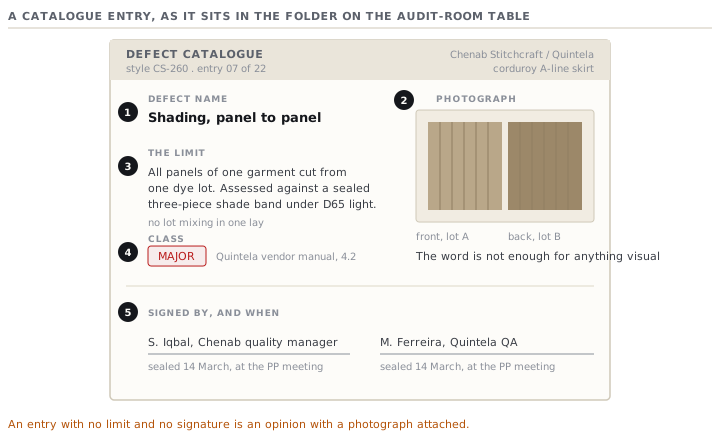
The last column is the one that gets left off, and it is the one that makes the catalogue a document rather than a file. A catalogue entry with no limit and no signature is an opinion with a photograph attached.
Prompt · Turn a tech pack's adjectives into limits
Before the pre-production meeting on a style whose quality notes are written in words like clean, even, consistent and no visible.
Act as a buyer's quality technologist who writes specifications for a living and has watched adjectives lose arguments in audit rooms. Here is the quality notes page from a tech pack: [PASTE IT]. The style is [STYLE] in [FABRIC AND CONSTRUCTION], made in [COUNTRY], selling at [RETAIL] in [MARKET], quantity [QTY]. My buyer's quality manual says [PASTE THE RELEVANT PART, OR SAY YOU DO NOT HAVE IT]. Do the following. First, list every requirement on that page that cannot be measured as written, and for each one say precisely which decision has been left open — visible to whom, over what length, under what light, compared with what. Second, rewrite each one as a requirement somebody can check, choosing deliberately between a number, a named comparison and a sealed limit sample, and say why you chose that form. Third, tell me which of them need a PHYSICAL limit sample rather than a sentence, and describe exactly what the acceptable-limit and reject-limit pair should show. Fourth, list what must be sealed and signed at the pre-production meeting for this style, as a checklist somebody can carry into the room. Fifth, for each rewritten requirement, tell me what the factory will find hard about it and whether that difficulty is a real cost or a habit. I would rather know before I write it into a contract than after. Sixth, flag any requirement on the page that is a market or safety rule rather than an appearance preference, and say plainly that it needs checking against the destination market's own rules rather than negotiated with me. Do not soften a requirement to make it easier to agree.
AI can make mistakes — check anything you act on.
Two complaints, one cause
Back to the 31 skirts. There is a second thing happening in the building that week, and nobody has connected them.
The cutting room has raised its own problem, to a different manager, on a different form. Consumption on CS-260 is running 4.6% over the marker: 1.36 m a skirt against the 1.30 m the cost sheet is built on. The fabric store is 588 m short with three days of cutting left. At USD 3.00 a metre that is USD 1,764 of fabric nobody costed.
Two complaints. One is a quality problem and one is a materials problem. Two people are working on them who have not spoken. They have the same cause.
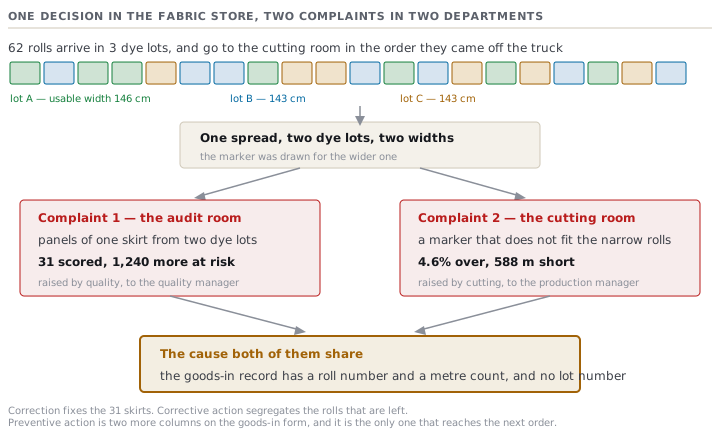
The bulk corduroy arrived as 62 rolls in three dye lots. Lot A measured 146 cm usable width. Lots B and C measured 143 cm. The fabric store issued rolls to the cutting room in the order they came off the truck, because that is how the goods-in book is arranged.
- So the spread mixed lots. A skirt whose front came off a lot A roll and whose back came off a lot B roll reads as two slightly different colours. That is the 31 skirts, and about 1,240 more are at risk because they were cut from the same mixed lays.
- The marker was made at 146 cm. On the 143 cm rolls it does not fit, so the cutter re-laid it narrower and lost pieces per lay. That is the 4.6%. And since 9,800 skirts were cut from lot B and lot C rolls, at 0.06 m a skirt over, that is where the 588 m went.
One decision, to issue rolls in arrival order, produced a shading defect and a consumption overrun. Neither department could see the other half.
Five whys, done properly
The technique is famous and usually performed badly. Five whys are asked until somebody says "operator error", which is not a cause. It is a place to stop looking. Done properly, it walks out of the department that noticed the problem.
- Why were 31 skirts shaded? Because their front and back panels came from different dye lots.
- Why did panels come from different lots? Because the spread mixed rolls from lot A and lot B.
- Why did the spread mix lots? Because the store issued rolls in the order they arrived.
- Why does the store issue in arrival order? Because the goods-in record has a roll number and a metre count and no lot number.
- Why does the record have no lot number? Because the goods-in book was designed years ago around a supplier who shipped single-lot orders, and nobody changed it when the supplier base changed.
Each answer is a fact you can check, and the fix at every level is different.
- Correction, which deals with what exists. Replace the 31 skirts and check the 1,240 at risk. Roughly USD 189 of downgraded garments plus USD 48 of sorting time.
- Corrective action, which stops it happening on this order. Separate the remaining rolls by lot, re-lay the marker for the 143 cm width, and issue by lot for the rest of the cut. One shift.
- Preventive action, which stops it happening on the next order. Add two columns to the goods-in record, lot number and usable width, and one rule to the issue procedure: one lot per lay, and a marker per width.
Add the two complaints together and QT-4471 lost USD 2,001: the fabric, the garments and the sorting. That is 9.5% of the order's entire margin. The preventive action is two columns on a form.
What the quality manual is for, and what an audit of it proves
Everything in this course is a decision about what this factory does when something specific happens: the four gates, the roving check, the catalogue, the limits, the goods-in columns. The quality manual is those decisions written down, so that the answer does not change with whoever is on shift. That is its entire purpose. It is not for the buyer, even though the buyer asks for it.
Which is why you should be careful about what a buyer's quality-system audit tells you. That audit reads the manual, checks that the records it describes actually exist, and scores the system. It is a real and useful thing. It is also a measurement of the writing, not of the goods. A factory can score highly on a system audit in the morning and fail a final inspection in the afternoon, and neither result contradicts the other. A good system makes good goods more likely and guarantees nothing. A factory that treats the audit score as its quality number has quietly swapped a hard measurement for an easy one.
Check yourselfAn inspector calls a fault that the tech pack does not mention at all. Is it a defect?Show the answer
Not by the definition in this lesson. But do not stop there, because the argument you can win is not always the argument you should have. Where the tech pack is silent, the approved sealed sample is the standard. Where that is silent too, the buyer's general quality manual is. Work down that order before you conclude that nothing was specified. If all three really are silent, you have a strong position and a weak product. Say so, ship the goods, and put the missing limit into the catalogue for the repeat order. A merchandiser who wins the argument and never fixes the specification will have the identical argument next season with a different inspector.
Check yourselfYour five whys ends at 'the operator did not follow the method'. What is wrong with stopping there?Show the answer
It is not a cause. It is a description of the symptom in different words. Ask the next question and it always opens. Was the method at the workstation? Was it in a language the operator reads? Was the operator trained on this operation, or moved to it that morning? Does the method still match the machine after the mechanic re-set it? Every one of those is a real cause with a real fix, and every one of them survives the operator leaving. If your corrective action is a conversation with a person, you have found a symptom. If it is a change to a form, a fixture, a setting or a procedure, you have probably found the cause.