Lessons · Lesson 1 of 3
Where a defect is found decides what it costs
Price one fault at every gate it could be caught at, and see why the cheapest gate is the one most factories skip.
Lesson 1 of 3 · 33 min
The situation
A flaw in cloth costs whatever has already been spent on that cloth. What has been spent depends on when somebody notices. This lesson takes one small fault and prices it at every gate it could have been caught at. The same fault costs many times more at the far end than at the near end. It also answers a fair question: why is a garment checked several times over?
Chenab Stitchcraft, Faisalabad. Purchase order QT-4471 from the Portuguese retailer Quintela: 16,200 women's corduroy A-line skirts, style CS-260, eight-wale cotton corduroy, three colours. FOB is USD 9.80, so the order is worth USD 158,760. Bulk cutting starts on a Monday. The vessel is booked for eleven weeks later.
Here is the cost sheet the factory built that price on, per skirt.
| Line | USD per skirt |
|---|---|
| Fabric, 1.30 m at USD 3.00 a metre | 3.90 |
| Trims — zip, waistband interlining, labels, hangtag | 0.72 |
| Cut, make and trim | 2.35 |
| Finishing, pressing and packing | 0.48 |
| Factory overhead | 1.05 |
| Made cost | 8.50 |
| Margin | 1.30 |
| FOB | 9.80 |
Hold on to two numbers. A finished skirt has USD 8.50 of the factory's money in it. The whole order carries USD 21,060 of margin, which is 16,200 skirts at USD 1.30 each. Everything in this course is measured against those two numbers.
Now a fault. Roll 19 of the bulk corduroy has a missing wale. A wale is one of the raised cords that run down the face of corduroy. On this roll a strip about 8 cm long has no pile, so the face shows a pale line. It is a real fault. Nobody at Chenab caused it. It will be found. The only question in this lesson is where.
One fault, six places to find it
That one missing wale can be found at six points between the fabric store and a customer's hand. It is the same 8 cm of ruined cloth every time. What changes is how much money has been spent on it by the moment somebody notices.
| Where it is found | What you actually pay for | USD | Times the first |
|---|---|---|---|
| Incoming fabric inspection, on the roll | 0.18 m of cloth the marker steps over | 0.54 | 1 |
| Cutting table, on the spread or the panel | one front panel re-cut: 0.62 m plus the cutter's time | 2.00 | 3.7 |
| Inline, after 11 of the 26 operations | the panel, plus half an hour of unpicking and re-sewing | 2.86 | 5.3 |
| End of line, garment complete and repairable | the panel, plus 74 minutes to take the skirt apart and rebuild it | 4.10 | 7.6 |
| End of line, not worth repairing | made cost 8.50, sold as a second for 2.40 | 6.10 | 11.3 |
| The buyer's distribution centre | FOB 9.80 charged back, plus a USD 6.50 handling charge | 16.30 | 30.2 |
The last column is the lesson. The same fault costs thirty times as much at the far end of the chain as at the near end. Not one of those steps involved anybody sewing worse.
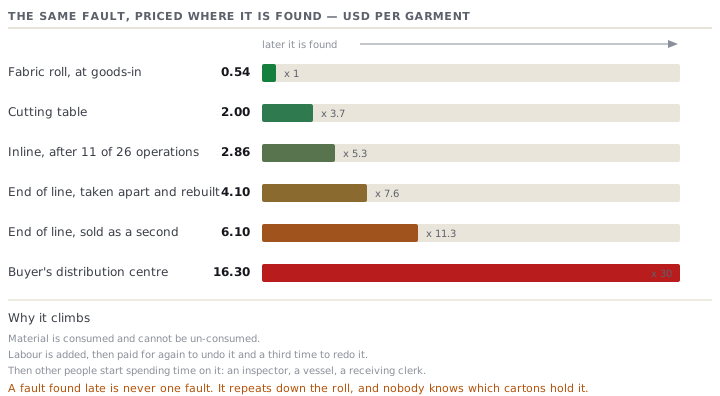
The chargeback figure at the bottom is invented, and it is worth saying so plainly. It is the shape of a real vendor manual, not a quotation from one. Every retailer sets its own handling charge and its own limits. The only number that matters to you is the one written into your buyer's vendor manual. Look it up before you need it. What is not invented is the shape of the ladder. The further a fault travels down the chain, the more finished work it destroys, and finished work is where all the money is.
Why the ladder climbs so steeply
Three things add up as a garment moves.
Material is consumed, and you cannot un-consume it. At the fabric gate the cloth around the fault is still cloth. You step over 18 cm of it and cut the rest. Once the panel is cut, that panel is a panel. You cannot turn it back into fabric, and the 0.62 m is gone.
Labour is added, and you never get it back. By operation 11 the skirt carries eleven operations of sewing. Removing the bad panel destroys the seams that held it. So you pay for that work twice: once to do it, once to undo it. Then a third time to redo it. This is why a rework minute costs more than a production minute at the same rate. Production minutes make garments. Rework minutes only put you back where you were.
Other people's time starts being spent. At the fabric gate one person is looking at cloth. At the final audit an inspector is billing a day, a booking has been made, a vessel has a cut-off, and a merchandiser in Portugal is waiting for a report. At the distribution centre a receiving clerk opens a carton. By then the cost of the fault is not a manufacturing cost at all. It is a commercial one, set by a contract you signed.
There is a fourth thing. It does not appear in the table and it matters more than any of them. A fault found late is never one fault. The missing wale on roll 19 was not a single 8 cm event. A weaving fault usually repeats down the roll. Found at goods-in, you know how many metres are affected before you cut anything. Found at the final audit, you know that some unknown number of the 16,200 skirts carry it, and you cannot tell which without opening every carton. Lesson 2 puts a number on that.
Four gates, four different questions
New merchandisers ask a fair question. If the garment is checked four times, why does anything get through? The four checks are not four attempts at the same thing. Each gate asks a different question, and no gate can answer another gate's question.
| Gate | The question it asks | What it looks at | What it cannot tell you |
|---|---|---|---|
| Incoming material | Is this input fit to cut? | Rolls, trims, lots, widths, shade against the approved swatch | Anything about sewing |
| Inline, roving | Is the process in control right now? | A few pieces at each operation, hourly | Whether the finished garment is good |
| End of line | Is this garment fit to pack? | Every garment, once | Why the fault happened |
| Final audit | Is this lot fit to offer? | A sample drawn from packed cartons | Anything you can still change cheaply |
Read the last column downwards. The incoming gate is blind to sewing. The inline gate looks at the operation, not at the garment: it can tell you that the hem folder on operation 9 has drifted, and it will never tell you whether skirt number 4,318 is good. The end-of-line gate looks at every garment and cannot tell you why any of them is wrong. And the final audit is the gate everybody in the building fears. It is the only one whose findings you can do almost nothing cheap about. By then the garments are made, pressed, folded, bagged and in cartons.
That is the honest answer to "why check the same garment four times". You do not. You check four different things, at four points where four different kinds of decision are still open.
The gate nobody runs
Look at the ladder again and notice which end of it is cheap. Then look at which end most factories staff.
A typical woven factory of this size has a dozen people at the end of the line and one or two in the fabric store. The fabric store is the first job cut when the order book is thin. That is exactly backwards, and the reason is not stupidity. It is visibility. The end-of-line table is where the buyer's auditor stands and where the defect log gets written. The fabric store is a room with rolls in it. Nobody has ever been praised for a fault they prevented, because a prevented fault leaves no trace.
The arithmetic is not close. On CS-260 the fabric gate costs USD 0.54 per fault caught. The same fault costs USD 6.10 if nobody finds it until the end of the line. So every fault stickered on a roll saves USD 5.56. Suppose Chenab put one more inspector in the fabric store for the twenty-three working days of this order. At USD 13.20 a day, that is a loaded cost of about USD 304, and the inspector pays for themselves at fifty-five faults. Price the same faults against the chargeback instead and the break-even is twenty. On 21,060 metres of corduroy, fifty-five faults is not a target. It is a slow morning.
Prompt · Price one defect at every gate it could be caught
Before you argue with a production manager about moving an inspector upstream, or the first time a buyer asks why your fabric store is staffed by one person.
Act as a garment factory quality manager who costs things rather than describing them. Build me a cost-of-defect ladder for one style. Order facts: buyer [BUYER], PO [NUMBER], style [STYLE], quantity [QTY] pieces, FOB [PRICE] per piece. My cost sheet per piece is: fabric [AMOUNT] using [METRES] at [PRICE] a metre, trims [AMOUNT], cut make and trim [AMOUNT], finishing and packing [AMOUNT], overhead [AMOUNT], margin [AMOUNT]. My loaded operator cost is [AMOUNT] an hour. The garment has [NUMBER] operations; the panel most likely to carry a fabric fault is [PANEL] and it uses [METRES]. Recovery price for a downgraded second is [AMOUNT]. My buyer's vendor manual charges back at [STATE THE RULE, OR SAY YOU DO NOT KNOW]. The defect I want costed is: [DESCRIBE IT AND WHERE IT COMES FROM]. Do the following. First, list every gate between goods-in and the buyer's distribution centre where this specific defect could be found, and say what makes it findable there. Second, cost the defect at each gate, showing the material, the labour and the third-party cost separately, and state every assumption. Third, express each gate as a multiple of the cheapest one. Fourth, tell me what the defect costs if the lot is held at final audit: sorting hours, re-inspection, and a discount at a percentage I give you. Show that total as a share of the order's whole margin. Fifth, tell me how many defects a single extra inspector at the cheapest gate would have to find to pay for themselves, using my real day rate and my real order length. Sixth, name the two numbers in your working that you are least confident about and tell me where in my own records I would find them. Do not give me ranges where an arithmetic answer is possible.
AI can make mistakes — check anything you act on.
What it costs when it goes all the way
The bottom of the ladder is a per-garment number, and it understates the damage badly. A fault that reaches the final audit stops being a per-garment problem. Suppose the audit on QT-4471 fails and the lot is held.
- 100% sorting of 16,200 skirts at 1.4 minutes each: 378 hours at USD 1.65 loaded, so USD 624.
- Re-inspection, booked and paid for again: USD 340.
- A discount to ship on the original vessel, at 4% of the order value: USD 6,350.
That is USD 7,314 on an order carrying USD 21,060 of margin. It is 34.7% of everything this order was ever going to earn, gone.
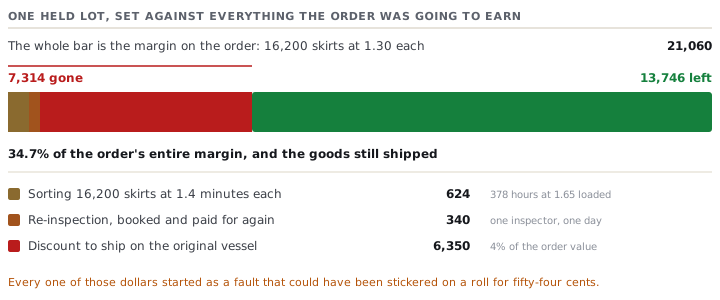
And that is the good outcome, the one where the buyer agrees to take the goods. What happens in the days after a rejected lot, and how those options are chosen between, is a subject of its own and belongs to the inspection course. What belongs here is the sentence underneath it: every one of those dollars started as a fault that could have been stickered on a roll for fifty-four cents.
Check yourselfYour fabric store finds nine faults on a delivery and the cutting room says 'do not stop the spread, we will cut around them'. What have you just agreed to?Show the answer
You have agreed to move those nine faults from the cheapest column of the ladder to a more expensive one, and you have agreed to it without pricing it. Cutting around a fault at the spreading table is not free. It is the USD 2.00 column, not the USD 0.54 column, because the spread is already laid and the panels beside the fault are affected. The bigger point is that "cut around them" only works for faults somebody has already stickered. The nine that were found are not the problem. The ones still on the roll are. The right answer is to keep spreading and keep inspecting the remaining rolls at the same time, so the cutting room knows before it lays the next spread rather than after.
Check yourselfA buyer's quality engineer asks why your end-of-line pass rate improved this month while the final audit result got worse. What is the likeliest explanation?Show the answer
That nothing about the garments changed and the end-of-line check got softer. An end-of-line pass rate is a statistic about the checkers, not about the line. It rises when they look less hard, and it rises fastest when the shipment is late and everybody knows it. The final audit is drawn from packed cartons by somebody with no shipping deadline. That is exactly why it is the one number you cannot improve by wanting it to improve. If those two numbers ever move in opposite directions, the honest first question is not about the line. It is about what the end-of-line table was told this month.