Lessons · Lesson 2 of 3
Defects, and who decides which is which
Sort a real defect list into critical, major and minor the way a buyer's manual does, and argue a disputed class while the inspector is still in the building.
Lesson 2 of 3 · 36 min
The situation
The count that decides whether a shipment sails is not a count of faults. It is a count of faults sorted into named degrees of seriousness. That is why two inspectors can write the same list and reach opposite verdicts. This lesson is about the sorting, and about who has the authority to name a fault. It ends with the disagreements that are worth having while the inspector is still in the building.
11:40 on the same day, the same 200 polos. The inspector's tally sheet says 17 majors, 22 minors, 0 critical. The factory QC manager's own sheet, from the pull he ran on Sunday over a different 200 pieces, says 8 majors, 31 minors.
Nobody is lying. They found broadly the same faults. They sorted them differently, and the sorting is where the money is. Seventeen majors against an accept number of 10 rejects the lot. Eight would have passed it comfortably. The garments did not change between Sunday and Tuesday. The sentence written next to each one did.
So the question is not "how many defects are there". It is who decides which class a defect belongs to, and on what authority.
The three classes
The definitions are old and short, and they are worth learning word for word, because every argument comes back to them.
- Critical. A defect likely to cause a hazardous or unsafe condition for the user, or one that breaks a mandatory regulation. It is not about how the garment looks. Almost every buyer sets critical at zero — one in the sample rejects the lot outright.
- Major. A defect likely to cause the garment to fail, or to materially reduce how usable it is for its intended purpose. In shop terms: a customer would notice it and not buy the piece, or would buy it and bring it back.
- Minor. A departure from the standard that does not reduce usability. A customer would probably not notice, or would notice and keep the garment anyway.
The practical test that survives a real inspection table is the shop-floor test. Would a consumer return this garment? Would it be refused at the till? Would it cut the price the retailer can charge? Yes to any of those, and it is a major.
| Defect | Class | Why |
|---|---|---|
| Broken needle fragment detected in the garment | Critical | Injury risk, and a metal-detection failure is a legal issue in most markets |
| Loose or insecurely attached button on childrenswear | Critical | Choking hazard under EN 71 and equivalent rules |
| Fibre content or care instruction wrong on the label | Critical | Mandatory labelling law in the EU and the US, whatever the garment looks like |
| Open seam of 3 cm at the side seam | Major | The garment fails in wear |
| Skipped stitches over 2 cm in visible topstitching | Major | Seen in the shop, and the seam is weak |
| Measurement outside the agreed tolerance by more than double | Major | The garment will not fit the size it is labelled |
| Shade variation between panels of the same garment | Major | Visible on the rail, and the commonest cause of a DC rejection |
| Oil stain 5 mm on the front chest | Major | Front of garment, unsaleable |
| Oil stain 5 mm inside the back facing | Minor | Not visible in wear |
| Untrimmed thread ends, 2 or 3 per garment | Minor | Cosmetic, removable by the consumer |
| Slightly uneven topstitch over 4 cm, hem, back | Minor | Visible only on inspection |
| Puckered collar seam, visible when hung | Major | It is the first thing a customer sees on a polo |
Notice the two oil stains. Same defect, same size, two classes. That is not inconsistency. It is the zone system, and it is the single most useful thing to understand about classification.
Zones: why the same fault is two different defects
Most buyer quality manuals divide a garment into zones, by how visible each area is in normal wear and on the hanger.
| Zone | Where | How a defect is treated |
|---|---|---|
| A | Front body, collar, placket, cuffs, front of sleeves — everything seen head-on | Strictest. A cosmetic fault here is usually a major |
| B | Back body, sides, back sleeves, under the collar | Moderate. The same fault is often one class lower |
| C | Inside facings, pocket bags, inside seams, unseen underlays | Loosest. Cosmetic faults are minors unless they affect function |
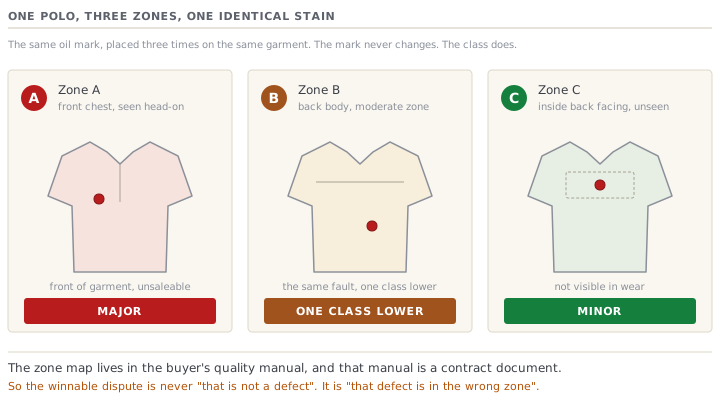
A 5 mm stain, an uneven stitch, a slight shade difference: all of them change class purely by zone. A polo is a zone-A-heavy garment, because a polo is worn and photographed from the front. That is why polo inspections are harder than the same factory's inspections of a fleece pull-on.
Who decides
Not the inspector, and not you. The authority runs in this order.
- The buyer's quality manual, issued with the vendor agreement. It holds the defect classification list, the zone map, the measurement tolerances and the AQL. It is a contract document. If you have never read your biggest customer's manual end to end, read it this week.
- The approved sealed sample, signed by both parties. Where the manual is silent, the sealed sample is the standard.
- The purchase order and the tech pack, for anything specific to this style.
- The inspector's judgement, and only where all three above are silent.
Which is why the same faulty seam is a major at one buyer and a minor at another, and both are correct. A discounter selling a polo at EUR 9.99 writes a manual that tolerates cosmetic variation, because their customer accepts it and their margin does not survive rework. A premium brand at EUR 79 calls the same skipped stitch a major, because their customer returns it. A defect class is a commercial position, not a physical property of the garment. The seam has not changed. What shipping it costs has.
Two more things move the line. Product category: identical hardware is a minor on a men's jacket and a critical on a toddler's. Destination market: a fibre-content label that is merely wrong in one market breaks the law in the EU and the US, which is why labelling faults are so often critical.
The argument, and how to run it
When your count and the inspector's count differ, you have a short window. He is in your building, the garments are on the table, and nothing has been signed. Once he leaves, you are arguing with a report.
Never argue the total. Saying "seventeen is too many" tells everyone you have not looked at the pieces. Argue the individual garment. Ask for the rejected pieces to be laid out, and go through them one at a time with the manual open at the classification page.
The disputes that are really winnable are narrow and specific.
- Zone. The fault is in zone B or C and has been scored as zone A. Show the zone map.
- Tolerance. A measurement is out of spec but inside the agreed tolerance, or the inspector measured a different point than the tech pack names. Measure it together.
- Lighting and metamerism. Shade calls made under the wrong lamp. The manual will name D65 or TL84. Ask for the light box and re-check under the one it names.
- Wrong standard. The inspector is working from last season's tech pack, or does not have the sealed sample in the room.
- Double counting. One garment with an open seam and a broken stitch on the same seam, scored as two majors. Most manuals count the piece, not the fault.
The disputes that are not winnable, and should not be attempted: a real critical, a fault the manual names outright, and anything where your argument is that the buyer will not notice.
If you cannot settle it, escalate before he signs. Photograph every disputed piece next to a ruler and the sealed sample. Email the buyer's QA manager with the pieces numbered. Ask the inspector to record the dispute on the report itself. A disagreement noted on the report can be reviewed. A disagreement raised two days later, after a signed report has reached the buyer, is a complaint about a decision.
Prompt · Build the case on a disputed defect classification
While the inspector is still in the building and the rejected pieces are still on the table.
Act as a senior garment quality manager preparing to challenge a defect classification with a third-party inspector who is still on site. Buyer [BUYER], style [STYLE], PO [NUMBER]. The inspection result is [MAJORS] majors and [MINORS] minors against accept numbers of [AC MAJOR] and [AC MINOR] on a sample of [N]. Here is the inspector's defect list, one line per piece, with the fault, its location on the garment and the class he gave it: [PASTE THE LIST]. Here is what the buyer's quality manual says about classification and zones: [PASTE THE RELEVANT PAGES OR SUMMARISE THEM]. Tolerances from the tech pack for any measurement defects: [PASTE]. Go through the list one piece at a time and sort it into three groups: classifications I should accept without argument, classifications that are genuinely disputable and on what specific ground (zone, tolerance, illuminant, wrong standard, double counting), and classifications I might dislike but should not contest. For each disputable line, write the exact sentence I should say to the inspector and name the document I should have open when I say it. Then tell me what the count becomes if every disputable line is re-scored my way, and whether that changes the verdict. Be honest where my case is weak: I would rather lose an argument now than lose the account later.
AI can make mistakes — check anything you act on.
Check yourselfAn inspector scores a 4 mm oil mark on the inside of a pocket bag as a major. Is he right, and what do you do?Show the answer
Almost certainly not, and this is a winnable dispute. A pocket bag is zone C in every manual I have seen: invisible in wear, cosmetic, and it does not affect function, so it is a minor. Open the buyer's manual at the zone map, show him the zone the pocket bag sits in, and ask him to re-score it while the garment is on the table. If he disagrees, ask him to note the disputed piece on the report, and photograph it. What you do not do is accept it quietly and then complain after the report is signed.
Check yourselfYour QC found the same faults as the third party but classed six shade-variation defects as minors. The manual calls them majors. Whose count goes on the report?Show the answer
The buyer's manual decides, so they are majors and the report will say seventeen. Your house standard has no authority over a contract document. The lesson is not about this inspection, which is already lost. It is that the gap existed for the whole production run. Every one of those six garments passed end-line QC because your own people were told to let them through, which means the true rate in the unlooked-at 8,200 is far higher than the sample suggests.