Lessons · Lesson 3 of 3
The failed inspection
Work through the real days after a rejected lot — sorting, re-booking, the discount conversation and the clearance signature — with the cost of each option in front of you.
Lesson 3 of 3 · 35 min
The situation
A shipment that fails its final check has not been declared bad. It has been declared unproven, and that difference matters. What follows is a set of contract consequences, not a verdict on the sewing. This lesson walks the days after such a failure, in the order somebody has to live them. Each choice is set beside its price.
16:20, 30 September. The inspector closes his sheet: 17 majors against an accept number of 10. Lot 8,400 pieces, code letter L, sample 200, AQL 2.5 major and 4.0 minor. Minors came in at 22 against an accept of 14, so the lot fails on both classes. Result: REJECTED.
He signs the report, photographs the defective pieces, emails the file to Verhoeven's sourcing office in Amsterdam at 17:05, and leaves. The vessel is on 12 October, port cut-off the 8th. It is now the evening of the 30th.
Say this out loud in the room, because half the factory will get it wrong: a rejected lot is not a claim that the goods are bad. It is the sampling plan reporting that the defect rate in the sample was too high to fit the agreed quality level. What it sets off is a chain of contract consequences, and every one of them costs money and days. What it does not do is give anybody permission to panic.
The days that follow
Somebody has to do these things, in this order, and by Wednesday morning.
- Get the defect breakdown by type, not the verdict. Seventeen majors: six shade variation between panels, four skipped stitches in the collar topstitch, three open seams at the side, two measurement failures on XL body length, two front-chest stains.
- Decide whether that is one problem or five. On PS-118 it is two: a shade-lot control failure at cutting, and a collar operation nobody rebalanced.
- Tell the buyer before the buyer tells you. Verhoeven already has the report. The email that matters is the one that arrives at 08:00 on 1 October with a plan in it, not an apology.
- Start sorting. Sorting is the only option common to every path forward, so it starts before the commercial decision is made.
Sorting and rework: the real arithmetic
100 percent re-inspection means every one of the 8,400 pieces is opened, checked against the defect list, and sorted into pass, repair and reject. Then repaired, re-pressed, re-polybagged and re-cartoned.
At 2.5 minutes a piece for inspect-and-sort on a polo, 8,400 pieces is 21,000 minutes, or 350 QC hours. Fourteen QCs at ten hours a day clear that in 2.5 days. Add the repair line. 17 majors in 200 is 8.5 percent, so expect roughly 700 defective pieces across the lot. Perhaps 600 of those can be repaired: a re-sew, a re-press, a stain wash. The other 100 cannot, because a shade-mismatched panel cannot be repaired and a front-chest oil mark rarely comes out.
| Line | Amount |
|---|---|
| Sorting and rework labour, 22 people over 3 days | USD 620 |
| Repacking: polybags, cartons, tape, re-pressing | USD 600 |
| Third-party re-inspection fee, 2 man-days at USD 350 | USD 700 |
| The failed inspection, charged back to the factory | USD 350 |
| Pieces written off, about 100 at USD 3.90 cost | USD 390 |
| Total direct cost of the sort | USD 2,660 |
Against an order value of USD 40,740 and a margin at 11 percent of USD 4,481, sorting alone eats 59 percent of the profit on this order. And it has not yet bought a single day of time.
The re-inspection booking is the constraint
This is the part that decides the vessel, and it is not in the factory's control. A third-party re-inspection has to be booked, and in the Bangladesh peak between September and November the agencies run five to ten working days out. Verhoeven's agent offers 7 October — five working days. Port cut-off is the 8th.
That is not a plan, it is a coin toss. If the re-inspection passes on the 7th, the cartons stuff on the 8th and the container makes the 12th with nothing to spare. If it fails again, the vessel is gone, and the next sailing to Rotterdam is eight days later.
And the re-inspection is a fresh, full sample drawn from the re-packed lot. It is not a re-check of the defects you fixed. The sorted lot is a new lot presented for judgement. Worse, the standard's own switching rules apply. After a rejection, a buyer is entitled to move you to tightened inspection, where code L at AQL 2.5 tightens from accept 10 and reject 11 to accept 8 and reject 9. Two rejections in five consecutive lots is the usual trigger. Five consecutive accepted lots under tightened brings you back to normal.
The commercial conversation
By 1 October there are four honest options. The merchandiser's job is to put them in front of the decision-maker with the numbers attached, not with adjectives.
| Option | Direct cost | Ships on | What you are betting |
|---|---|---|---|
| Sort, re-inspect 7 Oct, sea on the 12th | USD 2,660 | 12 Oct if it passes | That the re-inspection holds and the slot does not move |
| Sort, then air freight 4,200 kg chargeable at USD 5.20 | USD 24,500 | On time | Nothing — but it costs 5.5 times the entire margin |
| Ship as is under a written concession at 6 percent | USD 2,444 | 12 Oct | That the DC does not find what the inspector found |
| Split: sea-ship the 6,000 sorted-clean navy and white, hold the grey | USD 2,000 plus a part-shipment charge | 12 Oct for 6,000 | That the buyer accepts a part shipment |
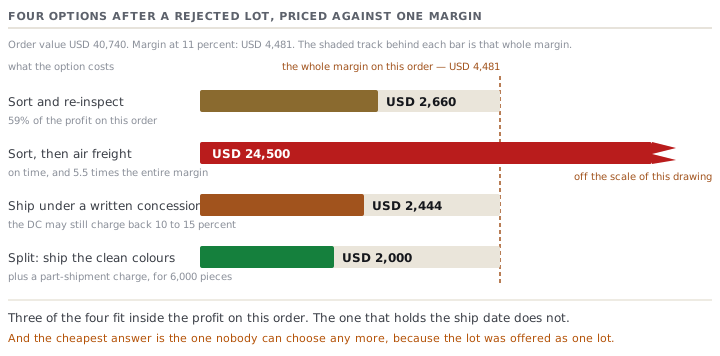
The discount conversation is the one that gets misunderstood. When a buyer offers to take a failed lot at 5 or 6 percent off, they are not being generous and they are not waiving anything. They are pricing the risk they now expect to carry at the distribution centre. In most vendor agreements that discount sits on top of their right to charge back defects found later. Read the concession wording. If it does not say the words "in full and final settlement of the defects identified in inspection report number VH-2214-01", it settles nothing.
Option four is usually the best one, and it is usually not on the table, because nobody thought about lot structure until it was too late. This is exactly the split from lesson one. Had the three colours been offered as three lots, the shade failure would have been quarantined in one 2,400-piece lot, and 6,000 pieces would have shipped clean on the original inspection.
Prompt · Cost the options after a lot is rejected
The evening a pre-shipment inspection fails and somebody has to choose between sorting, air freight, a discount and a part shipment before morning.
Act as a senior garment export merchandiser. A pre-shipment inspection has just rejected a lot. Facts: buyer [BUYER], PO [NUMBER], style [STYLE], [QTY] pcs, FOB [PRICE] per piece, order value [VALUE], my cost per piece [COST], margin [VALUE AND PERCENT]. Inspection: sample [N], [MAJORS] majors against accept [AC MAJOR], [MINORS] minors against accept [AC MINOR], critical [NUMBER]. Defect breakdown by type: [PASTE]. Ship date on board [DATE], port cut-off [DATE], today is [DATE]. Next re-inspection slot offered: [DATE]. Sorting rate on this garment [MINUTES] minutes per piece, available QC headcount [NUMBER], loaded labour cost [RATE] per person per day. Air freight rate [RATE] per kg, [PCS] pieces per carton, carton dimensions [DIMENSIONS], garment weight [KG]. Late-delivery clause: [PASTE THE EXACT WORDING]. Chargeback terms in the vendor agreement: [PASTE]. Give me: (1) the defect breakdown reduced to the number of distinct root causes, and which are repairable and which are write-offs; (2) each option priced in dollars and as a percentage of order margin, including sort and re-inspect, sort and airfreight, ship under written concession, and part shipment of the clean colours; (3) the chargeable weight calculation for air, using volumetric weight, not actual; (4) what the concession document must say and who at the buyer must sign it for it to protect me; (5) which option you would choose and the single assumption that decision rests on. Do not recommend shipping under concession without stating what it costs me if the distribution centre finds the same defects.
AI can make mistakes — check anything you act on.
The clearance decision, and the signature
Whatever is chosen, the goods do not move until somebody clears them. On a passed lot that is a formality. On a failed lot it is a decision with a name on it, and this is the part of the job people avoid.
Clearing a failed lot to hold a ship date is a decision somebody signs for. Not a phone call. Not "the buyer's merchandiser said on WhatsApp that it is fine". A concession, deviation or shipping authorisation is a written document. It names the inspection report. It states the defects and their counts. It states what is being waived. And it carries the name, title and date of somebody at the buyer with the authority to waive it. That is normally the QA manager or the sourcing head, never the assistant merchandiser who is easiest to reach on a Thursday evening.
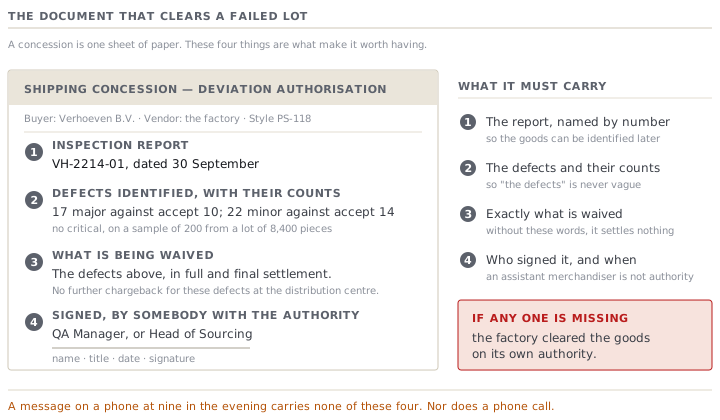
If that document does not exist, the factory has cleared the goods on its own authority, and owns everything that follows.
What it costs when the carton is opened
The reason the signature matters is what sits on the other side of it. If a cleared lot fails at Verhoeven's DC in Tilburg, the sequence is well established, and none of it is negotiable after the fact.
- Chargeback. Typically 10 to 15 percent of the invoice value plus a handling fee per carton. On USD 40,740 that is USD 4,000 to USD 6,100 — the whole margin, and then some.
- Sorting at destination, billed at European labour rates, usually EUR 1.50 to 2.50 a piece. On 8,400 pieces that is more than the goods are worth.
- Return to vendor or destruction, at the factory's cost, for a lot the DC will not handle.
- The vendor scorecard. This is the expensive one, and it never appears on an invoice. A rejected shipment moves a supplier from green to watch status. That means General Level III on every future PO, or 100 percent pre-shipment inspection at the factory's own cost for a season or two. Then the next season's placement is smaller, and nobody sends an email explaining why.
Set that against the USD 2,660 sort and the five days. The sort is almost always the right answer. The factories that get it wrong are not bad at arithmetic. They are looking at a ship date on a wall and a customer on the phone, and nobody in the room has written the other column down.
Check yourselfThe buyer offers to take the failed lot at a 6 percent discount to hold the vessel. It is 1 October and sorting would take five days. What do you check before answering?Show the answer
Three things, in this order. First, the concession wording: does it settle the identified defects in full and final settlement, or does the buyer keep the right to charge back at the DC? A 6 percent discount worth USD 2,444 against a possible 15 percent chargeback worth USD 6,100 is not a settlement, it is a deposit. Second, who is signing it, and do they have the authority — a QA or sourcing manager, in writing, quoting the inspection report number. Third, what the defects actually are. Six shade variations in a sample of 200 means visible banding on the rail, which is exactly the defect a DC catches and a discount will not survive. Skipped stitches you might ship under concession. Shade banding you sort.
Check yourselfAfter sorting, the re-inspection on 7 October finds 9 majors. Does the lot pass?Show the answer
It depends on the severity the buyer has moved you to, and you must settle that before the inspector arrives, not after. Under normal inspection, code L, sample 200, AQL 2.5, accept is 10 and reject 11 — nine majors passes. Under tightened inspection, which a buyer is entitled to apply after a rejection, accept is 8 and reject 9 — nine majors fails. Same nine garments, same day, opposite outcome. Ask the buyer in writing which severity applies to the re-inspection, on 1 October, while you still have time to sort to the harder number.