Lessons · Lesson 1 of 3
What AQL is, and what it is not
Read a sampling plan off the standard for a real lot, and know exactly what an accepted lot promises and what it does not.
Lesson 1 of 3 · 34 min
The situation
Before a container leaves a factory, somebody arrives with a table and a checklist. They pull a small number of garments out of the packed cartons and look at them. On that basis the whole shipment sails, or it does not. This lesson shows you where that small number comes from. It also settles what an accepted batch promises, and what it does not.
30 September, 09:00, a finishing floor in Chattogram. PO VH-2214 for the Dutch retailer Verhoeven: 8,400 men's piqué polos, style PS-118. Navy 3,600, white 2,400, heather grey 2,400. FOB USD 4.85, order value USD 40,740. On board 12 October, port cut-off the 8th.
The third-party inspector signs in at reception. In his first twenty minutes he does four things, and those four things decide the day. He confirms what the lot is. He counts the cartons and checks that at least 80 percent of the order is packed. He looks up a code letter. Then he pulls some garments off the pile and carries them to a table.
Everything after that is arithmetic. If you do not know where those numbers come from, you spend the day watching somebody else decide whether your container sails.
A sampling plan is three numbers
AQL stands for Acceptance Quality Limit. In apparel, an AQL inspection means one standard: ISO 2859-1. In the United States the same standard is published as ANSI/ASQ Z1.4. It is a set of tables. For a normal single-sampling inspection you walk those tables in one direction only.
- Take the lot size. That is how many pieces are being offered for judgement.
- Look up the sample size code letter for that lot, at the agreed inspection level.
- Read across to the agreed AQL. Take the sample size and the accept and reject numbers.
The accept number is the largest number of defects that still passes the lot. The reject number is always one higher. There is no gap between them and no room for judgement. At accept 10 and reject 11, ten majors pass the lot and eleven fail it.
Here is the part of the table an apparel inspection really lives in: General Inspection Level II, normal severity, single sampling.
| Lot size | Code letter | Sample size | Accept / Reject at AQL 2.5 | Accept / Reject at AQL 4.0 |
|---|---|---|---|---|
| 151 – 280 | G | 32 | 2 / 3 | 3 / 4 |
| 281 – 500 | H | 50 | 3 / 4 | 5 / 6 |
| 501 – 1,200 | J | 80 | 5 / 6 | 7 / 8 |
| 1,201 – 3,200 | K | 125 | 7 / 8 | 10 / 11 |
| 3,201 – 10,000 | L | 200 | 10 / 11 | 14 / 15 |
| 10,001 – 35,000 | M | 315 | 14 / 15 | 21 / 22 |
Working the real lot
Verhoeven inspect at General Level II, AQL 2.5 major and 4.0 minor, zero critical. That is the commonest specification in the trade, and it is what the PO says.
8,400 pieces sits in the 3,201 to 10,000 band. So the code letter is L and the sample size is 200. At AQL 2.5 the numbers are accept 10, reject 11. At AQL 4.0 they are accept 14, reject 15. Zero critical means what it says: one critical defect in the sample rejects the lot.
Two hundred garments out of 8,400. That is 2.4 percent of the order. On it rest USD 40,740 and a vessel.
Now the part most merchandisers have never thought about. The lot is a decision, not a fact. Verhoeven allow the three colours to be offered as one lot of 8,400. That is what the factory wants: one sample of 200, one verdict. Offer them as three lots instead and the arithmetic changes completely. Navy at 3,600 pieces is still code L and 200 pieces. White and grey at 2,400 each drop to code K: 125 pieces, accept 7 and reject 8. Total sample 450 instead of 200. Three separate verdicts, and three chances to fail.
That is the trade-off. One big lot is cheaper and faster, but if it fails, all 8,400 pieces are held. Three lots cost more inspection and are more likely to produce at least one rejection, but a failure quarantines 2,400 pieces while the other 6,000 ship. If you already know one colour ran badly, splitting the lot is not a technicality. It is how you save two thirds of the shipment.
The level is a dial, and it is negotiable
The inspection level sets how hard the buyer is looking. General Level II is the default. Level I pulls a smaller sample, for a supplier with a good record. Level III pulls a bigger one, when the buyer has stopped trusting you. Special levels S-1 to S-4 exist for checks that are slow or destructive, such as a wash test or a metal-detector pass.
| Inspection level | Code letter for a lot of 8,400 | Sample size | Accept / Reject at AQL 2.5 |
|---|---|---|---|
| General Level I | J | 80 | 5 / 6 |
| General Level II | L | 200 | 10 / 11 |
| General Level III | M | 315 | 14 / 15 |
A supplier moved to Level III after two bad seasons is not being punished with a stricter standard. The AQL has not moved: it is still 2.5. They are being looked at harder. A bigger sample is much better at finding a process that is really running at 4 percent.
Small lots behave oddly, and it catches people out. A 40-piece sample order at AQL 2.5 lands on code E: sample 13, accept 0 and reject 1. One major defect and the lot is rejected. And when the plan's sample size would match or exceed the lot, the standard says inspect 100 percent. A ten-piece pre-production shipment is not sampled at all.
What AQL is not
Here is the sentence to carry out of this lesson. AQL is a decision rule about a LOT. It is not a promise about a garment.
An accepted lot does not mean 8,400 good polos. It means this: on a sample of 200, the number of defects found was consistent with a process running at 2.5 percent majors or better, at the confidence the plan gives. Nothing in that sentence is about the garment in a customer's hand in Tilburg.
The way to feel this is the operating-characteristic curve. It shows the chance a lot is accepted at different true defect rates. For our plan, sample 200 and accept 10:
| True major rate in the lot | Expected majors in a sample of 200 | Chance the lot is accepted |
|---|---|---|
| 1.0 percent | 2 | about 100 percent |
| 2.5 percent | 5 | about 99 percent |
| 4.0 percent | 8 | about 82 percent |
| 5.0 percent | 10 | about 58 percent |
| 7.0 percent | 14 | about 18 percent |
| 10 percent | 20 | about 1 percent |
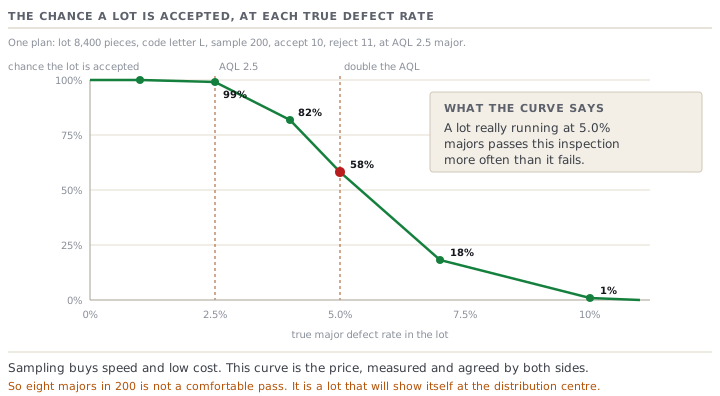
Read the fourth row again. A lot really running at 5 percent majors — double the AQL — passes this inspection more often than it fails. That is not a flaw in the standard. Sampling buys speed and low cost, and it pays for them with risk. This is that risk, measured, and agreed by both parties on the day they wrote AQL 2.5 on the purchase order.
Which is why the accept number is not a target. Ten majors in 200 is the edge of a lot running at about 5 percent. Find eight and you have not passed comfortably. You have passed a lot that will show itself at the distribution centre.
Check yourselfA lot of 2,000 pieces is offered at AQL 2.5 major, General Level II. The inspector finds 8 majors. Accept or reject?Show the answer
Reject. 2,000 sits in the 1,201 to 3,200 band, so the code letter is K and the sample size is 125, with accept 7 and reject 8. Eight majors is the reject number, not the accept number. The accept number is the largest count that still passes. This is the commonest misreading of the table, and it costs a shipment every season.
Check yourselfYour inspection passes at 9 majors against an accept number of 10. What have you actually learned about the order?Show the answer
That the lot fits a process running somewhere near 4 to 5 percent majors, and that roughly 300 to 400 defective garments are probably sitting in the cartons, unlooked at. The lot passed and the buyer must take it. That is a legal fact, not a quality one. Ask for the defect breakdown by type before you celebrate. Nine majors from one operation is a sort-and-fix job you can finish in a day. Nine spread across seven defect types is a process nobody is controlling.