Lessons · Lesson 3 of 3
The concession ledger, and the price review you have already had
Price four seasons of small favours on one account, read the total against the discount the buyer asks for, and build a counter-offer out of things that cost you less than they are worth.
Lesson 3 of 3 · 35 min
Thursday 22 October, the annual review
Over a few years a factory gives its customer dozens of small things. A different fold. A delay absorbed with overtime. An extra round of colour trials. A bill settled late. Each one is granted alone on a busy afternoon, and each one costs less than the argument would. So none of them is written down or charged for. This lesson adds four seasons of them up on one account.
PO TQ-6157 shipped on 21 August and arrived in Hamburg on schedule. Rania Shalaby is now in a meeting room with Ilse Renner and Georg Petzold. They are there to price the AW27 programme: 15,400 pieces of QN-514, the successor to QN-509, at the same FOB of USD 12.85. That is USD 197,890.
Georg opens with one sentence. We need 4% across the flannel programme.
Every merchandiser meets this sentence. What decides the next twenty minutes is not skill at arguing. It is whether you can put a dated list on the table.
What 4% actually is
| Per piece | On the AW27 programme | |
|---|---|---|
| FOB | USD 12.85 | USD 197,890 |
| Cost to make | USD 11.38 | USD 175,252 |
| Margin today | USD 1.47 | USD 22,638 |
| The discount asked | USD 0.514 | USD 7,915.60 |
| Margin after | USD 0.956 | USD 14,722.40 |
A discount of 4% on the price is a discount of 34.97% on the margin. It takes the return on this style from 11.44% of the FOB to 7.44%. That gap is the most useful piece of arithmetic in a price review. Put it in the conversation as a fact, not as a complaint. Buyers work in percentages of price because that is what their systems show them. Most of them have never seen the same number expressed against the margin it actually comes from.
But knowing that does not win anything on its own. It is a defensive fact. The offensive one is on the next page.
Four seasons of small favours
Every account builds up concessions that were never priced and never recorded. Each one arrived alone, on a busy afternoon, worth less than the argument would have cost.
| Date | What was given | Who asked | Cost |
|---|---|---|---|
| 14 March 2025 | Hanging pack instead of flat pack, 4,320 pieces at USD 0.11 | Ilse Renner | USD 475.20 |
| 22 July 2025 | Six days of approval delay absorbed with overtime rather than moving the ship date | Baumgart design | USD 3,180 |
| 9 February 2026 | Size ratio changed after cutting had started; one colour re-marked and re-cut | Baumgart planning | USD 2,240 |
| 11 June 2026 | Eleven lab dips beyond the four contracted rounds, at USD 45 | Baumgart design | USD 495 |
| 3 September 2026 | Payment extended from 30 to 60 days on an invoice of USD 92,000, at a borrowing rate of 14% | Baumgart finance | USD 1,058.63 |
| Total | USD 7,448.83 |
The discount being asked for is USD 7,915.60. The concessions already given, unpriced and unrecorded, are USD 7,448.83. That is 94.10% of it.
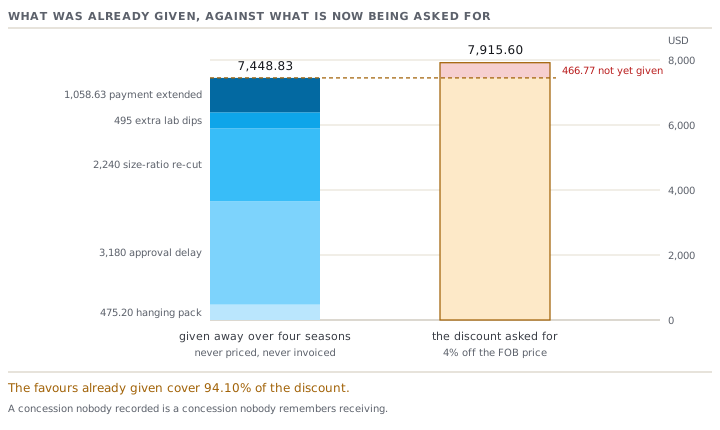
Shebin has already granted almost the whole of next year's discount, one favour at a time, over four seasons. On the morning of the meeting it could not have told you so.
What belongs in a ledger, and what does not
A ledger that records everything is not a negotiating record. It is a list of grievances, and a buyer can smell one from the other end of a table. So every entry carries a cause, and the cause decides what the entry is for.
- The buyer asked. The hanging pack, the size-ratio change, the payment extension. This is currency. It was a request, you granted it, and it has a price.
- The buyer's process caused it. The six-day approval delay, the extra lab dips. This is also currency, and it is the stronger kind. Nobody had to decide anything. Their calendar simply spent your money.
- The market moved. The USD 4,608 of yarn on TQ-6157, absorbed after the request was refused in May. This is context, not currency. You can name it to explain where the margin went. Presenting it as something you gave them is a stretch, and it will be treated as one.
- Your own failure. The USD 368.64 of stock-service cloth in July, caused by the mill's weaving fault. The mill is Shebin's supply chain, so this is Shebin's problem. It does not go in the ledger at all. An entry like that turns the whole document from a record into a confession, and one of them is enough to make a buyer discount the other five.
Two more rules of hygiene. Enter it the week it happens, in one line, with the date and the name of the person who asked. A ledger rebuilt from memory in October, in time for a meeting, is a document nobody believes, including you. And price it at the time, because the cost of a re-cut is obvious in February and a guess in October.
Prompt · Price the concession ledger and build the counter-offer
Two weeks before a price review, and never on the morning of one.
Act as a commercial manager at a garment supplier who negotiates against buying offices and keeps records. Help me build and read a concession ledger for one account. Account facts: buyer [BUYER], seasons covered [LIST], programme value this season [AMOUNT], next season quantity [QTY] pieces at FOB [PRICE], cost to make [AMOUNT] per piece. The discount now being asked for is [PERCENT]. Here is everything I gave away that I can remember, with dates where I have them: [LIST EACH ONE — WHAT, WHEN, WHO ASKED, ANY COST I KNOW]. My borrowing rate is [PERCENT] a year. Do the following. First, put every entry into a table with a date, what was given, who asked, a cost in money, and whether it was ever invoiced — and where I could not give you a cost, tell me exactly what to look up to work it out. Second, tag each entry by cause: the buyer asked, the buyer's process caused it, the market moved, or it was our own failure — and strike out everything in the last category, because it does not belong in this document. Third, total only the entries that are currency, and compare that total with the discount being asked for. Fourth, show the discount as a share of my margin as well as a share of price, per piece and on the programme. Fifth, build me a list of things that cost me little and are worth a lot to this buyer, each with my cost in money and the reason it matters to them, and the same list in reverse. Sixth, write a counter-offer: a smaller reduction, conditional on named changes that recover more than the reduction gives away, with the arithmetic shown, and flag any recovery I must confirm in writing with a supplier BEFORE I offer it. Seventh, name the two entries I should mention out loud and tell me to leave the rest in the file. Never invent an entry or a cost I did not give you.
AI can make mistakes — check anything you act on.
What to trade: the things that cost you least
A price review made only of yes and no has one outcome, and it is usually no for you. The way out is to know which things are cheap on your side and expensive on theirs. The only way to know the second half is to have asked.
| What Baumgart could have | What it costs Shebin | Why it is worth more to them |
|---|---|---|
| A photographed work-in-progress report every Monday, cut, sewn and packed against plan | forty minutes a week, no cash | It is the number their planner is asked for on Tuesday. Today they get it by chasing. |
| The first 600 pieces of the lead colour finished three weeks early | USD 343.80 for an out-of-sequence changeover and courier | Their range presentation and press dates are fixed and currently met with a sample-room piece. |
| Tolerance widened in their favour, from 3% either way to over-delivery only | nothing on a colour that sells | It removes their short-ship exposure entirely. |
| A named QA contact reachable on inspection day | nothing | It removes a day from every inspection query. |
| Three weeks of greige held for the repeat programme | USD 106.32 of money on USD 13,200 of cloth, plus the risk of holding cloth nobody reorders | It turns a repeat that takes nine weeks into one that takes four. |
Now read the same table the other way. This is the half most merchandisers never build.
- A discount of 4% costs Shebin USD 7,915.60. It moves Baumgart's landed cost by USD 0.514 a piece, and they will not change a retail price for that.
- Hanging pack costs USD 0.11 a piece, which is USD 1,694 across AW27. When Rania finally asked in October, the answer was that the Hamburg warehouse re-hangs everything on its own hangers anyway.
That second line is four seasons old. It cost USD 475.20 the first time and nobody ever questioned it, because nobody asked the only question that mattered: what does this do for you.
The counter-offer
Rania does not say no and does not say yes. She puts a trade on the table.
A reduction of 2% on QN-514, which is USD 3,957.80, conditional on three things.
- The PO confirmed, with the colour and size split, by 15 December. That puts Shebin into Karasu's January yarn contract instead of buying at market price in March. Karasu confirmed in writing on 16 October: USD 0.14 a metre off for a January booking. On 2.00 m and 15,400 pieces that is USD 4,312.
- The size ratio frozen at pre-production approval, with later changes charged at the re-cut cost. That removes the USD 2,240 risk.
- Lab dips beyond four rounds charged at USD 45. That removes the USD 495 risk.
Here is the arithmetic. Shebin gives USD 3,957.80 and recovers USD 4,312, which leaves it USD 354.20 ahead before either risk is counted. Baumgart gets a price reduction it can show its director, and gives up nothing it values: a confirmation date, a freeze at a milestone that already exists, and a charge for the eleventh lab dip.
One condition on the whole move, and it is not optional. The USD 0.14 has to be in writing from the mill before you offer it. Trade a discount you have not secured and you have sold something you do not own. You will discover it in January, when the mill tells you the January contract closed on the twentieth.
The two-entry rule
You never read the ledger out. Seven dated entries delivered across a table is a grievance. The person opposite stops hearing the numbers and starts defending their colleagues.
Name two: the most recent and the most expensive. On this account that is the eleven lab dips in June, USD 495, and the six days of approval delay absorbed in July of last year, USD 3,180. Both with a date, both with the department that asked. Then stop. Let the rest of the file do its work by being available rather than by being read.
The other five entries are not there to be quoted. They are there so that you know the total is USD 7,448.83 before you sit down. Then, when the number 4% is said out loud, you already know what it is standing next to.
Check yourselfYour buyer asks for 4% and your margin on the style is 11.44% of the FOB. What is the first number you say out loud?Show the answer
Not the 4%. Say what it is as a share of the margin: on this style it is 34.97% of everything the order earns, and it takes the return from 11.44% of the FOB to 7.44%. Say it as a fact, without heat, because it is genuinely new information to most buyers. Their systems show price, not your margin. It does not win the argument on its own. It changes what the argument is about, from a small-sounding number to a third of the return. Then go to the ledger, which is what you actually negotiate with.
Check yourselfWhich of these belongs in a concession ledger: a re-cut caused by the buyer's late size ratio, a fabric shortage caused by your mill, or a yarn price rise you absorbed after the buyer refused to share it?Show the answer
The first one, straightforwardly. They asked, you did it, it has a price. The third is context rather than currency. Name it if you are explaining where the margin went, but presenting a refused request as a gift is a stretch and will be read as one. The second does not belong anywhere near the document. Your mill is your supply chain, and an entry that says so turns a negotiating record into a list of your own failures, which is exactly what a buyer needs in order to dismiss the other entries.
What to take away
The price review is not where the price is decided. It is where the season's decisions are counted. The counting was done in March and June and September, by somebody who either wrote it down or did not.
So the discipline is two lines a week. What did we give, and what did it cost. Four seasons of that on the Baumgart account came to USD 7,448.83, enough to pay for 94.10% of the discount the buyer opened with. And it bought nothing at all, because a concession nobody recorded is a concession nobody remembers receiving.