Lessons · Lesson 2 of 3
The message that carries a decision
Write the same problem twice, once as a report and once as a decision, and price the difference between the two on one live order.
Lesson 2 of 3 · 37 min
Monday 20 July, 14:40
Something has gone wrong and you have to tell the customer. Most people write it as a report: here is what happened, please advise. However accurate that message is, it hands the problem to somebody who has none of your prices. This lesson writes one afternoon's bad news twice. The second version carries a decision the customer can actually take.
The last Ember fabric delivery for PO TQ-6157 is on the receiving bay at Shebin El Kom. The four-point inspection has just condemned two rolls. Both carry a reed mark running their full length.
The colourway needs 9,600 m for 4,800 pieces. What is usable is 8,448 m. That is 1,152 m short, which gives 4,224 cuttable pieces against 4,800. The gap is 576 pieces, or 12% of the colourway, against a contract tolerance of 3%. At the FOB of USD 12.85 those pieces are USD 7,401.60 of revenue and USD 846.72 of margin.
Fen Green and Slate are complete and untouched. The 21 August vessel is not at risk for the other two colourways.
Rania has to write to Ilse Renner this afternoon. Here are the two messages she could send. They contain the same facts. They take about the same fifteen minutes to write. The difference between them is USD 478.08 and 576 garments.
The message most people send
Subject: TQ-6157 - fabric shortage Ember

Dear Ilse,

The mill has delivered the Ember fabric short by 1,152 m following a weaving
fault. This leaves us with 4,224 pieces against the 4,800 ordered.

We are looking into the alternatives and will revert. Please advise how you
would like us to proceed.

Best regards,
Rania
Sixty words. Accurate, prompt, polite, and it costs the factory USD 846.72.
Ilse replies on Thursday afternoon with three reasonable questions. What caused it, is the same fault on the other colourways, and what does "alternatives" mean. Rania answers on Friday. Ilse takes it to her planner on Monday. The answer arrives on Tuesday 28 July: ship what you have and credit the balance. That is the correct decision for Baumgart. A short delivery costs them a gap in an allocation and nothing else. No cash, no risk, no shade question, no new approval. It costs Shebin the margin on 576 pieces and a supply-performance mark on the account.
A buyer who is handed a problem and no options will choose the option that protects the buyer. That is not bad faith. It is the only thing a person can do with a message that contains no options. And the loop took eight days, which is exactly what the cheapest option had.
What was actually on the table on 20 July
| Option | What it costs Shebin | What it does to the delivery | What can still go wrong |
|---|---|---|---|
| Ship the colourway short | USD 846.72 of margin, and USD 7,401.60 not invoiced | on time, 576 pieces missing | 12% against a tolerance of 3% is a scorecard event, and the pieces were already allocated to stores |
| Stock-service cloth from the same mill, at USD 3.71 against the contract USD 3.39 | USD 368.64, plus USD 259.20 of lot-separation handling in the worst case, so USD 627.84 | all 4,800 pieces on the 21 August vessel | a different dye lot: it may read outside the shade band |
| Wait for the mill to re-weave | USD 970 for a second shipment's inspection, documents and freight | the balance about four weeks behind the rest | the mill's next slot for this construction can move again |
| Make them later and air-freight them | USD 1,500.20 for 288 chargeable kg, against USD 846.72 of margin, so a loss of USD 653.48 | close behind the vessel | nothing, except that it costs more than the goods earn |
Stock-service cloth is cloth the mill already has woven and on the shelf, in the same quality, from a different dye lot.
The cheapest good answer is USD 368.64. The most expensive one costs more than the pieces earn. Nobody could have guessed that ranking from the facts alone. It took twenty minutes with the mill, the forwarder and a calculator, which is exactly the twenty minutes the first message skipped.
The deadline is derived, not invented
The stock cloth takes ten working days to reach Shebin El Kom. Everything after that is fixed by dates already in the plan: cutting, the final inspection booked for 10 August, gate-in on 14 August, on board on 21 August.
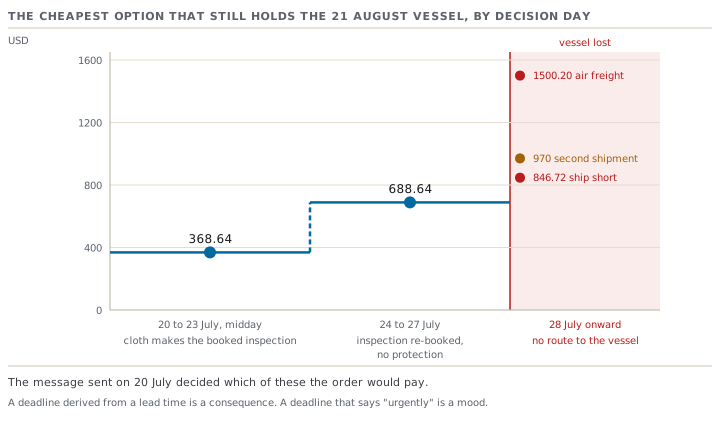
| Decision taken | Cheapest option still open | Cost | Protection left |
|---|---|---|---|
| By Thursday 23 July, midday | stock cloth, arrives 6 August | USD 368.64 | in the inspection as booked |
| Friday 24 to Monday 27 July | stock cloth, inspection re-booked | USD 688.64 | none — any slip loses the vessel |
| Tuesday 28 July onward | the vessel cannot be held for these pieces | USD 846.72, USD 970 or USD 1,500.20 | not applicable |
This is the most useful thing a deadline can be: a consequence, not a request. "Please respond urgently" is a mood. "Ordered on Thursday it arrives on 6 August and makes the inspection; ordered on Friday the inspection has to be re-booked" is a mechanism. A buyer who ignores a mechanism has decided something, rather than merely been slow.
The message that carries a decision
Subject: TQ-6157 Ember - 576 pcs at risk, decision needed by midday Thursday

Dear Ilse,

The facts, as of 14:40 today, Monday 20 July.

- Karasu delivered the Ember cloth 1,152 m short. Two rolls were condemned at
  the four-point inspection for a reed mark running their full length.
- That leaves 4,224 cuttable pieces against 4,800 ordered: 576 pieces, 12% of
  the colourway, against a contract tolerance of 3%.
- Fen Green and Slate are complete. The 21 August vessel is not at risk for
  the other two colourways.
- The cause is the mill's. Karasu has issued the credit for the short metreage.

Three ways forward. Only the first is still open on Thursday.

1. Stock-service cloth, same quality, same mill, different dye lot. With us
   6 August, cut 7 August, in the final inspection on 10 August as booked,
   gate-in 14 August, on board 21 August. All 4,800 pieces ship on the date
   you were given. The risk is shade: a different lot may read outside the
   band, in which case those 576 pieces are packed and labelled separately.
   The cloth premium is ours. If your warehouse charges lot-separation
   handling, that is ours too. A cutting of the stock lot goes to your QA by
   courier tomorrow morning so you can judge the shade before Thursday.

2. Ship 4,224 and take 576 off the order. Nothing to arrange and nothing to
   pay, and you are 576 pieces short in a window you have already allocated.

3. Wait for Karasu to re-weave. Their next slot for this construction is
   17 August, so those pieces would ship about four weeks behind the rest.

I recommend option 1. It is the only one that puts the whole colourway on the
vessel you were promised, and the only cost in it is ours.

What I need from you: one number, 1, 2 or 3, by 12:00 Cairo time on Thursday
23 July. That date is not arbitrary. The cloth takes ten working days to
reach us. Ordered Thursday it arrives 6 August and makes the inspection;
ordered Friday it arrives 9 August and the inspection has to be re-booked;
ordered after Tuesday 28 July it cannot make the vessel by any route.

If I have not heard by Thursday midday I will order the stock cloth, because
it is the only option that still delivers all 4,800 pieces on the confirmed
date and because the cost of it is ours. It stays reversible until we cut on
7 August. Tell me before Thursday if that is wrong.

Best regards,
Rania Shalaby
Merchandising, Shebin Garment Industries
The reply came at 09:40 on Tuesday 21 July. It was eleven words long: option 1, lot-separate if the band fails, send the cutting.
The six parts, and the one rule about options
- The fact, dated to the hour and measured. Metres, pieces, percentage of the colourway, set against the contract number it must be read against.
- *What is not affected.* Half of a buyer's alarm is about scope, and two sentences kill it.
- The cause, in one line, correctly attributed. Not an explanation. If it is yours, say so and stop. If it is not, say whose it is and show the credit note.
- Options that are priced and dated, with their failure modes named. An option with no risk attached is a sales pitch and reads as one.
- Your recommendation, in your own name. Three options without a recommendation is not neutrality. It is a refusal to be accountable, and it is what makes buyers distrust option lists.
- The decision, the deadline and the default, in that order, with the deadline derived from a lead time you can show.
You also meet a harder rule on a late order: never hand a buyer four options and ask them to plan your factory. Both rules are true. The line between them is this. Offer options only where the trade-off belongs to the buyer. Shade lot against short quantity against late delivery are things only Baumgart can value, because they change what arrives in its warehouse. How Shebin pays for the cloth, whether it runs overtime, which line it uses, whether it air-freights: those are the factory's. Putting them in front of a buyer is asking the buyer to run your factory.
The default, and what a default is not
Naming a default turns silence into a decision. It is the most useful sentence in the whole message. It is also the easiest one to get wrong, so it has three conditions.
It must be something you are willing to pay for yourself. Rania's default costs Shebin USD 368.64 and Baumgart nothing. A default that spends the buyer's money is an ultimatum in a friendly font.
It must stay reversible until a stated moment. Here that is the cutting on 7 August, and the message says so.
It is an operational device, not a legal one. It removes the delay. It does not create agreement. If Baumgart said in September that it never accepted a second dye lot, "I told you I would proceed unless you objected" is worth nothing, because silence is not acceptance. That is exactly why a default must be cheap, reversible and paid for by you. You are managing a calendar with it, not manufacturing a consent.
Prompt · Turn a problem into a message that carries a decision
The hour you find a shortfall, a fault or a delay and are tempted to write the words please advise.
Act as a senior merchandiser who has to write to a buyer this afternoon. Turn my problem into a decision message. Facts: buyer [BUYER] and contact [NAME], PO [NUMBER], style [STYLE], total [QTY] pieces, FOB [PRICE], cost to make [AMOUNT], margin per piece [AMOUNT]. The problem, as of [DATE AND TIME]: [DESCRIBE IT WITH MEASURED QUANTITIES]. Affected quantity [QTY] pieces, which is [PERCENT] of [THE COLOURWAY OR THE ORDER]. Contract quantity tolerance [PERCENT] and whether it reads per colourway or on the total: [ANSWER OR UNKNOWN]. What is NOT affected: [LIST]. Cause and whose it is: [ANSWER]. Fixed dates I cannot move: final inspection [DATE], gate-in [DATE], on board [DATE], buyer's warehouse window [DATES]. Recovery routes I know of, with lead times and prices: [LIST WHAT YOU HAVE, INCLUDING UNKNOWNS]. Do the following. First, tell me what I still have to find out before I can write anything, and who to telephone for each. Second, price every route as a cost to me in money, a date it lands, and a named failure mode. Third, work out the LAST day each route can be chosen and still hold the confirmed dates, and show the arithmetic. Fourth, split the routes into two lists — the ones whose trade-off belongs to the buyer because they change what arrives, and the ones that are purely mine to decide — and drop the second list out of the message. Fifth, write the message: dated facts, what is unaffected, the cause in one line, the buyer options priced and dated with their risks, my recommendation in my own name, one decision, a deadline derived from a lead time, and a default I am willing to pay for that stays reversible until a named day. Sixth, write the one-paragraph escalation version I would send a working day later, naming what expires and when, with no mention of anybody failing to reply. Do not write the phrase please advise anywhere.
AI can make mistakes — check anything you act on.
Asking a question you already know the answer to
On 6 March, four months before any of this, Rania sent Ilse two lines:
I am reading clause 6 of the PO as a quantity tolerance of 3% per colourway rather than on the order total, since your allocation runs by colour. Please confirm so we plan the cutting to it.
She knew the answer. Baumgart allocates by colour, so of course it is per colourway. The point was not to find out. It was to make the answer exist, in one line, in a thread, four months before anyone had a reason to want it read the other way. On 20 July, "576 short" is 12% of a colourway or 4% of the order depending on the reading. The party proposing the convenient reading is the party who is short. That argument happens while the vessel loads, between two people whose interests have just parted, and you cannot win it however right you are.
Three rules, because this habit can turn into something unpleasant.
- Ask before you need it. A confirmation requested a week before it becomes valuable reads as a trap. The same question four months early reads as planning.
- Say why you are asking. "So we plan the cutting to it" is the whole difference between a professional and a lawyer.
- Ask only questions you would accept either answer to. If the reply had been "on the order total", Rania would have cut differently.
Escalation is a mechanism, not a mood
Suppose Thursday midday passes and there is no answer. The temptation is to copy Georg Petzold, Baumgart's sourcing director, and let the silence speak. That is escalation as a mood, and it costs you a relationship for one order's benefit.
Escalation as a mechanism has five rules.
- Escalate a decision, never a person. The subject line names the decision and the day it expires. It never says that somebody failed to reply.
- Publish the trigger in advance. Rania's first message already carried the expiry date. So the escalation is only the mechanism she described, doing what she said it would do. Nobody is ambushed.
- Warn your counterpart in writing, in the same thread, a working day ahead. "The cloth option expires at midday tomorrow. If I have no answer by then I will copy Georg on this same message so he has the dates. This is not a complaint about you. The decision has outlived the window."
- One rung at a time. Jumping past Ilse to Georg turns a decision problem into a personnel problem. Ilse's next answer is then slower rather than faster, for a year.
- The escalation email is the same email. Same facts, same options, same numbers, plus one line saying what has changed and what expires when. An angrier version tells the director that the first one was not the whole story.
Escalating on Thursday preserves the USD 368.64 option. Escalating the following Tuesday preserves nothing, and the meeting is then about blame instead of about which cloth to order.
Check yourselfYou have priced four options. One of them turns on whether the factory pays overtime or runs the order on a second line. Do you put it in the buyer's message?Show the answer
No. That trade-off is entirely yours. It changes your cost and nothing the buyer receives. Decide it, and if it matters to what arrives, such as a different unit or a different date, report the decision as a fact. Options go to the buyer only when the buyer is the one who can value the difference, which means the difference has to be visible in their warehouse: quantity, timing, shade, packing, presentation. Sending a buyer a menu of your internal choices looks like transparency and reads as an inability to run your own factory.
Check yourselfYour message names a default that will run if nobody answers by Thursday. What has to be true about that default?Show the answer
Three things. You have to be willing to pay for it yourself, because a default that spends the buyer's money is an ultimatum. It has to stay reversible until a date you name in the message, so that a late answer is still an answer. And you have to understand that it manages the calendar rather than creating agreement. Silence is not acceptance, so if the option carries a real risk to the buyer it belongs in a question, not in a default. Cheap, reversible and paid for by you is the whole test.
What to take away
Two messages, the same facts, the same quarter of an hour. One reports a problem and hands the decision to the person best placed to protect themselves with it. The other prices three futures, names a recommendation, derives a deadline from a lead time and puts a reversible default under it. It got an eleven-word answer the next morning.
The difference on this order was USD 478.08 and 576 garments. Across a season it is the difference between a supplier who reports and a supplier who decides. Buyers pay for the second, without ever writing that down anywhere.