Lessons · Lesson 1 of 3
What is negotiable, and the window it moves in
Map each thing you can change on one order to the day it stops moving, and price the same request before that day and after it.
Lesson 1 of 3 · 38 min
The order
Most of what a factory and its customer argue about is not open all the time. Price, quantity, ship date, the way the goods are packed: each one can be changed freely for a while. Then it stops being changeable. Nobody announces the day it stops. Somebody in another building has taken a decision that rests on it. This lesson shows you how to find those closing days in advance.
It is Wednesday 11 March 2026, 08:15, in a woven-garment factory in Shebin El Kom. Rania Shalaby has the mill on one line and a costing sheet on her screen.
The order is PO TQ-6157 for Baumgart Mode, a German mid-market retailer. It is 14,400 men's brushed flannel overshirts, style QN-509, yarn-dyed check, in three colours: Ember 4,800, Fen Green 5,400, Slate 4,200. The price is FOB USD 12.85. FOB means the price with the goods loaded on the ship at your own port. Order value USD 185,040. On board 21 August. In the Hamburg warehouse in the first week of October.
The PO was confirmed on 3 March. Here is what sits behind that price.
| Line | Per piece |
|---|---|
| Fabric, 2.00 m at USD 3.23 | USD 6.46 |
| Trims | USD 0.72 |
| Cut, make and trim | USD 2.60 |
| Finishing, packing, testing | USD 0.34 |
| Factory overhead | USD 1.26 |
| Cost to make | USD 11.38 |
| FOB | USD 12.85 |
| Margin | USD 1.47 |
USD 1.47 a piece is 11.44% of the FOB. On the whole order it is USD 21,168. Hold that number. Everything in this lesson is measured against it.
The telephone call
Karasu Dokuma, the Turkish weaver, quoted USD 3.23 a metre on 18 February. The quotation is valid until 20 March. Cotton yarn has moved since then. The mill will not give a firm new price before 24 March, but it says two things today. The new price will be somewhere between USD 3.23 and USD 3.39. And it will hold the February price on this order if Shebin confirms the full colour and size split in writing and pays a deposit of 20% before the quotation expires.
The order needs 28,800 m. At the February price that is USD 93,024 of fabric.
Rania does the sensible thing. She does not go to the buyer with a range. She waits for the firm number, so she can put a real figure in front of Ilse Renner, Baumgart's merchandise manager, instead of a guess that will move.
On 24 March the mill confirms USD 3.39 a metre. That is USD 0.16 more. On 2.00 m it is USD 0.32 a piece. On 14,400 pieces it is USD 4,608, which is 21.77% of the order margin. Rania builds the case properly. She attaches the mill's two dated quotations, the yarn index, the exact consumption from the approved marker, and a request for USD 0.32 a piece. She sends it on Wednesday 6 May.
The answer comes on 8 May. It is a polite no.
Nobody did anything wrong
This is the case worth studying, because there is no villain in it. Waiting for a firm number instead of quoting a range is correct. Gathering the evidence before you ask for money is correct. Rania's 6 May message is better prepared than most price requests a buyer sees in a year.
It failed for one reason. On 6 May there was nothing left to move.
Baumgart set its autumn range prices on 27 March. Once a retail price is loaded into a range plan, the buying office is not refusing you out of meanness. The number they would have to change sits below a decision taken in another building, by people who do not know your order exists. On 11 March it sat above that decision.
Precision bought at the cost of timing is not precision. It is a well-evidenced request arriving at a door that closed six weeks ago.
Every variable has a window, and the window has a date
There are six things a merchandiser can move on an order. Each one opens at a different moment. Each one shuts at a different moment. The shutting is almost never announced.
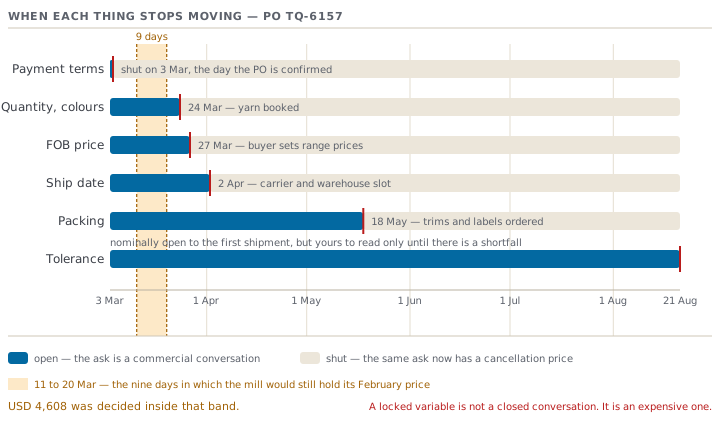
| What can move | Open from | What shuts it | Shut on this order |
|---|---|---|---|
| FOB price | the quotation | the buyer's range price meeting | 27 March |
| Quantity and colour count | the quotation | yarn booked at the mill | 24 March |
| Ship date | the quotation | carrier booking and the buyer's warehouse slot | 2 April |
| Quantity tolerance | the PO terms | the first shipment | 21 August |
| Packing and presentation | the PO terms | trims and labels ordered | 18 May |
| Payment terms | the PO terms, or the seasonal review | the PO is confirmed | 3 March |
Three things follow from that table, and none of them is obvious.
The windows do not shut in the order you meet the problems. Payment terms lock on the day the PO is confirmed. That is the first day you have the order. So a merchandiser who thinks about terms when the first invoice ages is thinking about them a season late. The quantity tolerance is the opposite. It stays open until the shipment. But it stops being yours to read the moment there is a shortfall, because from then on you are the party who gains from the reading.
The most valuable window is the shortest. On this order the gap between "the mill will hold February" and "the mill re-quotes" was nine days. Nine days decided USD 4,608.
A locked variable is not a closed conversation. It is an expensive one. After 24 March the quantity can still change, at the mill's cancellation terms. After 2 April the ship date can still move, at the cost of a new warehouse slot and a supply-performance mark on Baumgart's scorecard. The question is never "can this move". It is "what does moving it cost now that it has locked".
The two conversations, priced
Here is the same problem put to Ilse Renner on two different days.
| Lever | 11 March | 6 May |
|---|---|---|
| Share the movement, USD 0.16 a piece each | Live. The range price is not set. | Closed on 27 March. |
| Confirm the colour and size split early so the mill holds February | Live. Costs Baumgart nothing at all. | Meaningless. The yarn is bought. |
| Drop Slate, 4,200 pieces, to move to a smaller booking | Live. | Closed. The fabric is on the loom. |
| A lighter quality at USD 3.11 a metre | Live. No lab dip approved yet. | Closed. Bulk approved on the heavier cloth. |
| Move on board from 21 August to catch the mill's next run | Live. The warehouse slot is not booked. | Closed on 2 April. |
Five levers on 11 March. Zero on 6 May. The order absorbed the whole USD 4,608. That took the margin from USD 21,168 to USD 16,560, which is USD 1.15 a piece, or 8.95% of the FOB instead of 11.44%.
The question that was never asked
Look again at the second row. It is the one that matters, and it is the one nobody sees.
The mill would hold the February price against a written confirmation of the full colour and size split, plus a deposit of 20%. Rania could not give it. Baumgart's size ratio was not confirmed until 2 April, after their range meeting.
So the thing standing between Shebin and USD 4,608 was not money and not a concession. It was a size ratio, three weeks early, from a buyer who had already placed the order and was going to send it anyway.
Now price it. The deposit is 20% of USD 93,024, which is USD 18,604.80. It is outstanding for about 42 days, until the fabric invoice falls due. The factory borrows at 14% a year, so that money costs USD 299.72.
| Move | What it required from the buyer | What it was worth |
|---|---|---|
| Ask for the size split three weeks early, on 11 March | An email and a spreadsheet they already had | USD 4,608 saved, less USD 299.72 of money cost, so USD 4,308.28 |
| Ask for a share of the increase, on 6 May | A price change after their range was set | Nothing |
The question nobody asked was worth USD 4,308.28. The question that was asked was worth nothing, and it was the better piece of work.
How to find your own lock dates
Nobody will give them to you. Build them once per order, in an hour, when the order arrives.
- Ask the mill for the validity date in writing, and put it in the calendar as an event, not as a note. "Valid thirty days" on a quotation is a lock date the mill has already published and the factory has not read.
- Ask the buyer when their range prices are set. Merchandisers almost never ask this and buyers almost always answer, because to them it is a diary fact rather than a secret. It is the most useful date on the whole account, and it falls in the same week every season.
- Ask when the warehouse slot is booked and when the carrier booking is placed. Those two dates are the ship-date window.
- Write down the day trims and labels are ordered. Everything about packing, presentation, hangtags and pre-packs is free before that date and a re-print after it.
- Put the payment terms on the seasonal review agenda, never on an order. On an order they are already shut.
Prompt · Map the negotiation windows on this order
At order intake, before anything is booked. Use it again the day any cost moves under you.
Act as an experienced apparel merchandiser who has run export orders for a supplier and for a buying office, and who is blunt about timing. Build me a negotiation window map for one order. Order facts: buyer [BUYER], PO [NUMBER], style [STYLE], quantity [QTY] pieces, colourways and split [LIST], FOB [PRICE], cost to make [AMOUNT] broken down as fabric [AMOUNT] at [CONSUMPTION] per piece, trims [AMOUNT], cut make and trim [AMOUNT], finishing and packing [AMOUNT], overhead [AMOUNT]. PO confirmed [DATE]. On board [DATE]. Buyer's warehouse window [DATES]. Mill quotation dated [DATE], valid until [DATE], price [AMOUNT] per metre. Dates I already know: range prices set [DATE OR UNKNOWN], size ratio firm [DATE OR UNKNOWN], carrier booking [DATE OR UNKNOWN], trims ordered [DATE OR UNKNOWN]. Do the following. First, build a table of six variables — FOB price, quantity and colour count, ship date, quantity tolerance, packing and presentation, payment terms — and for each one give the day it opened, the event that shuts it, the calendar date of that event on THIS order, and what the same request costs after that date. Second, mark every date I gave you as UNKNOWN and write the exact one-line question I should send to get it, addressed to the right party. Third, tell me which window is shortest and what is decided inside it, in money. Fourth, list the requests that are still free today and would cost money next month, ranked by value. Fifth, name anything a buyer would say yes to that costs them nothing — an early confirmation, a frozen ratio, a released date — and write those asks for me. Do not give me general advice about relationships. Give me dates, amounts and sentences I can send today.
AI can make mistakes — check anything you act on.
Check yourselfA mill's quotation expires in nine days and the re-quote may be higher. You do not yet have a firm number. What do you send the buyer today?Show the answer
A dated message with a range and no request. The quotation expires on this date, the re-quote will be between these two numbers, the firm figure arrives on this date. Then one ask that costs them nothing and helps you: the colour and size split early, or a confirmation that the quantity is final. You are not negotiating yet. You are keeping the window open until you have something to negotiate with. A range with a dated correction attached is not a guess, and a buyer never holds it against you. Six weeks of silence followed by a precise demand is what they hold against you.
Check yourselfWhy are payment terms almost never negotiable on a live order?Show the answer
Because they lock on the day the PO is confirmed, which is the first day the order exists. By the time the cash-flow pain shows, usually when the first invoice ages past sixty days, the terms are a signed condition of an order already in production. Asking to change them mid-order reads as a signal that you are short of cash, not as a commercial request. That is the last thing you want a buyer to think. Terms move at the seasonal review, in exchange for something, before any PO is on the table.
What to take away
Negotiation is mostly a calendar problem in the clothes of a conversation. The variables are few and well known. What changes is which ones are still alive on the day you speak. So the discipline is not learning to argue better. It is knowing, on any given morning, which five levers are still on the table and which zero are, and asking for the cheap thing while it is still free.