Lessons · Lesson 1 of 3
Seeing it early
Read the signs that a date will be missed while recovery is still cheap, and turn a supplier's reassurance into a fact you can act on.
Lesson 1 of 3 · 34 min
Monday 17 August 2026
Every report on your desk says the order is fine. The order is already late. That is not unusual. It is normal. The reports are written by the people whose job it is for the news to be good. This lesson is about finding the delay while it is still cheap to buy back.
Order KG-4471 is ten weeks old. It is 31,500 pcs of style MHZ-320 for the German buyer Kesterling GmbH, at USD 14.40 FOB Alexandria. On board 14 October. Order value USD 453,600. Margin USD 44,730. Sewing loads on 3 September.
There are two days of float on the critical path. Float is the spare days you hold before a milestone starts pushing the ship date. And those two days were counted before the navy yarn slipped in early August.
Every report this morning is green. The mill's weekly update says on schedule. The trim board shows six of seven rows inside their buffer. Nobody has told you anything is wrong. The order is already late by about eleven days. It has just not surfaced anywhere yet.
This lesson is about those eleven days. How to find them in August, when a day costs USD 134 to buy back, instead of in October, when the same day costs USD 16,000.
A status that has not changed is not a status
Pull the mill's last three weekly updates and put them side by side. On 3 August, greige knitting for navy: in progress. On 10 August: in progress. On 17 August: in progress. Greige is fabric that has been knitted but not yet dyed.
Three weeks of a status that never moved is one line of text somebody copied forward. It proves one thing only: nobody at the mill re-read it either. A milestone that stays amber for a fortnight was never amber. It was late in the first week and nobody said the word.
The same pattern is on your trim board. The buyer's nominated label supplier in Colombo acknowledged the PO on 29 June. Promised in-house 29 July. Needed by 20 August. It is 17 August. There is no airway bill, no dispatch date, no invoice. Twenty-two days of buffer are gone and not one late day has been reported, because nothing on that row ever generates an event.
So read the board on the buffer column, every week, and ask one question of each row: is the number smaller than it was last week, and did anyone tell me? A buffer that shrinks in silence is the commonest way an order dies.
Turning a reassurance into a fact
A supplier saying "on track" is a statement about their intention. It is honestly meant almost every time. It is also worthless. It comes from the person whose bonus depends on it, and it survives contact with nothing.
Evidence is different. Evidence is a fact with a date and a number that a third party could check. A yarn contract number. A batch card. A dye-lot number. A photograph of the greige rolls with the lot card visible. An airway bill. A carrier booking reference. If a supplier cannot produce one, they do not have the thing they are describing.
Three questions turn a reassurance into a fact. They work on any supplier in any country.
- What is the physical state of my goods right now, and what machine do they go on next? "In progress" is not a physical state. Yarn on cones, greige on the knitting machine, greige in the dye-house queue, wet fabric on the stenter, rolls on the inspection table: those are physical states. Each one has a different number of days after it.
- When does that machine have my lot, and whose order is in front of mine? This one gets answered honestly. It is a question about their production plan, not about your order, so nobody feels accused.
- What is the document that proves it, and can you send it today? The document is the whole point. A batch card number takes thirty seconds to send if it exists.
On 17 August the mill answers "navy is queued for dyeing" and "Thursday, behind two lots", and sends a photograph of the greige rolls. That is a fact. It means navy is not on a machine on the day your calendar said it would be out of the dye-house. You now know eleven days before the fabric was due, instead of three days after.
The labels, and the need date nobody checked
The Colombo labels are the interesting row. They teach the second half of seeing it early: the need date on your calendar is not always the need date on the floor.
Your TNA says 20 August. TNA is the time and action calendar, the plan that dates every step of the order. That date is the intake sheet's rule: all trims in-house before the PP sample. It is a sensible rule and a real one.
But ask the industrial engineer which operation actually consumes the main label, and on which day. On MHZ-320 the main and care labels are set into the back-neck seam at operation nine. The first bundle reaches operation nine on the second day of line loading, which is 5 September.
So the true floor need date is 5 September. You have lost 22 days of a paperwork buffer and you still have sixteen days on the floor. You do not need a crisis. You need an airway bill.
Air freight from Colombo for 63,000 labels is about 190 kg. At USD 5.20 a kilo plus clearance and delivery, call it USD 1,340, landing four days after dispatch. Ten days recovered for three percent of the profit, on a risk that would otherwise idle two lines.
It only works because you asked on 17 August. Ask on 2 September and the labels still come by air, but now they are on the critical path, the price is whatever the agent says, and you have no answer if the flight is full.
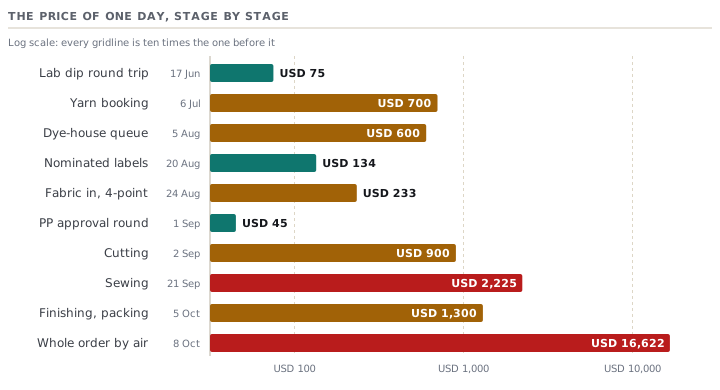
What each day costs, and when it stops being for sale
Recovery is not one lever. It is a series of them, and they close one by one as the order moves. That is why "see it early" is a commercial instruction rather than a virtue.
| Stage | Latest useful date | Days recoverable | How, and what it costs | Cost per day won |
|---|---|---|---|---|
| Lab dip round trip | 17 Jun | 4 | Hand-carried dips, buyer QA on a call — USD 300 | USD 75 |
| Yarn booking at the mill | 6 Jul | 6 | Spot yarn premium, USD 0.12/kg on 35,000 kg — USD 4,200 | USD 700 |
| Dye-house sequencing | 5 Aug | 5 | Queue position plus a split dye batch — USD 3,000 | USD 600 |
| Nominated labels, Colombo | 20 Aug | 10 | 190 kg by air instead of sea — USD 1,340 | USD 134 |
| Fabric transit and 4-point | 24 Aug | 3 | Dedicated truck, roll-by-roll inspection on arrival — USD 700 | USD 233 |
| PP approval round | 1 Sep | 4 | Courier plus a same-day video review — USD 180 | USD 45 |
| Cutting | 2 Sep | 1 | A second cutting shift — USD 900 | USD 900 |
| Sewing | 21 Sep | 4 | Overtime and rest-day working — USD 8,900 | USD 2,225 |
| Finishing and packing | 5 Oct | 2 | Extra hands and a weekend — USD 2,600 | USD 1,300 |
| Sea replaced by air, whole order | 8 Oct | 7 | USD 116,354, worked out in the next lesson | USD 16,622 |
Take two things from that table and nothing else.
The days do not add up. Once bulk fabric is in your store, the twelve days above it are gone. You cannot re-book yarn for goods that are already dyed. Recovery capacity decays as the order advances, and it decays fastest in the last three weeks.
The price of a day rises by a factor of two hundred between June and October. The same twenty-four hours costs USD 75 in the dip round and USD 16,622 on a plane. Nothing about the day changes. What changes is how many levers are still open when you reach for one.
Prompt · Audit an order for slippage nobody has reported
Weekly, on any order more than a month from its ship date, when every status is green and you do not believe it.
Act as a senior garment export merchandiser auditing a live order for delay that has not been reported yet. Order: [QTY] pcs of [STYLE] for [BUYER], on board [SHIP DATE], FOB [PRICE], order value [VALUE], margin [VALUE AND PERCENT]. Today is [DATE]. Here is my supplier and milestone board, one row per item, each with: item, supplier, quoted lead time and what that lead time runs from, date ordered, promised in-house date, required in-house date, and the status text the supplier gave me in each of the last three weekly updates: [PASTE THE BOARD]. Production: [OPERATORS] operators, [SAM] SAM, [EFFICIENCY] percent, [DAYS PER WEEK] working days, line loads [DATE]. Do four things. First, list every row whose buffer has shrunk over the last three weeks and say by how many days, whether or not anybody reported a delay. Second, flag every row where the status text has not changed across the three updates, and tell me what physical state and what document I should demand for that specific item. Third, for each critical-path row, tell me the true floor need date - the day the operation that consumes it actually runs - and how it differs from the date on my calendar. Fourth, tell me the single row most likely to be late that nobody has flagged, and what it would cost me to buy that time back today versus in the last two weeks before shipment. Do not reassure me and do not treat an unchanged status as evidence of progress.
AI can make mistakes — check anything you act on.
Check yourselfYour mill has reported navy greige knitting as in progress for three consecutive weeks and insists the ex-mill date is safe. What do you actually know?Show the answer
That the line of text has not changed. Nothing else. A status repeated without moving tells you nothing about the goods, only about the reporting. Ask what physical state the lot is in, which machine it goes on next, whose lot is in front of it, and for the batch card or dye-lot number. If no document exists, neither does the progress being described.
Check yourselfA nominated trim promised in-house on 29 July has not shipped by 17 August, against a TNA need date of 20 August. Is the order late?Show the answer
Not yet, and the calendar cannot tell you. Go and find out which operation consumes that trim and on what day the first bundle reaches it. On MHZ-320 the main label is set at operation nine on 5 September, so the floor need date is sixteen days later than the TNA date. That makes the fix an airway bill for USD 1,340 rather than a crisis. Ask the same question on 2 September and the trim is on the critical path with no options left.
What you own by Monday evening
Three things, and each one is a sentence with a number in it.
A written list of every milestone whose buffer shrank this week, and who did not report it. A document reference against every supplier claim that matters, so batch card, dye lot, airway bill or booking number, with a blank where nobody could evidence the claim. The blanks are the real report. And a decision on the labels, made and paid for today rather than escalated to somebody else.
Ninety minutes of work. Eleven days of schedule. About USD 1,300. The next lesson is what the same eleven days cost in the last week of September.
Time and Action calendar templatetna-calendar.xlsx