Lessons · Lesson 2 of 3
What recovery actually costs
Price every recovery option against the order margin, do the air-freight arithmetic in full, and know the point at which the rescue costs more than the delay.
Lesson 2 of 3 · 37 min
Monday 21 September 2026, 08:00
Once an order is behind, everybody has a suggestion. Work the evenings. Add a shift. Send some of it elsewhere. Put it on an aeroplane. This lesson prices every one of them in full, against the profit the order was going to make. Most of them cost less than the delay. A couple cost several times more than the problem they solve.
The labels came by air on 26 August. The navy fabric was absorbed by the loading sequence. Sewing ran to plan for nine working days from 3 September. Then on 14 September your own planner moved line 2 onto a different buyer's programme for four working days. That order had a nearer date and somebody decided it without opening this calendar.
It is Monday morning and you have the numbers.
- Sewn and passed at close of Saturday 19 September: 15,900 pcs of 31,500.
- Plan at that date: 18,850 pcs.
- Behind by 2,950 pcs. At 1,282 pcs a day that is 2.3 days of line output.
Nine working days remain before the 2 October sewing-complete date. Nine days at 1,282 is 11,538 pcs. You need 15,600. You are 4,062 pcs short, which is 3.2 line-days.
Follow that through the calendar and it is worse than three days. Sewing lands 6 October. Packing 9 October. You miss the 11 October carrier gate-in. The next Alexandria to Hamburg sailing is 21 October, so seven days late. That sits exactly on the edge of the clause where a 3 percent discount turns into air freight at your cost.
Nothing here is a supplier's fault, which makes it easier rather than harder. You control every lever. The only question is which one, and what it costs against USD 44,730.
The options, priced
Never bring a recovery option to a meeting without a dollar figure and a percentage of margin beside it. A list of ideas becomes a discussion. A list of prices becomes a decision.
| Option | Days won | Cost USD | Share of margin | The precondition nobody mentions |
|---|---|---|---|---|
| Do nothing, ship 21 October | 0 | 13,608 | 30% | You are on the cliff edge — one more lost day makes it air freight |
| Overtime, 2 h a day, 9 days | 1.4 | 3,200 | 7% | Operators consent; statutory premium paid |
| Overtime, 3 h a day, plus two rest days | 3.8 | 8,940 | 20% | Defect rate rises in hour eleven; budget the QC |
| Subcontract 5,000 pcs of Black | 3.9 | 4,750 | 11% | The unit is DISCLOSED and already audited by the buyer |
| Second shift, 90 operators | 6.0 | 14,360 | 32% | Ninety trained operators do not exist in nine days |
| Part shipment, 24,500 now and 7,000 later | protects 78% | 1,400 plus the balance | 3% plus risk | Buyer's written consent, and the balance misses their window |
| Air freight the 4,062-pc shortfall | 3.2 | 14,998 | 34% | Space booked six days out; costs more than the discount |
| Air freight the whole order | any | 116,354 | 260% | There is no precondition; there is only the arithmetic |
Read the second-to-last row twice. Airing only the shortfall is the option that sounds surgical and responsible. It costs more than simply accepting the 3 percent discount on the entire order. It is the most common expensive mistake in this trade, and it is made by people doing their best.
Overtime and the second shift, honestly
Egyptian labour law pays overtime at a 35 percent premium on day hours, 70 percent at night, and a rest day worked at double. A fully loaded operator-hour here is about USD 1.05, and the two lines are 104 people counting helpers, checkers and supervision. Two hours a day is USD 295. Add power, canteen and transport home after dark and call it USD 355 a day, so USD 3,200 over nine days.
The output side is where people fool themselves. The line makes 135 pcs an hour at target. Hours ten and eleven do not. There is no fresh line balance, the helpers have gone, and the feeding is thinner. Seventy-two percent is a fair figure: 97 an hour, 194 a day, 1,746 over nine days. That is 1.4 days won, not 2. Plan overtime on the day rate and your recovery under-delivers by a third.
A second shift looks biggest and is usually a fiction. It needs ninety trained operators who can sew a heavyweight hood, and you cannot train them in nine days. So in practice it means taking people off another line, and another buyer's order goes late instead of this one. Sometimes that is the right commercial call. It is never a free one. If you do not price the other order's penalty into this decision, you have not decided anything. You have moved the problem to a colleague.
The air-freight arithmetic, in full
Do this properly once and you will never again say "we can always air it" as though it were a plan.
Step one, the two weights. Air charges on the greater of actual gross weight and volumetric weight. Volumetric weight is what the cargo costs in space rather than in mass.
MHZ-320 is 0.68 kg gross a piece, including the polybag and its share of the carton. So 31,500 pcs is 21,420 kg actual. It packs 20 to a carton, which is 1,575 cartons at 60 by 40 by 30 cm, and 0.072 CBM each, so 113.4 CBM. Airline volumetric is CBM divided by 0.006, and 113.4 over 0.006 is 18,900 kg.
Chargeable is the greater of the two: 21,420 kg. The density is 189 kg per CBM, above the 167 kg per CBM air break, so a heavyweight fleece charges on real weight. Do not assume that. A t-shirt programme or a padded jacket charges on volume, and the bill can be double what the scale says. Calculate both, every time.
Step two, the whole bill and not the rate.
| Line | Basis | USD |
|---|---|---|
| Airport to airport, Cairo to Frankfurt | 21,420 kg at USD 4.80 | 102,816 |
| Trucking Alexandria to Cairo airport | 12 trucks | 2,400 |
| Export handling, AWB, security screening | USD 0.22/kg | 4,712 |
| Destination clearance, break-bulk, Frankfurt to Hamburg DC | USD 0.30/kg | 6,426 |
| Total | 116,354 |
The quoted rate was USD 4.80. The real cost is USD 5.43 a kilo, 13 percent above it, and the gap is entirely in the lines a freight quotation does not mention.
Step three, against the order. Margin is USD 44,730, so USD 116,354 is 260 percent of the entire profit. The order stops earning USD 44,730 and starts losing USD 71,624. Per piece that is USD 3.69 to fly a garment that earns USD 1.42, so every piece you put on a plane loses USD 2.27 net.
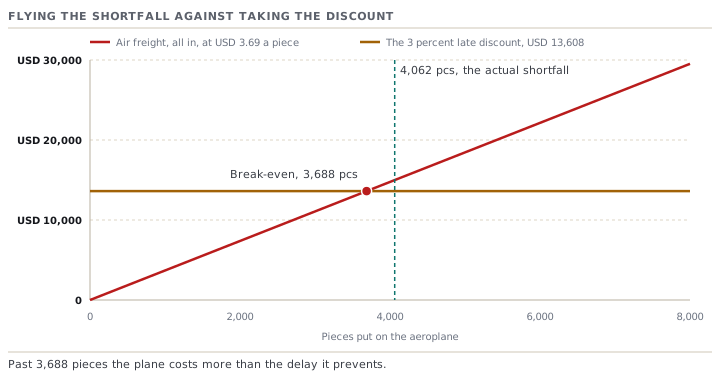
Step four, the break-even that decides it. The 3 percent clause on days one to seven costs USD 13,608. Divide that by USD 3.69 and you get 3,688 pcs. Air more than about 3,700 pieces, which is 12 percent of the order and under three days of line output, and you have spent more than accepting the discount on the whole shipment. The shortfall here is 4,062 pcs. It is already over the line.
There is one number to claw back. The order is FOB Alexandria, so Kesterling pay the sea freight, and if you fly it they do not. Two 40-foot high cubes to Hamburg is roughly USD 3,600 they no longer spend. Ask for it as a credit. It is 3 percent of the air bill and it will not save you, but it costs one email and it tells the buyer you did the arithmetic rather than panicked.
Part shipment, and the discount they ask for instead
A part shipment is cheap for you and expensive for them, which is why they charge for it. Ship 24,500 pcs of Black and Heather Grey on the 14 October vessel and the 7,000 Navy on the 28th. That is a second document set, a second booking, roughly USD 1,400 direct. But their DC window is 4 to 11 November, the second sailing lands around the 15th, and 7,000 pieces arriving after the window is a markdown conversation rather than a delivery.
Very often the buyer takes none of your options and simply asks for money. Know the shape of it.
- The contractual late discount. 3 percent, USD 13,608, which is 30 percent of the profit for being one day late.
- A markdown allowance. The goods arrive after their promotion date, so they will discount at retail and want you to share it. Typically 5 to 8 percent. At 5 percent that is USD 22,680, half the margin.
- A chargeback passed down. Their own retailer deducts an on-time-in-full penalty, and it reaches you as a debit note against a future invoice, three to six months later, from their finance team rather than your merchandiser.
One piece of arithmetic governs all three. A discount comes off the invoice, which is 100 percent of the price, and out of the margin, which is 9.9 percent. A 10 percent concession is USD 45,360 against a profit of USD 44,730. You would be paying Kesterling USD 630 for the privilege of making their order. Know the percentage at which your order reaches zero before the call, because inside the call it sounds like a small number.
And settle it once, in writing, in one sentence: in full and final settlement of all claims arising from the revised delivery of PO KG-4471, including any markdown allowance, handling charge or deduction. Without that sentence, the discount agreed in September and the chargeback arriving in March are two separate payments.
Prompt · Price every recovery option against the margin
The morning you find out you are behind, before anyone proposes a solution in a meeting.
Act as a senior garment export merchandiser building a costed recovery board. Order: [QTY] pcs of [STYLE], FOB [PRICE], order value [VALUE], per-piece cost [COST], margin [VALUE AND PERCENT], on board [DATE], carrier gate-in [DATE], next sailing after that [DATE]. Position today, [DATE]: sewn [QTY] against a plan of [QTY], line output [PCS PER DAY], [N] working days remaining before the sewing-complete date. Late clause, exact wording: [PASTE IT]. Costs: fully loaded operator-hour [RATE], operators and support on the line [N], statutory overtime premium [PERCENT], rest-day premium [PERCENT], internal CM per piece [VALUE], subcontract CM per piece [VALUE]. Garment gross weight per piece [KG], pieces per carton [N], carton dimensions [CM], air rate airport to airport [RATE PER KG]. Produce one table: option, days won, cost in USD, cost as a percentage of order margin, and the precondition that must be true for the option to exist at all. Cover doing nothing and taking the clause, overtime at two and three hours, rest-day working, a second shift, subcontracting, part shipment, airing the shortfall only, and airing the whole order. For air freight, calculate actual gross weight and volumetric weight separately, state which is chargeable and why, and add inland trucking, export handling, AWB, security screening and destination clearance to the airport-to-airport rate before you give me a total. Then tell me the break-even quantity at which air freight costs more than the contractual late discount. Rank cheapest first, name the cheapest lawful combination that closes the gap, and do not recommend air freight until you have shown me it is the only option left.
AI can make mistakes — check anything you act on.
Check yourselfYou are 4,000 pcs short and someone proposes airing only the shortfall rather than the whole order. Is that the sensible middle option?Show the answer
No, and it is the most expensive mistake available. All-in air costs USD 5.43 a kilo, so USD 3.69 a piece, and 4,000 pcs is about USD 14,800. That is more than the USD 13,608 you would pay by simply accepting the 3 percent late clause on the entire order. The break-even is 3,688 pcs, so anything above roughly 3,700 pieces on a plane costs more than the delay it prevents. Air freight is a rescue only for quantities small enough to be pointless, or for trims, which is where it belongs.
Check yourselfSubcontracting 5,000 pcs is the cheapest row on your board at USD 4,750. What do you check before you take it?Show the answer
Whether the unit is on the buyer's approved and audited list, and disclosed for this PO. If it is, subcontracting is your best option by a wide margin. If it is not, it is not an option at any price. Undisclosed subcontracting is a termination clause and an audit finding, and factories are delisted for it every season. The decision that makes this row available is made in June, when a second unit is put through the buyer's audit while nothing is wrong.
What you decide, and the shape of the answer
Subcontract 5,000 pcs of Black to the disclosed unit at USD 4,750, plus two hours of overtime a day at USD 3,200. That is USD 7,950, 18 percent of margin, and 5.3 days won against a 3.2-day gap. It ships on 14 October as confirmed, it rebuilds a day of protection, and it costs 42 percent less than doing nothing and taking the discount.
Two closing observations. The cheapest option on your board on 21 September was created on 12 June, when somebody got a second unit onto the buyer's approved list. And every recovery on that table costs less than the delay it prevents, except the two involving an aeroplane.
The next lesson is the harder half: telling Kesterling.