Lessons · Lesson 3 of 3
Telling the buyer
Tell a buyer an order is at risk early enough to matter, with a plan they can act on, and in language that survives being forwarded to their finance team.
Lesson 3 of 3 · 33 min
Monday 21 September 2026, 11:00
You have fixed it. The plan holds and the ship sails on the day you promised. So does the customer need to hear about any of it? This lesson says yes, and not out of conscience. The repaired plan has far less room in it than the original one.
You have the numbers and you have the plan. 5,000 pcs of Black to the disclosed unit, two hours of overtime a day, USD 7,950, sewing complete 1 October, on board 14 October as confirmed. The order is recoverable.
Which raises the question every merchandiser gets wrong at least once. If you can still ship on time, do you tell Kesterling anything at all?
Yes, and not because of ethics. Because of arithmetic. Your recovered plan has one day of protection instead of three. Say nothing and it holds, and you gained nothing. Say nothing and it slips again, and you deliver two pieces of bad news on the same day in October: the order is late, and you knew in September.
Buyers absorb dozens of delivery problems a year. They do not absorb the second one. It gets your allocation cut next season by a planner you never speak to.
When to tell them
Three rules, in this order.
Tell them the day you know, not the day you are certain. Certainty arrives after the container has sailed. What you owe them on day one is the fact, not the analysis.
Never let the ship date be the day they find out. A buyer told on 11 October that a 14 October vessel will be missed has no moves left. Their DC slot is booked, their marketing is set, their store allocation is printed. The same buyer told on 21 September can shift a promotion, re-plan an inbound slot, or tell you they would rather have 24,500 pieces on the boat than 31,500 in November. Every option they have depends on when you speak.
Do not wait for the full plan before you say anything. This is where most people go wrong, and the instinct behind it is defensible. Nobody wants to raise an alarm and then be asked a question they cannot answer. So split the message in two instead.
A holding note goes out within two hours of knowing. Three lines, no options, no promises, and an explicit date by which the real message arrives. The recovery message follows within two working days, with the arithmetic and the plan. On KG-4471 the problem surfaced on Thursday 17 September, and the days in between went on confirming that the subcontract unit was still on the buyer's audited list. That was the difference between an option and a wish. Those days were well spent. Spending them in silence would not have been.
The holding note
Subject: KG-4471 - production update, full plan Monday

Dear Anke,

A capacity problem on our side has put KG-4471 behind plan this week. I am
working through the recovery options now and I will send you the complete
picture, with dates and a recommendation, by Monday 21 September.

I do not have a revised on-board date for you yet, and I would rather give
you one number that holds than three that move.

Hazem
Sixty words. It commits to nothing except a date for the next message, and it makes the one promise you can definitely keep.
What a credible recovery message contains
Six things, in this order, and nothing else.
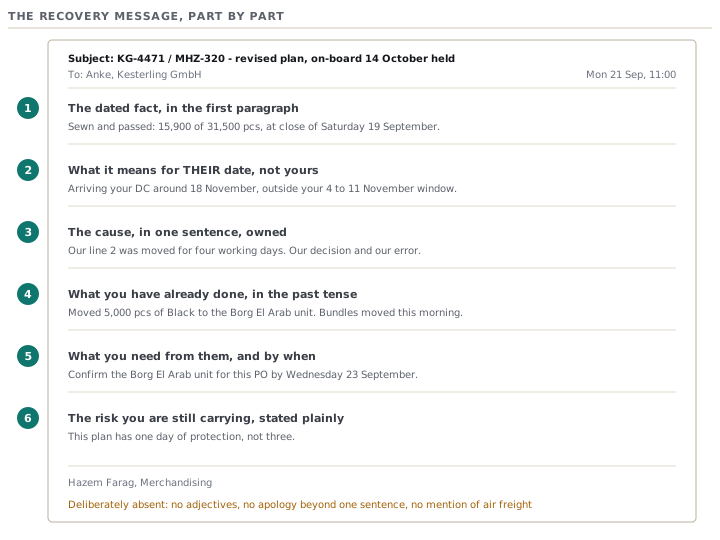
- The fact, dated, in the first paragraph. Pieces sewn against pieces planned, as of a stated day. Not "we are experiencing delays".
- What it means for their date, not yours. The on-board date is your milestone. Their milestone is the DC window, the few days their distribution centre has booked to receive the goods. Convert it for them. If you do not, they will, and they will do it pessimistically.
- The cause, in one sentence, owned. If it is yours, say so and stop. A cause is one line. An explanation of a cause is an excuse, and it reads as one.
- What you have already done, in the past tense, with specifics. Not what you will try. Bundles moved this morning. Overtime agreed with the operators. Inspection re-booked with a reference number.
- What you need from them and by when. One decision, one deadline. Do not present a buyer with four options and ask them to plan your factory.
- The risk you are still carrying, stated plainly. This is the paragraph that makes the whole message credible. A recovery plan with no residual risk is a plan nobody believes, because none has ever existed.
The message
Subject: KG-4471 / MHZ-320 - revised plan, on-board 14 October held

Dear Anke,

Where the order stands, at close of Saturday 19 September:

- Sewn and passed: 15,900 of 31,500 pcs.
- Plan at that date: 18,850 pcs. We are 2,950 pcs behind, which is 2.3 days
  of line output.
- Cause: our line 2 was moved onto another programme for four working days
  between 14 and 17 September. That was our planning decision and our error.
  It was not a material, quality or approval issue, and nothing on your side
  contributed to it.

What that would have meant with no action: sewing complete 6 October, packing
9 October, and we would miss the 11 October carrier cut-off. The next
Alexandria-Hamburg sailing is 21 October, arriving your DC around 18 November,
outside your 4-11 November window.

What we have done since Thursday:

1. Moved 5,000 pcs of Black to our Borg El Arab unit - the unit on your
   approved and audited list from the March visit, disclosed for this PO,
   same QC manager. Cutting is complete and the bundles moved this morning.
   Our QA supervisor is on site there from tomorrow until the last piece.
2. Two hours of authorised overtime per day on both lines from today to
   2 October, agreed with the operators and paid at the statutory premium.
3. Confirmed the final AQL inspection with the third party for 6 October,
   unchanged. Booking reference is with our shipping team if you want it.

Where that lands us: sewing complete 1 October, packing 4 October, inspection
6 October, ship clearance 8 October, gate-in 11 October, on board 14 October
as originally confirmed. Your DC window is unaffected.

What I need from you, by Wednesday 23 September:

- Confirmation that the Borg El Arab unit is acceptable to you for this PO.
  It is already on your approved list, so I am asking you to confirm rather
  than to approve. If your compliance team wants to re-verify before
  shipment, tell me on Wednesday and not in October.

That is the only thing I am asking for. I am not requesting a date change, a
price change or any concession.

The risk I am still carrying: this plan has one day of protection, not three.
If we lose a day to anything between now and 2 October, you will hear it from
me in the same week, and we would then be looking at 15 or 16 October on
board. You will not learn that on the 11th.

I will send you a short written update every Monday and Thursday until the
container gates in, whether the news has changed or not.

Best regards,
Hazem Farag
Merchandising
Note what is absent. No apology beyond the ownership sentence, no adjectives, and no mention of air freight. Naming air freight in an email is not information. It is an offer, and it will be quoted back at you in October as something you proposed.
What never goes in writing
Every message you send about a late order is a document in a file. It will be read again during a chargeback negotiation, by somebody who was not on the call and does not know you.
| What you were tempted to write | What their file reads back | Write this instead |
|---|---|---|
| We are pushing the factory hard | Nobody is in control and there is still no date | Sewing completes 1 October. Daily output plan attached. |
| We will try to hold 14 October | It will not be 14 October | On board 14 October, with one day of protection, not three. |
| We may need to consider air freight | He has offered to pay for a plane | Nothing. Price it, decide who pays, then discuss it if you must. |
| Due to circumstances beyond our control | He will not tell me what happened | Our line 2 was moved for four days. Our decision, our error. |
| Your PP comments came back late | He is building a claim against me | Only if it is materially true, only as a dated fact, never as blame. |
| Sorry for the inconvenience caused | Boilerplate, so the rest is probably boilerplate too | Delete it. One ownership sentence, then dates. |
Two more that are not about wording.
Never give a second revised date without a structural change behind it. One moved date is a problem, and buyers live with problems. Two means your dates are estimates, and a buyer who believes that starts dual-sourcing the style.
Never let a decision live only on WhatsApp or a phone call. Whatever was agreed verbally goes into an email the same day, in your words, ending with a request to correct anything you have misstated. Six months on, when a debit note arrives, the audit trail has to have something in it exactly where the dispute is.
Check yourselfYou find out on Thursday morning. Your full recovery plan will not be costed and confirmed until Monday. When do you contact the buyer?Show the answer
Thursday, within two hours, with a holding note of three lines: there is a problem, I am working the options, you will have the complete picture with dates by Monday. Then the full recovery message on Monday. Waiting until you have the answer is defensible for two working days and indefensible for two weeks. The holding note costs you nothing, and it buys the credibility that makes Monday's message land as a plan rather than a confession.
Check yourselfYour recovery plan holds the confirmed on-board date. Do you still tell the buyer what happened?Show the answer
Yes. Two reasons, and neither is sentimental. Your protection has dropped from three days to one, so the chance of a second slip has risen sharply. If that happens you will be delivering the delay and the concealment in the same message, and buyers forgive the first but not the second. And if the recovery involved a subcontract unit, a changed inspection date or anything else touching a term they approved, the fact will surface later in a document. That is the worst possible way for them to learn it.
How the relationship survives it
Buyers do not remember delays with any precision. They handle hundreds a year and most of them blur. What they remember with total clarity is how they found out. Whether the news came from you or from their own inbound report. Whether the first message contained a number or an adjective. And whether the date you gave them second held.
So the last part of recovering a late order happens after it has shipped, and it takes an hour. Send the closing note when the container gates in: actual dates against plan, what it cost, and the one structural change that stops the failure repeating. Here that means no line moves off a confirmed programme without the merchandiser's sign-off. That is the control that was missing on 14 September. Then raise it at the next order review before they do.
A factory that hides a four-day capacity error is a supplier. A factory that reports it on the day, prices the fix, ships on the confirmed date and then tells you what it changed is a partner. The difference between those two is worth considerably more than USD 44,730 a season.
That is the whole argument for everything in this course. The delay is rarely what damages the relationship. The way it is communicated almost always is.