Lessons · Lesson 1 of 6
Eight owners between a cotton field and a hanger
Take one order apart into the companies that own it, and separate who holds the goods from who chose the supplier.
Lesson 1 of 6 · 18 min
One order, and everybody it belongs to
This course follows one order all the way through the industry that makes it.
Halvedge is a mid-market clothing retailer. On 4 February it confirmed PO HV-41-6620. The style is HV-3110: a men's heavyweight cotton crew sweatshirt, brushed on the inside, in a 320 gsm loopback fabric. The quantity is 74,400 pieces in three colours — Fenmoor 33,500, Oatmoss 25,600, Redlark 15,300. It leaves the factory on 19 June, reaches the distribution centre on 31 July, and goes on the shop floor in week 33.
It is costed at FOB USD 8.90. FOB means free on board: the factory's price with the goods loaded on the ship, before freight and duty. The shelf price is USD 49.00 before sales tax.
One purchase order. Now count the companies that all have to succeed for it to arrive.
| Stage | Party | Buys | Sells |
|---|---|---|---|
| Cotton | Trescoe Cotton, a merchant | lint from gins | lint by the bale |
| Yarn | Semberly Spinning | lint | ring-spun yarn |
| Fabric | Calderfield Mills, knitting and dyeing | yarn | finished loopback, by the kilogram |
| Garment | Verrick Knitwear | fabric and trims | garments, by the piece |
| Buying | Marchbanks Sourcing, a buying agent | nothing | its time, on commission |
| Carriage | a forwarder and an ocean carrier | nothing | space and movement |
| Retail | Halvedge | garments | garments, one at a time |
Lint is ginned cotton: the cleaned fibre a spinner buys, sold by the bale.
That is seven stages. Add the gin behind Trescoe and you have eight companies before a shopper touches a sleeve. Not one of them sees the whole chain. Semberly does not know what garment its yarn becomes. The buyer at Halvedge has never heard of Semberly.
A tier is not a job. It is something owned, and something refusable
People usually draw this as a row of boxes with arrows. That teaches nothing. It suggests the tiers exist because somebody drew them. They do not. A tier exists because it owns something and can refuse something. Those two facts decide everything that happens to your order later.
So describe each company with three questions instead of a job title.
- What does it own while it holds the goods? Ownership of goods is called title. Title is not a formality. The party holding title carries the loss if the goods burn, are seized, come out wrong, or cannot be sold.
- What does it decide? Who it buys from, at what price, on what date.
- What can it refuse, and what happens to it if it does? Almost nobody asks this one, and it is the one that predicts where trouble lands. Keep it in mind. Lesson 6 turns it into a test.
Run those three questions down the chain and something uncomfortable appears.
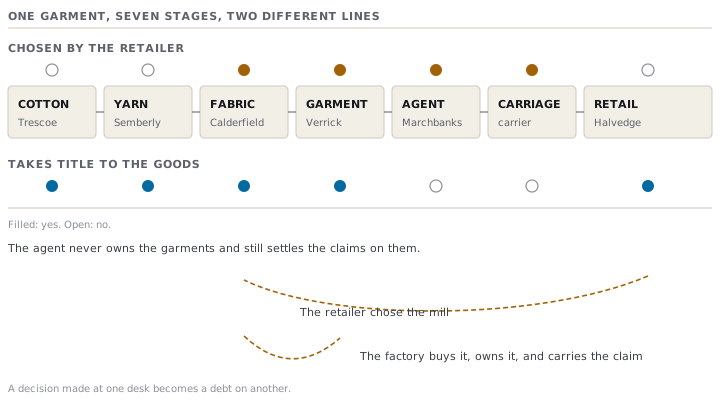
The two lines do not meet
Title runs down the chain in order. Trescoe owns the lint until Semberly pays for it. Semberly owns the yarn until Calderfield pays for it. Calderfield owns the fabric until Verrick pays for it. The moment Calderfield's fabric leaves its gate it is Verrick's fabric: Verrick's money, Verrick's warehouse, Verrick's problem if it is wrong.
Choice does not run in the same order. Halvedge chose Verrick. Halvedge also chose Calderfield. The fabric for HV-3110 is nominated, which means this: Halvedge's fabric technologist approved Calderfield's quality, agreed the price with Calderfield directly, and told Verrick to buy from it. Halvedge chose Marchbanks. Marchbanks chose the forwarder.
So on this order one company decides who makes the fabric and a different company owns the fabric and pays for it. Nobody did anything improper. Nomination exists for good reasons. It protects a colour standard across four factories, it lets a retailer book a mill's capacity in advance, and it stops a factory quietly switching to a cheaper cloth. It is normal practice and it is not going away.
But write it down plainly: a decision made at one desk becomes a debt at another. Lesson 2 puts a number on that sentence.
The tier that owns nothing
Look at Marchbanks. It never takes title. The garments are never its property. It does not buy them and it does not sell them. It earns 5.5% of FOB, which on this order is USD 0.4895 a piece and USD 36,418.80 in total.
From Verrick's chair that is the easiest number in the industry to resent. Marchbanks owns nothing, makes nothing, and takes more on this order than Calderfield keeps as profit on all the fabric.
And yet Marchbanks does things. It ran the four sample rounds. It sat in the factory for the inline checks. It packed this order with five others into one container programme. When 900 pieces came out of the last order half a shade dark, it settled with Halvedge and did not pass the cost back. That last one is worth noticing: a tier that owns no goods can still absorb a loss on them.
Whether the commission is worth what it buys is arithmetic, not opinion, and lesson 4 does it in full. What matters here is the shape. A tier's price is not payment for what it touches. It is payment for what it takes off somebody else's hands.
Where the value sits, in one table
Here is one piece, from the field to the shelf. The weights are what HV-3110 really consumes, including the losses at each stage: 0.62 kg of finished fabric a piece, and because knitting and dyeing lose weight, 0.657 kg of yarn to make it, and because spinning loses more, 0.749 kg of lint to make that.
| Stage | Input | Price | Cumulative cost | Added here |
|---|---|---|---|---|
| Cotton | 0.749 kg lint | USD 1.86 a kg | USD 1.39 | USD 1.39 |
| Yarn | 0.657 kg yarn | USD 3.42 a kg | USD 2.25 | USD 0.86 |
| Fabric | 0.62 kg finished | USD 5.85 a kg | USD 3.63 | USD 1.38 |
| Garment, FOB | — | — | USD 8.90 | USD 5.27 |
| Agent commission | — | 5.5% of FOB | USD 9.39 | USD 0.49 |
| Freight, duty, inland | — | — | USD 10.73 | USD 1.34 |
| Shelf, before sales tax | — | — | USD 49.00 | USD 38.27 |
Every figure in that table belongs to an invented order in an invented market. They are here so you can check the arithmetic, not because they are anybody's real prices.
Take two things from it.
The whole physical chain is USD 10.73 of a USD 49.00 shelf price. Everything eight companies did to turn a field into a folded garment on a shelf is 21.9% of what a shopper pays. The other 78.1% is the retailer's, and lesson 2 explains what it buys.
The garment factory adds more than the cotton, the yarn and the fabric together. USD 5.27 against USD 3.63. That is exactly why so much of this industry's argument happens at the factory gate. It is the biggest single step in the physical chain, so it is the most attractive place to look for a saving.
Check yourselfVerrick pays Calderfield for the fabric, and Halvedge chose Calderfield. Which of them is the mill's customer?Show the answer
Verrick is the customer in every sense that has consequences. It places the order, takes title, pays the invoice and carries the fabric on its balance sheet. Halvedge is not the mill's customer in any legal sense at all, and yet it set the price, approved the quality and picked the supplier. That gap — commercial power at one desk, commercial exposure at another — is not an accident in this arrangement. It is the arrangement.
What this course does with all that
Six lessons, one order.
- This lesson separated ownership from choice.
- Lesson 2 shows the same split between money and risk, and measures one loss against each party's profit rather than its revenue.
- Lesson 3 explains why a factory two tiers from the shop floor gets decisions instead of signals, and what that costs it in fabric it did not need.
- Lesson 4 prices an intermediary properly: what a buying agent costs, what replacing it costs, and the quantity at which the answer flips.
- Lesson 5 takes apart the difference between a group that owns the whole chain and a factory that coordinates one, and asks what a buyer is really paying for.
- Lesson 6 gives you the general rule and a test you can run on your own customer on Monday.
Prompt · Map my chain, then tell me who cannot refuse
Before your next negotiation with your largest customer, or the first week you take over an account.
Act as a sourcing structure analyst. I want ONE purchase order mapped into its parties, and then I want to know where an unpriced risk will land. The order: buyer [BUYER], style [STYLE CODE], product [DESCRIBE THE GARMENT AND ANY SUBCONTRACTED OPERATION SUCH AS PRINT, EMBROIDERY OR WASH], quantity [TOTAL] split as [COLOUR: QTY], price [FOB OR OTHER TERM AND AMOUNT], shelf price if known [AMOUNT], ex-factory [DATE], in store [DATE]. The parties, one a line: [NAME, WHAT STAGE IT PERFORMS, WHO CHOSE IT, WHO PAYS ITS INVOICE, WHETHER IT TAKES TITLE TO THE GOODS, WHAT SHARE OF ITS YEAR I AM, WHAT SHARE OF MY YEAR IT IS]. Do the following. First, draw the chain as two separate lists — the order in which TITLE to the goods passes, and the party that CHOSE the supplier at each stage — and name every stage where those two are different parties. Second, for each such gap, say what would happen if the goods from that stage were defective: who would carry the cost after the usual contractual limits, and why. Third, run a refusal test: for every party, say what happens to it if it refuses to absorb a cost, and rank them from most able to refuse to least. Fourth, name the party at the bottom of that ranking and list every risk on this order that is likely to settle on it. Fifth, for each of those risks, tell me what evidence I would need from my own records to put a per-piece price on it. Do not recommend renegotiating anything yet; I want the map first. Where I have not given you a field, say so and treat it as unknown rather than assuming it is fine.
AI can make mistakes — check anything you act on.
The business models themselves — cut-make-trim, FOB, ODM, private label — are course 11.3's subject. How a buyer decides what to buy in the first place is course 11.4's. This course stays on the structure underneath both: who is in the chain, why they are there, and what happens to a risk when somebody leaves.