Lessons · Lesson 2 of 6
Where the money sits and where the risk sits
Measure one loss against every party's own profit on the same order, and see why the tier with the smallest share of the price carries the largest share of the damage.
Lesson 2 of 6 · 20 min
Revenue is not profit, and a share of the price is not a share of the risk
Lesson 1 ended with the value chain. The retailer takes 78.1% of the shelf price and the whole physical chain takes 21.9%. That table is true, and on its own it misleads, because it compares revenue across companies whose costs are nothing like each other.
So ask each company a different question. Of the money you invoice on this order, how much do you keep? Each figure below is that company's own net margin on this order, in this invented market. Net margin is what is left after every cost, as a share of what the company charged.
| Party | Net margin on its own selling price | Kept per piece | Kept on the whole order |
|---|---|---|---|
| Trescoe Cotton | 1.4% | USD 0.019 | USD 1,447.82 |
| Semberly Spinning | 3.1% | USD 0.070 | USD 5,189.40 |
| Calderfield Mills | 4.6% | USD 0.167 | USD 12,423.31 |
| Verrick Knitwear | 5.4% | USD 0.481 | USD 35,756.64 |
| Marchbanks Sourcing | 38% of its commission | USD 0.186 | USD 13,839.14 |
| Halvedge | 6.2% | USD 3.038 | USD 226,027.20 |
Check any line. Verrick's is 74,400 pieces at USD 8.90, which is USD 662,160 of FOB value, times 5.4%.
Now the shares change shape, and by less than you would expect. Halvedge takes 78.1% of the price and 76.7% of the profit. Verrick takes 10.8% of the price and 12.1% of the profit. The retailer's huge share of the shelf price is not mostly profit. Most of it goes on rent, staff, distribution, returns, the styles that did not sell and the markdowns on them. But after all of that, it still keeps three-quarters of what the chain earns.
That is the money. The risk is arranged completely differently.
One fault, three different sizes
On 2 May, Verrick cuts the Oatmoss colour. On 6 May its quality manager holds a cut panel against the approved swatch under a light box. The panel is outside the shade band, which is the range of colour a buyer will accept. It reads as a wash of grey through the beige: dirty, rather than a different colour. It is Calderfield's dyeing. It is not Verrick's cutting. And it is 25,600 pieces of fabric, USD 92,928 at the price Verrick paid.
Re-dyeing is impossible, because the fabric is cut. Replacing it costs 26 days the calendar does not have. Halvedge agrees to take the pieces against a concession of USD 1.35 a piece. A concession is a price reduction given to settle a fault. This is a good outcome and a normal one.
USD 34,560. One number. Now measure it three times.
| Party | Its profit on this order | The loss as a share of it |
|---|---|---|
| Calderfield Mills, whose fault it was | USD 12,423.31 | 278.2% |
| Verrick Knitwear, which paid it | USD 35,756.64 | 96.7% |
| Halvedge, which chose the mill | USD 226,027.20 | 15.3% |
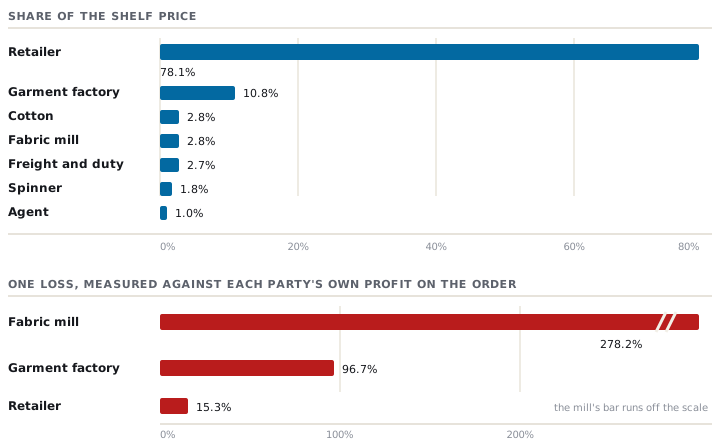
Read that table slowly. It is the centre of this course.
The mill cannot pay for its own mistake. Calderfield's entire profit on this order is 35.9% of the loss it caused. Even a mill acting in perfect good faith cannot put this right out of this order. It would have to fund it from other customers' work.
The factory can pay, and it costs it the year. Verrick's whole profit on 74,400 sweatshirts is USD 35,756.64. The concession takes 96.7% of it. Verrick did not choose the mill, did not dye the fabric, and made no error. It ends the order with USD 1,196.64 left.
The retailer feels it least, and it made the decision. For Halvedge the loss is 15.3% of what it planned to make on the style. That is a bad line in a report, not a bad year.
Why it landed there, and why nobody was wrong
There is no villain here. Follow the sequence.
- Halvedge nominated Calderfield to protect the shade across its whole autumn range. Correct.
- Verrick bought from the nominated mill because its contract requires it. Correct.
- Calderfield accepted a fabric order at a price Halvedge had negotiated, with Halvedge's own volume in mind. Correct.
- The dyeing drifted, which happens in every dyehouse on earth.
- Verrick's claim against Calderfield ran into the ordinary limits. The fabric had been inspected, accepted and cut before the fault was called. And Calderfield's terms cap any claim at the invoice value of the goods, and exclude the cost of making them up. Correct, and standard.
- So the loss stopped at the company that had taken title, cut the cloth and needed the next order.
The risk did not land where the fault was, and it did not land where the decision was. It landed where refusal was least affordable. Halvedge could have refused the shipment. Calderfield could have refused the claim, and largely did. Verrick could have refused the concession. But Halvedge is 41.0% of Verrick's sewing capacity this year.
The risk the retailer really does carry
None of this means the retailer takes no risk. It takes the largest risk in the chain by a wide margin, and it is worth measuring so the comparison is honest.
Halvedge plans this style at 72% full-price sell-through. Sell-through is the share of the pieces that sell before any price cut, and 72% is Halvedge's own planning figure, not an industry rule. It achieves 61%.
Eleven points of 74,400 pieces is 8,184 pieces. Those sell at the first markdown of 40% off USD 49.00, which is USD 19.60 a piece given away: USD 160,406.40, or 71.0% of the profit Halvedge planned on the style.
That is more than four times the shade loss in cash, and it lands on the retailer alone. Verrick is paid its FOB whatever the sell-through turns out to be.
So the difference between the two exposures is not size. It is this.
- The markdown risk is priced. It is the reason the retail margin is 78.1% of the shelf price and not 30%. Halvedge knows it will lose some of every range. It plans for it and charges for it.
- The shade risk was priced at nothing. Verrick's FOB of USD 8.90 holds no allowance for a nominated mill's dyeing. Lesson 6 works out what that allowance should have been.
A risk you are paid to carry is a business. A risk you carry without being paid is a tax. The tiers differ far less in how much risk they hold than in which of the two kinds they hold.
Check yourselfVerrick's insurer is not involved and Verrick's contract with Calderfield capped the claim at invoice value. Where should the USD 34,560 have gone?Show the answer
Somewhere it was priced. There are three honest homes for it. A made-up-goods clause in the fabric contract, which the mill would price into the cloth. A shade allowance inside Verrick's FOB, which Halvedge would pay in the piece price. Or a clear Halvedge policy that a nominated mill's fault is Halvedge's own, which is the cleanest and the rarest. What actually happened is the fourth option: nobody put it anywhere, and it settled by gravity on the thinnest party.
Prompt · Price the risks I carry and am not paid for
When a quotation is being built, or after an order where a loss landed on you that you did not cause.
Act as a factory cost analyst who is neither optimistic nor defensive, and who shows every calculation. I want the risks I absorb without payment turned into a per-piece number I can put into a price. My order: style [STYLE], quantity [TOTAL], term and price [FOB OR OTHER, AMOUNT], my net margin on this order [PERCENT OF SELLING PRICE], my working capital rate as quoted by my own bank [PERCENT A YEAR], payment days from bill of lading [NUMBER]. The risks I carry: nominated materials, value on this order [AMOUNT], and my uncovered claims on nominated materials over the last three years as a percentage of nominated value [PERCENT]; indicative quantities I must buy materials against, last twelve orders as [INDICATED QTY, CONFIRMED QTY, MATERIAL WRITTEN OFF]; concessions and discounts I have granted for faults I did not cause, last twelve orders [AMOUNTS]; testing and re-inspection costs I absorbed [AMOUNTS]; any delivered-terms exposure such as duty, demurrage or currency [DESCRIBE, WITH MY OWN INCIDENT RECORD AS EVENTS OUT OF SHIPMENTS AND AVERAGE COST]. Do the following. First, turn each risk into an expected cost for THIS order and then into a figure per piece, showing the arithmetic. Second, state each one as a percentage of my selling price and as a percentage of my PROFIT on this order, because those two numbers argue very differently. Third, tell me which of these risks an allowance can honestly cover and which are too lumpy for one — compare the largest single historic loss against the annual allowance and say how many years of allowance it consumed. Fourth, for each risk give me the three ways it could be re-homed: priced into my quotation, taken back by the party that chose the supplier, or removed by a contract clause; and say what the clause would have to say. Fifth, write the one sentence I should say to the customer for each risk, in the form of a number rather than a complaint. Label every estimate as an estimate.
AI can make mistakes — check anything you act on.
Lesson 3 stays with Verrick and asks a different question. The shade fault was at least visible. What happens to a factory over something it can never see at all?