Lessons · Lesson 5 of 6
An integrated group and a coordinated chain
Price the premium a buyer pays for a single owner, against the thing it is supposed to buy, and check which stages the owner actually owns.
Lesson 5 of 6 · 18 min
The same sweatshirt, quoted twice
Halvedge asks a second supplier to quote HV-3110.
Anselm Group owns spinning, knitting, dyeing and garment making. Yarn made in its own mill becomes fabric in its own knitting hall, is dyed in its own dyehouse, and is cut and sewn in its own factory. One company, one balance sheet, one managing director. That is what vertically integrated means: one owner across several stages.
Verrick Knitwear owns a cutting room and sewing floors. It buys yarn through a merchant, has it knitted by a commission knitter, dyed by Calderfield, and makes the garments. Four companies, four balance sheets, three commercial handoffs.
Anselm quotes USD 9.29. Verrick quotes USD 8.90. The difference is USD 0.39 a piece, which on 74,400 pieces is a premium of USD 29,016.
The sourcing paper recommends Anselm and gives the reason everybody gives: shorter chain, one point of accountability, faster to fix a problem. All three sentences are true. This lesson asks whether they are worth USD 29,016, and finds a more interesting answer than yes or no.
What a buyer is actually buying
Not machines. Anselm's dyeing machines are the same machines Calderfield has, run by people trained in the same places.
What differs is who decides, and how many refusals stand between a problem and its fix.
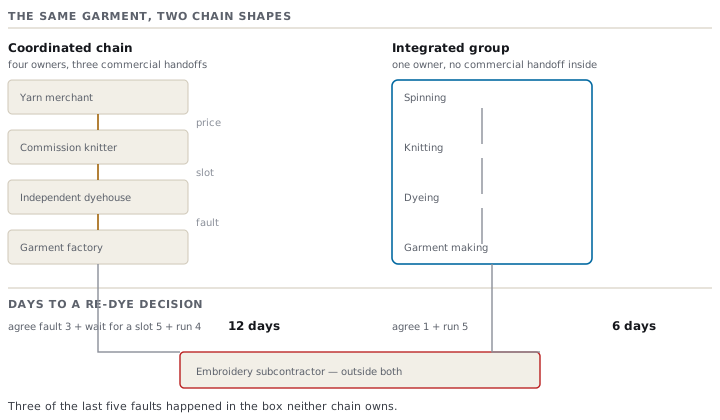
Take lesson 2's shade fault and run it through both shapes.
In the coordinated chain, three separate things have to happen, and each is a negotiation with a company that has its own book to protect.
- Agree whose fault it is: 3 days. Calderfield's technologist says the undyed cloth was fine. The knitter says the yarn lot changed. The merchant says the yarn met specification. Somebody eventually concedes.
- Get a dyeing slot: 5 days. Calderfield's kettles are full of another customer's work. Verrick is 4.1% of Calderfield's year, and a re-dye for 4.1% of your year does not move the customer who is 20% of it.
- Run it: 4 days.
Twelve days.
In the integrated group, the dye lab, the dyehouse planner and the garment planner all report to the same person and are measured on the same order.
- Agree and decide: 1 day. There is no fault to allocate, because there is nobody to allocate it to.
- Run it: 5 days, slower than Calderfield because Anselm's dyehouse is smaller.
Six days.
So the whole advantage is 6 days, and it is real. It is not a technical advantage. It is the absence of three commercial conversations.
Price the six days, then check the odds
Six days late on HV-3110 means missing the week 33 floor set. Halvedge's own figure for that: 8,900 pieces would then sell at the first markdown of 30% off USD 49.00, which is USD 14.70 a piece — USD 130,830.
Against a premium of USD 29,016, that looks decisive. It is not, because it only happens when there is a fault.
Halvedge's own record for this category: a fabric fault reached a re-dye decision on 5 of the last 27 orders. Five in twenty-seven is 18.5%, so the expected value of the six days is 130,830 times 5 divided by 27, which is USD 24,227.78.
That is 83.5% of the premium. On the response argument alone, and before anything else is considered, the integrated group is already slightly the worse buy.
Then comes the number that settles it. Of those five faults, how many were at a stage Anselm actually owns?
Two.
The other three were at the embroidery subcontractor. The chest logo on HV-3110 is a 9,400-stitch embroidery, and Anselm subcontracts it to the same shop Verrick uses, because neither of them owns embroidery machines. On those three faults Anselm's structure buys nothing at all: the same negotiation with the same outside company, on the same terms.
So the six days apply to two faults in five, and the expected value falls to USD 9,691.11, which is 33.4% of the premium.
What the coordinated chain buys, which does not appear on a quotation
The comparison is not finished, because the coordinated chain has an advantage of its own, and it also has a number.
In March, Trescoe's quoted lint price moves from USD 1.86 to USD 2.21 a kilogram, up 18.8% in this invented market.
Verrick's chain can move. Its yarn is bought through a merchant, so when one spinner's price moves it can take the next order's yarn from another. Its fabric price holds at USD 5.85 a kilogram.
Anselm cannot move. It owns spinning capacity, it is committed to running it, and it passes through USD 0.31 a kilogram of the increase. At 0.62 kg a piece that is USD 0.1922, which on the next order of the same size is USD 14,299.68, or 49.3% of the premium Halvedge paid to be inside one company.
Integration is a bet on your own demand. A group that owns every stage must keep every stage loaded, so when a stage becomes uncompetitive the group keeps buying from it. A coordinated chain owns nothing and can therefore leave anything. That freedom to leave is invisible on a quotation, and it is worth money in exactly the seasons when a market moves.
So which one is the buyer really buying
Neither speed nor accountability survives the arithmetic on its own. What does survive is narrower and more honest, and it is worth saying plainly, because it is what a factory should sell against.
A buyer pays for a single owner when the failure it fears sits inside that owner's walls and is expensive when it happens. For a printed jersey tee, where the fault is nearly always in the print, integration buys almost nothing. For a piece-dyed garment where the whole risk is shade and the shade is dyed in-house, it buys a great deal.
And here is the second half, which is the answer for a factory like Verrick reading this. You cannot buy your way to one owner, but you can buy your way to one decision. Verrick's twelve days were three days of arguing about fault and five days of waiting for a slot. Neither of those needs ownership to fix. A fault-allocation clause saying the mill runs the re-dye first and settles afterwards removes the three days. A standing block of dye capacity, paid for whether it is used or not, removes most of the five. Priced against USD 130,830, both are cheap.
Check yourselfAnselm is dearer and owns four of your five risky stages. Verrick is cheaper and owns one. What else do you need before choosing?Show the answer
Which stage actually fails, in your own history rather than in general. The whole comparison turns on it. An integration premium is paid on every order and collected only when a fault lands inside the owned stages. You need the count of faults, which stage each was in, and what each cost — three columns on the last twenty orders. If most of them sit in a subcontracted stage, you are being asked to pay for a wall around the wrong stages, and the money is better spent on the two clauses that remove the argument and the queue.
Prompt · Cost the intermediary I am about to remove
The week somebody proposes going direct, dropping an agent, or paying a premium for a supplier that owns more of the chain.
Act as an analyst who has no view on intermediaries and reports arithmetic. I am considering removing a tier from my chain, or paying a premium to shorten it. Case A, removing an intermediary: the intermediary is [NAME AND WHAT IT IS], its charge is [RATE AND BASIS], my order quantity [NUMBER], my unit price [AMOUNT]. What it currently does, one a line, with what it would cost me to do instead: [FUNCTION, MY REPLACEMENT COST, AND WHETHER THAT COST IS FIXED PER ORDER OR VARIES WITH QUANTITY]. Also state, separately: the payment days it currently absorbs and whose working capital would fund them instead, at [PERCENT A YEAR]; the claims it currently settles at its own cost, [AMOUNT AN ORDER]; and any consolidation, freight or volume benefit that disappears with it, [AMOUNT PER PIECE]. Case B, paying for a shorter chain: the premium is [AMOUNT PER PIECE], the supplier owns these stages [LIST] and subcontracts these [LIST], my style's operations are [LIST], and my own fault history over the last [NUMBER] orders is [FOR EACH FAULT: WHICH STAGE, WHAT IT COST, HOW MANY DAYS IT TOOK TO RESOLVE]. Do the following. For case A, split the replacement into a fixed cost per order, a stepped cost, and a variable cost per piece; give me the total at my quantity; and SOLVE for the break-even quantity at which removing the tier stops costing money and starts saving it. Then run it at half and at three times my quantity. Then split the replacement cost into what lands on the buyer and what lands quietly on the supplier, and say which party each line actually falls on in a direct arrangement. For case B, work out the premium on my order, the cost of the delay the shorter chain would avoid, the probability of that delay from my own fault history, and then RE-COMPUTE the probability using only the faults that occurred in stages the supplier actually owns. State both figures and the gap between them. Finally, for both cases, name the two or three contract terms that would buy most of the benefit without the structural change, and price them. Show every calculation.
AI can make mistakes — check anything you act on.
Lesson 6 takes the pattern out of these five and turns it into something you can run on your own customer without any of the invented numbers.