Lessons · Lesson 3 of 6
The signal you cannot see decides your order book
Trace a small miss at the till into a large cut at the factory, and price the fabric a factory buys against a number it is never shown.
Lesson 3 of 6 · 18 min
Two tiers from the shop floor, you receive decisions
Verrick's planning manager knows exactly one thing about demand for HV-3110: the quantity on the purchase order. She does not see Halvedge's weekly sales. She does not see its stock position. She does not see the second style Halvedge is running against this one in the same wall bay.
Nobody is hiding anything. This is a property of the shape. Verrick is two tiers from the shop floor, and what crosses each tier boundary is a decision, not a signal. A signal is what the till produced. A decision is what somebody made after reading it. By the time a decision reaches you it already contains a judgement you cannot see and cannot argue with.
This lesson follows one till number all the way to Verrick's fabric store, and puts a number on what it cost to be blind to it.
Six weeks of selling, and one honest arithmetic
HV-3110 lands on the floor in week 33. Halvedge's plan for the first six weeks is 4,650 pieces a week. It sells 4,100.
That is a miss of 11.8%. It is not a disaster. A buyer looking at it in week 39 would call the style soft, not dead.
Halvedge had planned a repeat of 38,000 pieces for the second delivery. Its planner now does two completely correct things.
- Rebase the forward rate. If the style sells at 4,100 rather than 4,650, the repeat should carry the same ratio: 38,000 times 4,100 divided by 4,650, which is 33,505.
- Correct the stock. Closing stock at week 38 was planned at 32,000 pieces and came in at 35,300, because the sales that did not happen stayed on the shelf. Those 3,300 pieces are already bought and already paid for, so they come off the repeat.
33,505 minus 3,300 is 30,205, and the buyer confirms 30,200.
| Measured at | Planned | Actual or revised | Change |
|---|---|---|---|
| The till, weekly units | 4,650 | 4,100 | −11.8% |
| The repeat purchase order | 38,000 | 30,200 | −20.5% |
| Fabric called off, kilograms | 23,560 | 18,724 | −20.5% |
| Verrick's line-days on the style | 32.20 | 25.59 | −6.61 |
A miss of 11.8% at the till arrives at the factory as a cut of 20.5%, which is 1.74 times the size. Neither number is wrong. The amplification is arithmetic. The order has to absorb both the lower rate and the stock the lower rate left behind, and only one of those is a change in demand at all.
What it cost, and why nobody breached anything
Verrick lost 6.61 line-days. A line-day is one sewing line running for one day. Its contribution on this style is USD 705 a line-day, so that is USD 4,660 it will not earn, and at five weeks' notice it cannot sell those days to anybody else.
The larger number is in the fabric store. Verrick had bought fabric for 38,000 pieces. Calling fabric off means asking the mill to dye and deliver it, and Calderfield's lead time forced that call long before the repeat was confirmed.
- Bought: 38,000 times 0.62, which is 23,560 kg.
- Needed: 30,200 times 0.62, which is 18,724 kg.
- Surplus: 4,836 kg, at USD 5.85 a kg, which is USD 28,290.60 of dyed fabric with no order behind it.
Verrick sells 42% of its value as a stock lot to a local jobber and writes off the rest: USD 16,408.55, which is 45.9% of its whole profit on the original order.
Now list who did anything wrong.
- Halvedge's plan was a plan and was labelled one. The 38,000 was an indication.
- Halvedge's cut was arithmetically correct. A buyer who had not cut it would have been wrong.
- Verrick bought fabric against the indication because the dyeing lead time is longer than the notice period. Any factory would have.
- Calderfield dyed what it was asked to dye.
Every party forecast correctly at its own tier, and the chain still produced a write-off. That is what a structural problem looks like. It survives everybody doing their job.
The amplification does not stop at the garment
Watch what the cut does to the colours. The repeat keeps the original ratio, so 30,200 pieces splits into Fenmoor 13,600, Oatmoss 10,390 and Redlark 6,210. In kilograms that is 8,432, 6,442 and 3,850.
Calderfield's minimum dye lot is 6,000 kg. That is the smallest batch it will run in one kettle at one shade. Redlark is now below it. Calderfield will still run it, at a short-lot surcharge that takes that colour's fabric from USD 5.85 to USD 6.14 a kilogram, which is 5.0% more.
So one soft style produced, in sequence: a miss of 11.8% at the till, a cut of 20.5% at the purchase order, an identical cut in kilograms, and a price increase of 5.0% on one of three colours. The signal got larger and changed sign as it travelled. Nobody upstream can predict that from what they are shown, because what they are shown is a total.
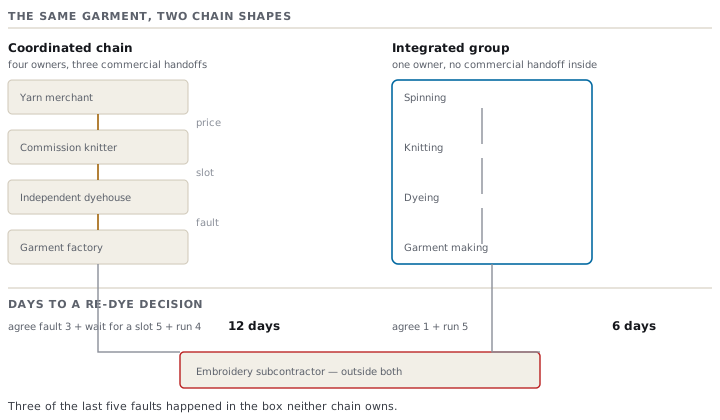
That drawing belongs properly to lesson 5, and it is here for one reason. Count the boxes between the till and the dyehouse in either shape. Every box is a place where a signal becomes a decision.
Check yourselfVerrick asks Halvedge for weekly sell-through on its own styles. Halvedge's buyer says no. Is that unreasonable?Show the answer
It is not unreasonable, and it is worth understanding why, so you can ask for the right thing instead. Sell-through by style is competitive information. It is often restricted by contract where a retailer runs concessions inside other stores. And a buyer who releases it invites every supplier to argue with every buying decision. What a factory can usually get is narrower and nearly as useful: a call-off schedule with a firm window and a forecast window, stated separately. Lesson 4 shows what a factory should be willing to pay for it, and the answer is not nothing.
What a factory can actually do about it
Three things, none of which needs the retailer to change.
Split the call-off against the confirmed part. Verrick's error was not buying fabric early. It was buying all of it early. The confirmed 74,400 needed 46,128 kg. The 38,000 indication needed a further 23,560. Dyeing the second block in two halves would have cost a second lot charge on two colours and saved most of USD 16,408.55.
Price the indication. An indicative quantity that a factory must buy fabric against is not free to the factory, so it should not be free to the buyer. A quantity band with a floor — not less than 24,000 — costs the buyer nothing when the style sells, and is worth the whole write-off when it does not.
Ask for the shape of the signal, not the signal. You will rarely get sell-through. You can often get the week the style hits the floor, the number of doors, and whether the repeat is planned or optional. All three are things a buyer can say without disclosing anything, and all three change how a factory buys fabric.
Prompt · Price the risks I carry and am not paid for
When a quotation is being built, or after an order where a loss landed on you that you did not cause.
Act as a factory cost analyst who is neither optimistic nor defensive, and who shows every calculation. I want the risks I absorb without payment turned into a per-piece number I can put into a price. My order: style [STYLE], quantity [TOTAL], term and price [FOB OR OTHER, AMOUNT], my net margin on this order [PERCENT OF SELLING PRICE], my working capital rate as quoted by my own bank [PERCENT A YEAR], payment days from bill of lading [NUMBER]. The risks I carry: nominated materials, value on this order [AMOUNT], and my uncovered claims on nominated materials over the last three years as a percentage of nominated value [PERCENT]; indicative quantities I must buy materials against, last twelve orders as [INDICATED QTY, CONFIRMED QTY, MATERIAL WRITTEN OFF]; concessions and discounts I have granted for faults I did not cause, last twelve orders [AMOUNTS]; testing and re-inspection costs I absorbed [AMOUNTS]; any delivered-terms exposure such as duty, demurrage or currency [DESCRIBE, WITH MY OWN INCIDENT RECORD AS EVENTS OUT OF SHIPMENTS AND AVERAGE COST]. Do the following. First, turn each risk into an expected cost for THIS order and then into a figure per piece, showing the arithmetic. Second, state each one as a percentage of my selling price and as a percentage of my PROFIT on this order, because those two numbers argue very differently. Third, tell me which of these risks an allowance can honestly cover and which are too lumpy for one — compare the largest single historic loss against the annual allowance and say how many years of allowance it consumed. Fourth, for each risk give me the three ways it could be re-homed: priced into my quotation, taken back by the party that chose the supplier, or removed by a contract clause; and say what the clause would have to say. Fifth, write the one sentence I should say to the customer for each risk, in the form of a number rather than a complaint. Label every estimate as an estimate.
AI can make mistakes — check anything you act on.
Course 11.5 is where the demand signal itself is studied: what an outlook is worth and how to read one. This lesson claims only the structural half. The further you are from the till, the later and the larger the news arrives, and neither of those is anybody's fault.