Lessons · Lesson 2 of 6
The back-to-back: your buyer's credit as collateral
Turn the credit you hold into a credit your fabric mill will accept, and cost the structure line by line against the bank's own tariff.
Lesson 2 of 6 · 20 min
A credit in your favour is an asset
A documentary credit is a bank's own promise to pay you against documents. Once it is advised to you, you hold something whose value does not depend on your own balance sheet. It depends on Northgate Union Bank's.
A back-to-back credit puts that to work. Almasa Commercial Bank issues a second, completely separate documentary credit in favour of Chenglin Textile Mills, and takes comfort from the first one. Chenglin never deals with Sakhra's creditworthiness at all. It deals with Almasa's.
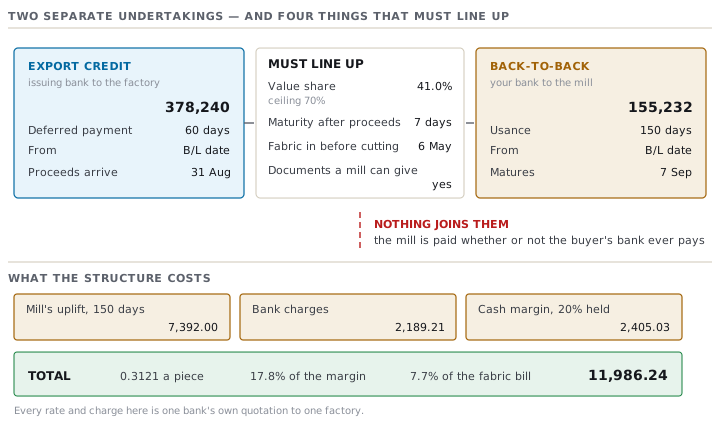
"Back-to-back" describes a commercial arrangement, not a legal one. Nothing in the rulebook joins the two credits. Almasa's promise to Chenglin stands on its own. Almasa must honour it against correct documents whether or not Sakhra ever ships a garment, and whether or not Northgate ever pays. Hold on to that sentence. Lesson 5 is built on it, and so is everything Almasa is about to ask for.
What Almasa needs before it will issue
Mervat Shukri in Almasa's trade finance department reads the export credit before she reads Sakhra's accounts. Six things have to be true.
- The export credit must be advised through Almasa. If Northgate's credit is advised through another bank, Almasa has no grip on the documents and no way to be sure the money comes to it. It will decline, politely, and will not explain why.
- The export credit must be workable. No term Sakhra cannot physically meet. No document that only Wrenfield can issue. No condition that depends on something outside Sakhra's control. If the credit asks for something no document can prove, Almasa will not build on it, because its own risk would then rest on Wrenfield's goodwill.
- The issuing bank and its country must be acceptable. Almasa's credit committee scores Northgate Union Bank and the market it sits in. This is not a formality. It is the whole basis of the deal.
- The second credit must sit well inside the first. Almasa's own rule: a back-to-back may not exceed 70% of the export credit's value. Sakhra's fabric credit is 41.0% of it. Comfortable — and worth knowing before you negotiate a fabric price.
- The second credit must fall due AFTER the export money arrives. This is the condition that fails in practice. Lesson 4 is about the day it did.
- Security. A cash margin, an assignment of the export credit's proceeds to Almasa, and the export documents routed through Almasa. On this deal the margin is 20% of the second credit's value.
The tenor problem, and what it costs at the mill
Chenglin asked to be paid at sight, meaning as soon as it presents its documents. Almasa will not do that. Paying the mill in April out of Almasa's own money, then waiting until 31 August to get it back, is a loan to Sakhra. Almasa has already refused to lend to Sakhra. That refusal is the reason this structure is being discussed at all.
So the second credit is issued at a tenor. Tenor is how long the credit waits before it pays. This one is payable 150 days from the bill of lading date. The fabric bill of lading is dated 10 April, so the credit falls due on 7 September — after the export money lands on 31 August. Almasa is never out of pocket.
Chenglin will do it, at a price. Here is its quotation, which the mill states openly:
| Payment instrument | USD a metre | On 67,200 metres, USD |
|---|---|---|
| Documentary credit at sight | 2.20 | 147,840 |
| Documentary credit, 150 days from bill of lading | 2.31 | 155,232 |
| Open account, 90 days | 2.255 | 151,536 |
The 150-day price is 5.0% above the sight price. That is USD 7,392.00 on the order, or USD 0.1925 a piece. The third row is not available to Sakhra yet, and lesson 6 comes back to it.
Now read that uplift as an interest rate rather than as a percentage of the fabric bill. At sight the mill would have been paid around 17 April. Now it is paid on 7 September. It waits 143 days longer for 5.0%. That works out at 12.8% a year, simple.
Almasa's working-capital rate to Sakhra is 14.5%. Chenglin's money is cheaper than Sakhra's bank's money, and it is available to a factory the bank has refused. Every figure in the last two paragraphs belongs to this mill and this bank and is only an example. The arithmetic that turns an uplift into a rate is not an example. It is the single most useful calculation in this course.
What Almasa charges
| Charge | Basis | USD |
|---|---|---|
| Opening commission | 0.30% flat on the credit amount | 465.70 |
| Usance commission | 0.125% per 30 days or part, 195 days is 7 periods | 1,358.28 |
| SWIFT, advising and handling | flat | 210.00 |
| Settlement commission | 0.10% on payment | 155.23 |
| Bank charges | 2,189.21 |
Then the margin. A cash margin is money you deposit with the bank and cannot touch while the credit is alive. 20% of USD 155,232 is USD 31,046.40, locked from the day the credit is issued until it settles — 195 days. Sakhra funds it out of a previous order's money, so its cost is not interest. It is the same money doing nothing. At 14.5%, that is USD 2,405.03.
The total, and what it is really being compared with
| Component | USD |
|---|---|
| Mill's uplift for the 150-day tenor | 7,392.00 |
| Almasa's charges | 2,189.21 |
| Cost of the cash margin | 2,405.03 |
| Total | 11,986.24 |
USD 0.31 a piece. 17.8% of the order's gross margin. 7.7% of the fabric bill.
That last figure is the one to carry around. Financing fabric this way costs about 7.7% of what the fabric costs. Not a rate per year — a slice off the top.
Now the honest comparison. If Almasa had simply lent Sakhra USD 147,840 at 14.5% from 17 April to 31 August, lesson 1 priced that at USD 7,987.41. The back-to-back is USD 3,998.83 dearer.
The back-to-back is not cheap. It is available. The overdraft in that comparison does not exist, and will not exist until Sakhra has a trading record and security it does not have today. The real alternative to USD 11,986.24 is not USD 7,987.41. It is turning down PO WM-8172 and its USD 67,200 of gross margin.
Check yourselfChenglin's uplift for waiting 143 days is 5.0% of the fabric price. Sakhra's bank lends at 14.5%. Which is dearer, and what does the answer tell you to do first next season?Show the answer
The mill is cheaper. 5.0% over 143 days works out at 12.8% a year, against the bank's 14.5%. So negotiate the tenor with the mill BEFORE you go to the bank. Every day of credit you buy from the supplier is a day you do not have to buy from a lender at a higher price. And unlike the bank, the mill does not ask for a cash margin.