Lessons · Lesson 1 of 6
The gap you are actually financing
Measure the hole between the day the mill is paid and the day the buyer's money lands, on one real order, and put a price on it.
Lesson 1 of 6 · 20 min
The order that everybody is pleased with
3 February. Sakhra Apparel Company is a woven-shirt factory in Sadat City. It confirms PO WM-8172 with Wrenfield Menswear of Leeds: 38,400 men's cotton twill overshirts, style MO-624, four sizes, two colours. The price is FOB Alexandria USD 9.85. FOB means the price covers everything up to the goods being loaded on the ship. Order value USD 378,240. On board 2 July.
The payment terms are the good kind. Wrenfield's bank, Northgate Union Bank in London, issues a documentary credit in Sakhra's favour. A documentary credit is a bank's own written promise to pay you when you hand over the right documents, and it cannot be cancelled. It is advised — passed on — through Sakhra's own bank, Almasa Commercial Bank in Cairo. Payment is deferred: it falls due 60 days after the bill of lading date. The bill of lading is the document the carrier issues when the goods go on board. Nobody has to chase anyone. Course 13.2 teaches you to read that credit for the terms that will get your documents refused. This course starts one step earlier, from a fact the credit never mentions.
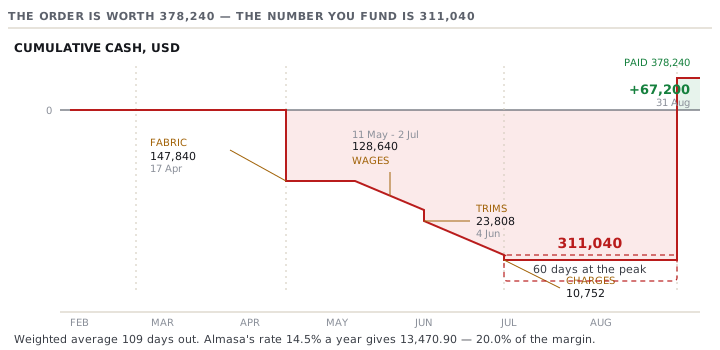
Sakhra has to spend USD 311,040 before a single dollar of the USD 378,240 arrives.
That is not a vague cash-flow worry. It is a specific sum, on specific dates, and you can work it out to the day. This lesson works it out.
What the order costs, and what is left
| Line | Per piece, USD | On 38,400 pieces, USD |
|---|---|---|
| Fabric, 1.75 m at USD 2.20 a metre | 3.85 | 147,840 |
| Trims, interlining, labels, packing | 0.62 | 23,808 |
| Cut, make and trim | 3.35 | 128,640 |
| Export charges to the ship's rail | 0.28 | 10,752 |
| Total cash out | 8.10 | 311,040 |
| FOB Alexandria | 9.85 | 378,240 |
| Gross margin | 1.75 | 67,200 |
Every line there is correct. Every line has been checked twice. What no line carries is a date, and the dates are where this order gets difficult.
The dates
The fabric is a yarn-dyed cotton twill from Chenglin Textile Mills in Shaoxing. Yarn-dyed means the yarn is coloured before it is woven. Chenglin needs 45 days from the day it holds a payment instrument it can work with. The cloth then needs about three weeks at sea, plus clearance and inland transport. Count that backwards from a 2 July vessel and the fabric order cannot wait.
- 24 February — the fabric is ordered and Chenglin is given a payment instrument it will accept.
- 10 April — the fabric goes on board at Shanghai.
- 17 April — Chenglin presents its documents and is paid at sight. USD 147,840 leaves.
- 6 May — the cloth is in Sadat City, inspected and relaxed.
- 11 May to 2 July — cutting, sewing, finishing and packing. USD 128,640 of wages and factory cost goes out across those eight weeks.
- 4 June — the trims supplier's 45-day terms fall due. USD 23,808 leaves.
- 2 July — on board at Alexandria. USD 10,752 of export charges leaves.
- 9 July — documents presented to Almasa and forwarded to Northgate.
- 31 August — 60 days after the bill of lading date, USD 378,240 arrives.
Putting a price on the wait
Almasa quotes Sakhra a working-capital rate of 14.5% a year, simple interest on a 365-day year. Every rate and charge in this course is this bank's own quote to this factory, and it is only an example. Your bank's number is on your own facility letter, and that is the only one you may use.
Price each outflow by the number of days it waits for the money on 31 August.
| Outflow | Date it leaves | USD | Days to 31 August | Cost of the wait, USD |
|---|---|---|---|---|
| Fabric, paid at sight against the mill's documents | 17 April | 147,840 | 136 | 7,987.41 |
| Wages and factory cost, at the midpoint of the run | 6 June | 128,640 | 86 | 4,394.91 |
| Trims, on 45-day terms | 4 June | 23,808 | 88 | 832.30 |
| Export charges | 2 July | 10,752 | 60 | 256.28 |
| Total | 311,040 | 13,470.90 |
USD 13,470.90. That is USD 0.35 a piece. It is 20.0% of the order's gross margin of USD 67,200. A fifth of what this order earns is eaten by one fact: the money arrives after the costs.
Now read the table again. It tells you three things the total does not.
One: the order value is not your exposure
A merchandiser quotes USD 378,240. The bank lends against a different figure. The money that has to exist somewhere is USD 311,040, and only for an average of 109 days. That matters when you ask for a facility. Ask for a limit sized on the order value and you will be refused. Ask for a limit sized on the cash profile and you have an argument.
Two: the fabric is where the money is trapped
The fabric is 47.5% of the cash out and 59.3% of the cost of waiting. It costs more than its share because it goes out first and stays out longest — 136 days of the 136-day window. Nothing else on the order is close.
That gap is the reason this course exists. Halving the fabric's wait is worth about ten times as much as halving the export charges' wait. And only one of the two can be negotiated.
Three: the peak is not the average
From 2 July to 31 August, Sakhra is out USD 311,040 on this order and gets nothing back for 60 days. Run four orders of this size with staggered ship dates and the peaks overlap. The factory then needs several times one order's number. A facility sized on one order will fail in the month all four peaks meet.
What a mill will actually accept
Chenglin opens at 30% with the order and the rest in cleared funds before the cloth leaves the mill. Sakhra does not have it, and saying so out loud is not a negotiating position.
What Chenglin will take instead is a bank's promise rather than Sakhra's. Not because a bank is nicer. A bank's promise is a different kind of thing: it does not depend on whether Sakhra's order goes well. The next three lessons cover the two ways to give a supplier that promise out of the credit you already hold, what each one costs, and which risk each one moves onto whom.
Check yourselfSakhra's order is worth USD 378,240 and its gross margin is USD 67,200. What number should it take to the bank when it asks for a facility, and why?Show the answer
Neither. It should take USD 311,040 with the dates attached. That is the cash that has to exist, and 109 days is how long it has to exist for. The order value is too big: it includes the whole margin and every dollar the buyer's money covers the moment it lands. The margin is too small, by a factor of nearly five. A facility request is a request about a cash profile, and the profile is the table, not the total.