Lessons · Lesson 3 of 6
Transferable: passing part of the credit along
Transfer part of a credit to the factory that will actually make the goods, price it, and see the one problem a transfer can never solve.
Lesson 3 of 6 · 18 min
A second order, and a different problem
11 August. Wrenfield places the repeat: PO WM-8390, 21,600 pieces of the same MO-624 overshirt, same FOB USD 9.85, order value USD 212,760. Northgate issues the credit in the usual way, with one difference. This one says, on its face, that it is transferable.
Sakhra has a problem that has nothing to do with money. Its own floor can take 7,200 pieces in the window and no more. The other 14,400 have to be made by Selmiya Garments in Tenth of Ramadan, a shirt factory Amr Tantawy has used twice before.
Selmiya asks the question every subcontractor asks: who is paying me, and when. Sakhra's honest answer is "Wrenfield, at the end of November, and I will pass it on when it arrives". Nobody accepts that answer.
The transferable credit exists for exactly this.
Transferable means it says so, and nothing else does
A credit is transferable only if the issuing bank states that it is, on the face of the credit. There is no back door. A credit that does not say so cannot be made transferable by asking the advising bank nicely, by agreeing it in the purchase order, or by anything the beneficiary does. It takes an amendment issued by the issuing bank — which means going back to Wrenfield and asking Wrenfield to instruct Northgate.
And even when the credit does say so, the bank asked to transfer is under no obligation to do it, beyond what it expressly agrees to. Almasa can decline. It usually will not, because a transfer costs it nothing. But the right is real, and it is worth knowing that the transferring bank is doing you a service rather than performing a duty.
What may be changed when a credit is transferred
The transferred credit is the original credit, with a short list of permitted changes and no others. All of them move one way — down or shorter — except one, which moves up.
- The amount may be reduced.
- The unit price may be reduced.
- The expiry date may be brought forward.
- The last date for presentation may be brought forward.
- The period for shipment may be shortened.
- The percentage of insurance cover may be increased.
- The applicant's name may be replaced by the first beneficiary's.
Everything else transfers as it stands: the goods description, the documents required, the terms of delivery, the ports.
The insurance line is the one that surprises people, because it is the only increase in a list of decreases. The arithmetic shows why. Wrenfield's credit is FOB, so it asks for no insurance document and the point does not bite here. But change one letter of the terms and it does. Suppose a credit at USD 9.85 a piece requires cover for 110% of invoice value. That is 10.835 a piece. The second beneficiary invoices at USD 8.90, so to produce the same cover its policy has to be written for 122% of its own invoice. 8.90 at 122% is 10.858, which clears it. Round that percentage up, never down.
The numbers
| Pieces | USD a piece | USD | |
|---|---|---|---|
| Transferred to Selmiya Garments | 14,400 | 8.90 | 128,160 |
| Retained by Sakhra on the transferred leg | 14,400 | 0.95 | 13,680 |
| Made and drawn by Sakhra itself | 7,200 | 9.85 | 70,920 |
| Credit total | 21,600 | 9.85 | 212,760 |
Almasa charges 0.25% of the transferred amount to transfer, minimum USD 250, plus USD 85 of SWIFT and handling. On USD 128,160 that is USD 320.40 plus 85, a total of USD 405.40.
No cash margin. No commission per month. No interest. USD 405.40 — 0.32% of the amount moved, or USD 0.0282 on each transferred piece.
Set that beside lesson 2. The back-to-back cost 7.7% of the amount it covered. The transfer costs 0.32% of the amount it covers. Twenty-four times less, for a structure that looks similar on the surface. Lesson 5 is entirely about why.
Substitution, and what it is for
Selmiya ships its 14,400 pieces and presents its documents to Almasa under the transferred credit, invoicing at USD 8.90. Almasa pays Selmiya out of Northgate's credit.
But Wrenfield's credit is for USD 9.85 a piece, and Wrenfield must never be handed an invoice showing USD 8.90. So Sakhra substitutes. It gives Almasa its own invoice and its own draft for the same goods at USD 9.85. Almasa swaps them for Selmiya's, forwards the set to Northgate, and Sakhra draws the USD 13,680 difference.
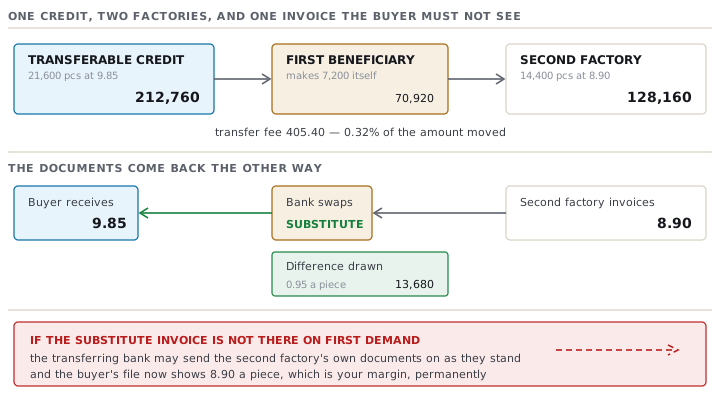
Substitution is the whole reason the mechanism has commercial value. Without it, a transfer announces your margin to your buyer. With it, the buyer's file shows one supplier, one price and one set of documents, exactly as if Sakhra had made all 21,600 pieces itself.
It is also the part that fails, and it fails for reasons that have nothing to do with anybody being careless. That is lesson 5.
Check yourselfSakhra's fabric mill wants a payment undertaking and Sakhra holds a transferable credit from Wrenfield. Can it transfer part of it to the mill?Show the answer
No, and the reason is worth stating precisely rather than as a rule of thumb. A transfer passes on the right to draw under the credit by presenting the documents the credit asks for. Here that means a bill of lading covering 38,400 overshirts from Alexandria to Felixstowe. The mill cannot produce that document, because the mill does not ship that cargo. A transfer serves a supplier of the finished goods. The mill needs a back-to-back, which is a separate credit describing cloth.