Lessons · Lesson 6 of 6
The cheaper answers, and why you cannot have them yet
Price five ways of paying for the same cloth to a cost per garment, and see why the dearest one is the only one on offer in year one.
Lesson 6 of 6 · 16 min
Five ways to pay for the same cloth
Everything in this course has been one question. How does USD 147,840 of Chinese fabric get paid for in April, out of money that arrives in August? The back-to-back is one answer. It is not the only one, and it is not the cheapest.
| Route | Cost on the order, USD | Per piece, USD | Share of the USD 67,200 margin | What it needs |
|---|---|---|---|---|
| The mill's own terms, 90 days open account | 3,696.00 | 0.0963 | 5.5% | three clean orders behind you |
| The buyer nominates and pays the mill | 4,032.00 | 0.1050 | 6.0% | the buyer to want to |
| Pay cash out of your own funds | 7,987.41 | 0.2080 | 11.9% | USD 147,840 sitting idle in April |
| A working-capital line at 14.5% plus a 1.0% arrangement fee | 9,987.41 | 0.2601 | 14.9% | a limit the credit committee will grant |
| A back-to-back credit | 11,986.24 | 0.3121 | 17.8% | a workable export credit advised through your bank, and a 20% cash margin |
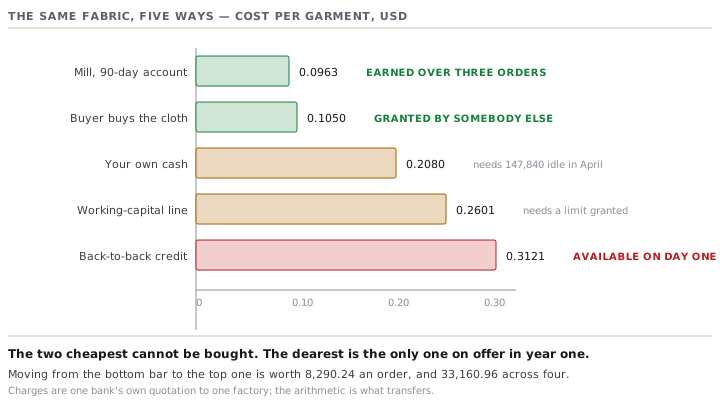
Read the table twice. The first reading gives you the order of cost: the back-to-back is the most expensive route on the page, by a distance.
The second reading gives you the finding. The two cheapest routes are the two you cannot buy. One is earned over years. One is granted by somebody else. The most expensive route is the only one available to a factory in its first season with a new mill. That is not a market failure. It is exactly what lesson 5 said the price measures: what the bank has promised, and to whom.
The mill's terms, priced properly
Chenglin's third rung was USD 2.255 a metre on 90 days open account, against USD 2.20 at sight. That is an uplift of 2.5%, or USD 3,696.00 on the order.
Convert it before you compare it, the way lesson 2 converted the 150-day price. At sight the mill is paid about a week after the bill of lading. At 90 days it waits 83 days longer for 2.5%. That works out at 11.0% a year — cheaper than Sakhra's own money at 14.5%, cheaper than a working-capital line, and about a third of what the back-to-back costs.
There is no bank in it. No margin, no commission per month, no document examination. It is the cheapest money on the page, and it costs USD 8,290.24 an order less than the back-to-back. Across four orders a year that is USD 33,160.96.
When the buyer buys the cloth
Wrenfield buys the same construction at USD 2.14 a metre, on its own volume across several suppliers. Suppose it nominates Chenglin, pays the mill direct, and deducts the cloth from the FOB price at USD 3.745 a piece. Sakhra's whole financing problem disappears.
It is not free. Sakhra's own fabric line is USD 3.85 a piece, so it gives up USD 0.105 a piece, or USD 4,032. That is the honest figure to put in the table.
What is not in the table is the part that costs more. When the buyer owns the fabric contract, you lose the delivery date. You cannot press a mill that does not invoice you. You have no leverage when the cloth slips three weeks. And the ship date is still yours. Take the money if you want it, but price the loss of control first. Read course 7.x on the critical path before you decide it is a bargain.
The one nobody asks for
The last route is not on the table, because it is a negotiation rather than a product: ask the buyer for a fabric advance. Thirty per cent against a bank guarantee is common in some markets and unthinkable in others. The instrument that makes it possible is course 13.7's subject. Course 16.4 is about how the ask is made. Most factories do not have this option, and the reason is not that buyers refuse. It is that nobody puts it on the list.
Where this course stops
This is one order. Four orders with overlapping peaks is a different problem, and it has its own arithmetic. Course 13.4 is the cash cycle across the whole book, and it is the course that tells you what size of facility you actually need.
And there is a second half to the 60 days this course has treated as fixed. Once Sakhra has shipped and Northgate has taken up the documents, Sakhra holds a bank's promise to pay in sixty days. That promise is itself an asset, and it can sometimes be sold. Course 13.5 is about selling it, and about what a discount really costs when you compare it with the gap it closes.
Check yourselfThe back-to-back costs USD 11,986.24 and the mill's 90-day open account costs USD 3,696.00. Why did Sakhra use the back-to-back?Show the answer
Because open account was not on offer to it. Chenglin's 90-day price is real, but it is quoted to a customer with a settlement record, and Sakhra had none. This was the first order between them. The choice in February was between a structure costing USD 11,986.24 and no fabric at all, and USD 11,986.24 against USD 67,200 of gross margin is a clear yes. The instruction the table gives is about the season after: pay every due date on the day, three times running, and the same fabric becomes USD 8,290.24 an order cheaper without anybody negotiating a price.