Lessons · Lesson 2 of 6
Concentration is not your biggest customer
Measure concentration on the thing that actually fails, and count how many separate bets a book really holds.
Lesson 2 of 6 · 18 min
The number everybody quotes
Ask a factory how concentrated its order book is and you will be told the share of its biggest customer. Concentration means how much of the book depends on one thing. Zerrand's biggest customer is Vintry Hall at 26.00% of the autumn book, comfortably inside its own 35% policy.
That single number throws away almost everything. It says nothing about the second customer. It says nothing about whether the remaining 74.00% is spread across two names or twenty. And — the subject of this lesson — it says nothing about whether the names are separate at all in the way that matters.
Step one: use the whole list, not the top of it
There is a standard way to turn a whole list of shares into one figure, and it has been in use since the middle of the last century: square every share and add them up.
Zerrand's book by buyer:
| Buyer | Order value | Share | Share squared |
|---|---|---|---|
| Vintry Hall | 1,586,050 | 26.00% | 0.06760 |
| Ospreyfield | 1,341,940 | 22.00% | 0.04840 |
| Ternhill Group | 1,190,000 | 19.51% | 0.03806 |
| Callisay | 1,098,000 | 18.00% | 0.03240 |
| Sundermere | 884,000 | 14.49% | 0.02100 |
| 6,099,990 | 0.20746 |
Squaring is what makes the measure useful. A share of 50% adds 0.2500, while a share of 10% adds only 0.0100. So a large customer counts for far more than its size suggests. That is exactly how it feels when one leaves.
Then turn the total upside down. 1 divided by 0.20746 is 4.82.
That number has a plain meaning worth memorising. A book of five equal customers would give 0.20000, and an effective number of exactly 5.00. Zerrand's real, unequal book of five behaves like 4.82 equal ones. It is genuinely well spread by customer. Reporting this effective number instead of the largest share is already an improvement, because it uses every row.
Step two: measure the thing you are really trying to protect
Turnover is not what a factory lives on. Run the same sum on margin and the ranking changes.
| Buyer | Costed margin | Share of margin | Share of turnover |
|---|---|---|---|
| Ospreyfield | 210,948 | 29.66% | 22.00% |
| Vintry Hall | 176,520 | 24.82% | 26.00% |
| Ternhill Group | 159,600 | 22.44% | 19.51% |
| Callisay | 83,570 | 11.75% | 18.00% |
| Sundermere | 80,580 | 11.33% | 14.49% |
Zerrand's largest customer is Vintry Hall. Its largest exposure is Ospreyfield. Ospreyfield buys an expensive technical shell at a 16.21% margin. Callisay buys a cheap padded jacket at 7.61%, so it looks far bigger than it is worth. Losing Callisay entirely would cost 11.75% of the book's profit and remove 18.00% of its turnover. Every conversation about Callisay in the building uses the second figure.
If you only ever change one thing after this lesson, change what you weight the shares by.
Step three: what fails is not what invoices
Now the real point. A purchase order is issued by a company. A cancellation is caused by an event, and an event does not stop at company boundaries.
So ask a different question of every row: what single piece of news would move this order? Then group the rows by their answer. Zerrand's rows group into three:
| Group | Orders | Value | Share | Share squared |
|---|---|---|---|---|
| Autumn outerwear, Northern Europe, retail | VNH-3106, VNH-3119, OSF-771, CLS-5540, SDM-2094 | 4,613,990 | 75.64% | 0.57214 |
| Workwear, domestic, contract | TNH-118 | 1,190,000 | 19.51% | 0.03806 |
| Spring rainwear, Northern Europe, retail | OSF-780 | 296,000 | 4.85% | 0.00235 |
| 6,099,990 | 0.61255 |
Turn 0.61255 upside down and you get 1.63.
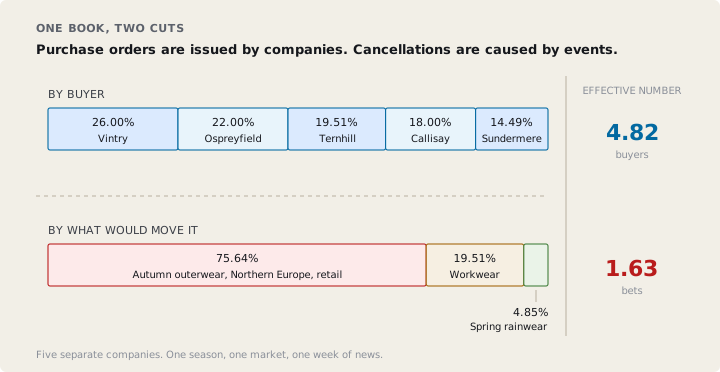
Four point eight two customers. One point six three bets. Same book, same week, cut two ways. The gap between the two numbers is the whole of this course. Weighted by margin rather than turnover, the group figure is 1.76 — slightly kinder, and still nowhere near the customer number.
The five orders in the first group belong to five separate companies. Vintry Hall is a department-store group. Ospreyfield sells hiking equipment. Callisay is an online value retailer. Sundermere is the clothing arm of a supermarket. Different owners, different countries, different price points, and buyers who have never met. Yet all five are selling a warm coat to the same people in the same three months. Every one of them will redo its forecast off the same weather and the same first four weeks of trade.
They feel separate because they behave separately in every ordinary week. They are one bet in the week that matters.
Choosing the groups honestly
The grouping is a judgement, and a dishonest one gives you a comforting number. Three rules keep it useful.
- Group by cause, not by category. "Jackets" is not a group. "Sold into a Northern European autumn" is. The test is whether one piece of news reaches every row in the group.
- A group of one is allowed, and is often the truth. Ternhill's workwear contract genuinely does not care about the weather in a shopping street. Leaving it alone is what makes the arithmetic worth doing.
- Run it more than once, on more than one thing. Demand is not the only thing that reaches several orders at a time.
That last rule matters more than it sounds. Group Zerrand's book by shell fabric supplier instead, and it looks like this. Merevale Mills supplies five of the seven orders, 64.85% of the value, and the effective number is 2.07. That is a different 2.07 from the demand grouping. It is a different set of orders, cutting across the demand groups, exposed to a completely different kind of news. A mill fire, a dyehouse shut down over its waste water, a shortage of raw material: any of these reaches five orders at once, and none of them appears on a credit report.
What this arithmetic is not
It breaks the book into parts. It is not a forecast. It tells you how many separate bets you are carrying, and that is all. It does not say whether any of them will lose. It does not give you a probability. And it will not settle an argument with a sales director on its own.
It is also not the concentration limit inside a finance agreement. A factoring company caps how much it will fund against one debtor. A credit insurer caps how much it will cover. Both are somebody else's limit imposed on you, and course 13.5 covers what they cost and how to work with them. This lesson is about a limit you set for yourself, on something no lender measures, because no lender is exposed to your production calendar.
Prompt · Cut my order book on what actually fails
When somebody asks how concentrated the book is, and the only answer in the room is the share of the biggest customer.
Act as the commercial director of a garment factory who has lived through a season where several buyers cut in the same week. I am going to give you my live order book, and I want it cut two ways. Facts: my factory makes [PRODUCTS] on [NUMBER] lines. Here is the book, one row per order: buyer, product, end market, selling season, channel, ship window, units, price, order value, costed margin — [PASTE THE ROWS]. Do the following. First, group by BUYER: give me each buyer's share of value and of costed margin, square the shares, add the squares, and turn each total upside down to give me an effective number of buyers on each weighting. Second, regroup every row by the answer to this question: what single piece of news would move this order? Name each group in plain words, tell me which rows are in it, and run exactly the same arithmetic to give me an effective number of groups. Third, put the two effective numbers side by side and say in one sentence what the gap between them means for me. Fourth, run the grouping again on TWO more things — the mill or material each order depends on, and the eight-week window each one ships in — and give me the effective number for each. Fifth, tell me which of the four groupings is the most concentrated, and what one order I could add or refuse that would change it most. Sixth, list every judgement you had to make about which rows belong in which group, so I can overrule you. Do not give me general advice about spreading risk. Give me the numbers for this book.
AI can make mistakes — check anything you act on.
Check yourselfA factory's five buyers each take 20% of its book. What is its effective number of buyers, and what would make that reassuring figure meaningless?Show the answer
Five equal shares each square to 0.0400. The sum is 0.2000 and the effective number is exactly 5.00 — the ideal answer to the customer question. It becomes meaningless the moment you group the five by cause instead of by name. Suppose four of the five sell the same season into the same market. Then one group holds 80.00% and the other 20.00%, the squares add to 0.6800, and the effective number of bets is 1.47. The customer sum and the cause sum can disagree completely, and only the second one is measuring what cancels.
What to take away
Square the shares, add them, and turn the total upside down. That gives you one honest number for the whole book. Run it on margin rather than on turnover. Then run it again on groups that answer what would move this, because purchase orders are issued by companies and cancellations are caused by events. Zerrand has 4.82 customers and 1.63 bets, and every rule in the building was written against the first figure.