Lessons · Lesson 3 of 6
The nine days in September, and where the cloth was
Price a week of cancellations properly, and see why the stage the goods had reached mattered more than the size of the cuts.
Lesson 3 of 6 · 20 min
Four calls, four people, nobody wrong
September in Zerrand's main end market was the warmest in fourteen years. Autumn outerwear sat on the rails through weeks 36, 37 and 38. Four buyers reached the same conclusion within nine days of each other.
- 14 September, Ospreyfield. Its own sell-through — the share of the stock it has bought that has actually sold — is at 71.0% of plan. It cuts the second delivery of the insulated shell OSF-771 by 3,100 units. The order lets a delivery be changed until eight weeks before its date, so this call is inside that window and fully allowed by the contract.
- 16 September, Callisay. It uses the flex-down written into every one of its purchase orders: the right to reduce the quantity by 20.0%, which is 12,200 units off CLS-5540. Zerrand's commercial director had agreed to that clause and had priced it into the quotation.
- 19 September, Sundermere. It does not cut anything. It asks to move the remaining 14,000 school coats from week 39 to week 46, so the stock lands closer to the school holiday when the coats sell.
- 22 September, Vintry Hall. It cancels the unshipped part of the men's gilet VNH-3119 — 9,000 units — and reduces the parka VNH-3106 by 4,200.
Four buyers, four account managers, four separate conversations, each one defensible. Each of Zerrand's four people handled their own call well. They held the price, they got a settlement, they protected the relationship. Each reported a good outcome on a bad day.
None of the four knew about the other three until the Friday management meeting. That is the mistake nobody made. There was no bad decision anywhere in the chain — just four correct decisions taken by people whose job ends at the edge of their own account.
The loss is not the cancelled value
The instinct is to price a cancellation as lost sales. 28,500 units at their selling price is USD 855,335 of order value gone. That figure is both frightening and wrong, and using it leads to the wrong action.
What Zerrand actually loses on a cancelled unit is two things and only two:
- The margin it will now never earn — the piece of the price that was profit.
- The committed cost it cannot recover — cloth contracted, trims bought, panels cut, wages already paid — less whatever it can get back for it.
Everything else was never Zerrand's money. So the arithmetic needs a column that no cancellation notice contains: where was each order standing on the day the call came?
| Order | Units cut | Stage on the day | Cost per unit | Committed | Recovered | Recovery |
|---|---|---|---|---|---|---|
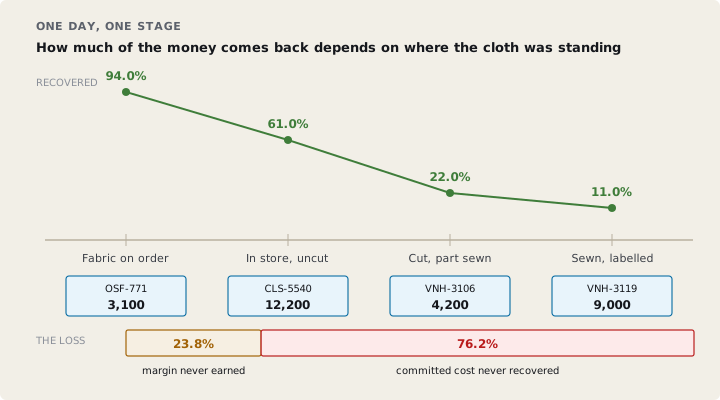
| OSF-771 shell | 3,100 | fabric on order at the mill | 70.68 | 100,789.68 | 94,742.30 | 94.0% |
| CLS-5540 padded jacket | 12,200 | fabric delivered, not cut | 16.63 | 137,962.48 | 84,157.11 | 61.0% |
| VNH-3106 parka | 4,200 | cut, part sewn | 38.81 | 133,661.64 | 29,405.56 | 22.0% |
| VNH-3119 gilet | 9,000 | sewn, labelled, packed | 19.07 | 171,630.00 | 18,879.30 | 11.0% |
| 28,500 | 544,043.80 | 227,184.27 | 41.8% |
The committed figure is the share of the unit cost Zerrand could no longer get out of at that stage. It is 46.0% with the cloth contracted but not yet delivered, 68.0% once cloth and trims are in the store, 82.0% once the panels are cut and the line is part way through, and 100% for a finished garment.
The recovery figures are what Zerrand got back, and each has a physical reason. Merevale Mills released the undelivered shell fabric for a 6.0% cancellation charge. Callisay's cloth is a plain navy taffeta in a common weight, so a dealer in surplus stock took it at 61.0% of cost. The parka panels are cut in a melange made only for that buyer, so they are worth their trims and nothing else. The gilets are finished garments carrying a Vintry Hall woven label; once that label is unpicked they are a job lot.
The number that reorders the whole problem
| Amount | Share | |
|---|---|---|
| Margin the book will never earn | 98,709.00 | 23.8% |
| Committed cost not recovered | 316,859.53 | 76.2% |
| Total loss | 415,568.53 |
Three quarters of the damage is money that had already left the building. Everything said in the management meeting was about the missing margin, because margin is what the sales report measures. And margin is the smaller quarter.
That changes the remedy completely. Arguing for a bigger cancellation fee is arguing about the USD 98,709.00. Arguing for a clause that changes who owns the cloth once it is cut is arguing about the USD 316,859.53. Course 14.2 owns how those clauses are drafted. This lesson is about knowing which of the two is worth the meeting.
Why they were all standing in the same place
Here is the finding that makes this a production problem, not only a sales one.
Run the same four cuts again, changing only one thing. Suppose every one of the 28,500 units had been at the earliest stage: cloth contracted at the mill and not yet delivered, the way Ospreyfield's happened to be. The average cost across those units, weighted by quantity, is USD 26.55. So 46.0% of it would be committed, and 94.0% of that would come back.
The loss would have been USD 119,591.88.
Same drop in demand. Same units. 28.8% of the damage. The difference between USD 415,568.53 and USD 119,591.88 is not caused by the buyers at all. It is caused entirely by where the cloth was standing on 22 September.
Now ask why the cloth was where it was. Because all five of those orders shipped between week 32 and week 41. Because they were all autumn. Because autumn is what made the buyers move together in the first place.
A book concentrated in one selling season is concentrated twice over. Once on the demand side, where one piece of news reaches every buyer. And once inside your own factory, where every affected order is standing at the same point in production on the day the news arrives, so they all carry the same poor recovery rate at the same moment. The second effect is the larger of the two, and almost nobody counts it.
The delay that cost almost nothing
Sundermere is the useful counter-example, because it did the thing the others did not.
Moving 14,000 school coats from week 39 to week 46 means Zerrand carries money it has already spent. That is USD 330,820 of committed cost held for eight weeks at its 14.5% borrowing rate, which comes to USD 7,379.83. Add storage at four cents a coat a week, USD 4,480. Total USD 11,859.83. Course 13.4 owns the arithmetic of what a day of held cash costs.
Now compare like for like. Those coats were finished. Cancelled at that stage they would have cost USD 23.40 a unit. Delayed, they cost USD 0.85 a unit. Delaying is 27.5 times cheaper than cancelling. The whole difference is Zerrand's to argue for, because the buyer barely minds which of the two it gets.
That is a sentence worth carrying into the call. When a buyer opens with a cancellation, the counter-offer is not a smaller cancellation. It is a later delivery.
Check yourselfTwo orders of the same value are cut on the same day. One is cloth contracted at the mill; the other is sewn and labelled. Why is the second loss so much larger, and what does that tell you about how to spread a book?Show the answer
Because almost none of the money is spent on the first and all of it is spent on the second. And because a finished garment carrying a buyer's label is worth far less to anybody else than a roll of undyed cloth. The committed share runs from about 46.0% to 100% across those stages, and the recovery falls from 94.0% to 11.0%. So spreading orders across DELIVERY WINDOWS protects you even when it does nothing at all about buyers moving together. If half the affected orders had been eight weeks behind the others, half of the cut units would have been at a stage where the money was still recoverable.
What to take away
Price a cancellation as the margin you give up plus the committed cost you cannot get back. In Zerrand's September the second part was three quarters of the loss. Recovery is decided by the physical stage the goods had reached, not by the wording of the notice. And because every order in a single-season book stands at the same stage on the same day, a concentrated book carries a second, larger concentration inside the factory that no customer report can see.