Lessons · Lesson 2 of 3
Markup, margin, and the price a plan implies
Convert between markup and margin in both directions, build a ticket price backwards from a target, and work out the full-price sell-through a planned margin really requires.
Lesson 2 of 3 · 40 min
Two numbers that are the same fact
There are two ways to describe the gap between what a garment costs a shop and what a customer pays. They sound like the same statement, and they give different answers. A supplier and a buyer can shake hands on one figure and mean amounts far apart.
This lesson moves between the two descriptions in both directions. It then works backwards, from the profit a business needs to the price on the ticket. It ends on how much has to leave at full price before the plan is true.
MWD-2214 lands at Marchwood's distribution centre at GBP 6.05 a unit and tickets at GBP 22.00. Where a landed cost comes from — a factory's quotation, a currency rate, freight, duty, clearance — is course 16.1's ground, and course 8.1's before that. Here it arrives as given data. That is how it arrives on a planner's desk.
Two things happen to the ticket price before it is a number anybody can use.
Sales tax comes off. Clothing in Marchwood's market carries tax at 20%, collected at the till and handed on. Of GBP 22.00, GBP 3.67 is tax and GBP 18.33 is net sales. That second figure is the only one that appears in the accounts. It is the base every margin in retail is calculated on.
Then the same gap gets described two ways. Marchwood pays 6.05 and keeps 18.33, so:
- Aviyur Knits says Marchwood sells it for 3.03 times what it costs. That is the markup.
- Marchwood says its margin is 67.0%. That is the margin.
Both are correct, and they describe one gap. The difference is what each one divides by.
markup   = net selling price ÷ cost
margin % = (net selling price − cost) ÷ net selling price × 100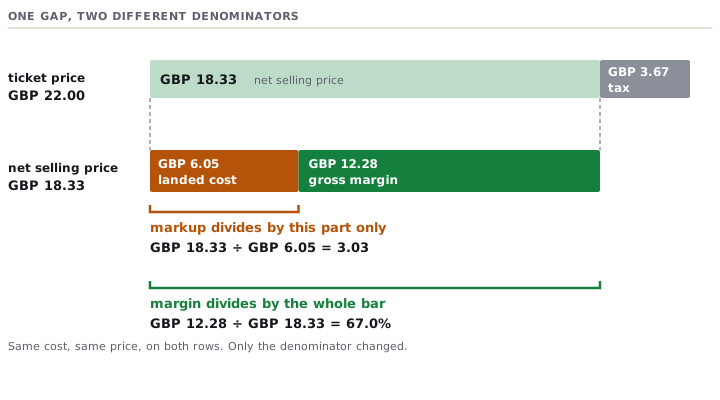
Markup divides by cost. Margin divides by selling price. Retail runs on margin, and not out of habit. Every other cost a retailer carries — shop payroll, rent, distribution, marketing — is planned as a percentage of sales. So a margin expressed as a percentage of sales can be added to those costs and subtracted from them. A markup cannot. A supplier who negotiates in markup and a planner who negotiates in margin will agree on every word and disagree about the money.
Converting, in both directions, without a calculator
The two identities are worth memorising, because you will be asked to do this in a meeting.
margin  = (markup − 1) ÷ markup
markup = 1 ÷ (1 − margin)| Margin | Markup |
|---|---|
| 50.0% | 2.00 times |
| 55.0% | 2.22 times |
| 60.0% | 2.50 times |
| 64.6% | 2.82 times |
| 67.0% | 3.03 times |
| 70.0% | 3.33 times |
Two rows in that table are Marchwood's real styles: MWD-2214 at 67.0% and MWD-2260 at 64.6%.
Building the price the other way round
A planner rarely starts from a price. They start from a target margin the department has to make, and the price is what falls out of it.
Marchwood's jersey class runs to a target intake margin of 65.0%. Rearranged, the identity gives the net selling price a cost has to reach:
required net selling price = cost ÷ (1 − target margin)
required ticket = required net selling price × (1 + tax rate)| MWD-2214 | MWD-2260 | |
|---|---|---|
| Landed cost | GBP 6.05 | GBP 4.72 |
| Net selling price needed at the target | GBP 17.29 | GBP 13.49 |
| Ticket that implies | GBP 20.74 | GBP 16.18 |
| Ticket actually set | GBP 22.00 | GBP 16.00 |
| Intake margin that produced | 67.0% | 64.6% |
Neither ticket is the calculated one, and neither should be. Marchwood tickets jersey at a short ladder of price points: 12.00, 14.00, 16.00, 18.00, 22.00. It does that for two reasons. A customer reads a range as a set of steps rather than as a set of calculations. And a shelf edge with five prices on it sells better than one with nine. So the arithmetic produces a floor, and the price point nearest above it usually wins. On MWD-2214 that rounded up, and bought two points of margin. On MWD-2260 it rounded down to hold a 16.00 price point, and cost four tenths of a point.
The intake margin is where a buy is signed off, and it is a promise about a season that has not happened. It assumes every unit sells at the ticket. Not one season in the history of retail has done that.
The season, and what the promise was worth
Here is what actually happened to both styles. Every unit bought is somewhere in these two tables: sold at some price, or cleared. Net selling prices are shown rounded to the penny, and the money is worked out from the exact figures, so a column may differ by a pound from your own multiplication.
| Sold at | Ticket | Net a unit | Units | Net sales |
|---|---|---|---|---|
| Full price, weeks 1 to 13 | 22.00 | 18.33 | 8,882 | 162,837 |
| Thirty per cent off, weeks 14 to 17 | 15.40 | 12.83 | 512 | 6,571 |
| Cleared to a jobber, week 18 | — | 2.50 | 206 | 515 |
| Total | 9,600 | 169,923 |
| Sold at | Ticket | Net a unit | Units | Net sales |
|---|---|---|---|---|
| Full price, weeks 1 to 14 | 16.00 | 13.33 | 9,498 | 126,640 |
| Twenty-five per cent off, weeks 15 to 20 | 12.00 | 10.00 | 3,770 | 37,700 |
| Fifty per cent off, weeks 21 to 24 | 8.00 | 6.67 | 2,800 | 18,667 |
| Seventy per cent off, weeks 25 to 26 | 4.80 | 4.00 | 1,220 | 4,880 |
| Cleared to a jobber | — | 1.10 | 712 | 783 |
| Total | 18,000 | 188,670 |
A jobber is a clearance trader. They buy unsold stock in bulk, for cash, and take it away to sell through markets and discount channels. They pay very little, and at the end of a season the taking away is worth something on its own.
Now the two margins that matter, side by side.
| MWD-2214 | MWD-2260 | |
|---|---|---|
| Units bought | 9,600 | 18,000 |
| Cost of goods | GBP 58,080 | GBP 84,960 |
| Net sales | GBP 169,923 | GBP 188,670 |
| Gross margin | GBP 111,843 | GBP 103,710 |
| Intake margin | 67.0% | 64.6% |
| Achieved margin | 65.8% | 55.0% |
| Full-price value of the buy | GBP 176,000 | GBP 240,000 |
| Given away in price | GBP 6,077 | GBP 51,330 |
achieved margin % = (net sales − cost of goods) ÷ net sales × 100MWD-2214 sold 47% fewer units. It tied up GBP 26,880 less of Marchwood's money. And it made GBP 8,133 more gross margin. It gave away GBP 6,077 of price across a whole season. MWD-2260 gave away GBP 51,330 — eight and a half times as much, on a buy less than twice the size.
The most useful number a planner can hand a buyer
Everything above is a post-mortem. The same arithmetic run forwards is the thing worth taking away. It answers a question a buyer can act on in October: what share of this buy has to sell at full price before the plan is true?
There are two versions of it. The first is the harder floor.
Break-even: the full-price sell-through at which the buy pays for itself. Let the units that do not sell at full price go at the clearance value. Then ask how many full-price sales cover the whole cost of goods.
break-even full-price units = (cost of the buy − units × clearance net price)
                              ÷ (full-price net − clearance net)
Take MWD-2214. The buy costs GBP 58,080. 9,600 units at a clearance value of 2.50 is GBP 24,000. The gap is GBP 34,080. Each full-price sale is worth 18.33 minus 2.50, or GBP 15.83, more than a cleared one. So 2,152 units — 22.4% of the buy — and the style has paid for itself.
The second version is the one that matters, because breaking even is not the plan.
The full-price sell-through a planned achieved margin requires. Marchwood plans jersey tops to an achieved margin of 60.0%. Take MWD-2260. Assume whatever does not go at full price goes at half price — 8.00, a net 6.67 — which is the middle of the ladder the class actually uses.
The net sales that a 60.0% achieved margin implies come straight out of the cost of goods. When the margin is 60.0%, cost of goods is 40.0% of net sales:
- required net sales = GBP 84,960 ÷ 0.40 = GBP 212,400
- 18,000 units all at half price would be GBP 120,000
- the shortfall, GBP 92,400, has to come from moving units up from half price to full price
- each unit moved up is worth 13.33 minus 6.67, or GBP 6.67
- so 92,400 ÷ 6.67 = 13,860 units, or 77.0% of the buy
| MWD-2214 | MWD-2260 | |
|---|---|---|
| Full-price sell-through to break even | 22.4% | 29.6% |
| Full-price sell-through the plan needed | 41.7% | 77.0% |
| Full-price sell-through actually achieved | 92.5% | 52.8% |
The middle row of that table carries its disposal assumption with it, and the two styles use different ones. MWD-2214's residual is priced at the thirty-per-cent-off step it actually used. MWD-2260's is priced at half price. Change the assumption and the requirement changes. That is a feature of the number, not a defect in it.
Now look at MWD-2260's middle row against week 8 of the previous lesson. The plan required 77.0% of 18,000 units — 13,860 of them — to leave at GBP 16.00 inside a twenty-week window. At week 8 the style had sold 5,688, was running at 716 a week, and had 12 weeks left. Twelve weeks at 716 is 8,592 more units, for a full-price total of 14,280. That would just about have done it, if the rate of sale held perfectly flat for twelve weeks. No style does. It sold 9,498.
That calculation takes two minutes, and it can be done in week 3. It is the single most useful thing a planner can put in front of a buyer, because it turns an abstract target into one testable sentence: this style has to sell 13,860 units at full price by 21 June.
Check yourselfYour buying director asks for 'a 35% margin' on a garment costing GBP 8.00. What do you put on the ticket, in a market taxing clothing at 20%?Show the answer
GBP 14.77 — and the interesting part is what you had to ask first. A 35% margin means cost is 65% of the net selling price. So the net selling price is 8.00 divided by 0.65, which is GBP 12.31. That is a markup of 1.54, not 1.35. Anyone who adds 35% to cost arrives at 10.80 and a margin of 25.9%. Then add the tax the customer pays: 12.31 times 1.20 is GBP 14.77. Two divisors and one multiplier, and skipping either one loses real money. In practice you would then move to the nearest price point above.
Check yourselfA style is bought 6,000 units, costs GBP 5.00, tickets at GBP 20.00 with tax at 20%. Whatever does not sell at full price goes at half. What full-price sell-through does a 60% achieved margin need?Show the answer
50.0%, which is 3,000 units. The net full price is 20.00 divided by 1.20, or GBP 16.67, and half price nets GBP 8.33. Cost of goods is 6,000 times 5.00, or GBP 30,000. At a 60% margin the cost of goods is 40% of net sales, so net sales must be GBP 75,000. All 6,000 units at half price would be GBP 50,000, leaving GBP 25,000 to find. Each unit moved up from half price to full price adds GBP 8.33, so 25,000 divided by 8.33 is 3,000 units. The trap to name out loud: a 60% margin does not need a 60% sell-through. The two are both percentages and they are not related at all. That is why the arithmetic has to be done rather than guessed at.
Prompt · Turn a target margin into a sell-through I can test
Before a buy is signed off, when the intake margin looks fine and nobody has said what the season has to do for the plan to come true.
Act as a retail merchandiser converting a margin plan into one testable sentence. Facts: style [CODE], units [NUMBER], landed cost a unit [AMOUNT], intended ticket price [AMOUNT], sales tax in my market [RATE], my class target INTAKE margin [PERCENTAGE] and my class target ACHIEVED margin [PERCENTAGE]. My markdown ladder for this class, as steps off the ticket: [STEPS]. My clearance value a unit, if I sell the residue to a jobber: [AMOUNT]. Do the following. First, take the ticket to a net selling price and show the tax that came off. Then give me the intake margin as a percentage of net sales AND the markup as a multiple of cost, and say in one line why a supplier quoting the markup and me quoting the margin are describing the same gap. Second, work out the ticket price my target intake margin actually requires, compare it with the ticket I intend, and tell me in points and in money what the difference is worth across the whole buy. Third, work out the break-even full-price sell-through: the units that must go at the ticket for the buy to cover its own cost of goods, with everything else assumed sold at my clearance value. Fourth, and this is the number I actually want: the full-price sell-through my TARGET ACHIEVED MARGIN requires, assuming everything else goes at the markdown step I name. State it as a percentage AND as a number of units AND as a date — 'this style must sell N units at full price by [DATE]'. Fifth, state the disposal assumption underneath that number in the same breath, then re-run it at one step gentler and one step deeper so I can see how sensitive it is. Sixth, tell me what weekly rate of sale that requirement implies across the full-price window, so I can compare it with what the style is actually doing. Do not tell me the plan is achievable or unachievable: give me the number and let me judge it. Never assume a markdown ladder or a clearance value I did not give you. Ask.
AI can make mistakes — check anything you act on.
Where this goes next
You can now move between markup and margin in either direction. You can take a landed cost to a ticket price through a target margin and a tax rate, and read an intake margin against an achieved one. And you can state, before a season starts, the full-price sell-through a plan is quietly assuming.
What is still missing is the units nobody sold. MWD-2260 finished its full-price window with 4,732 of them. MWD-2214 finished with a shortage that appears in no report at all. Lesson 3 is terminal stock: what it is worth, what it says about the intake that produced it, and why the whole of this season was decided on Monday 13 October 2025.