Lessons · Lesson 2 of 3
The promotion that hit every target
Judge a finished promotion over a window long enough to hold its own payback, and find the one number the whole verdict rests on.
Lesson 2 of 3 · 44 min
The situation
A discount can pass every test it was set and lose money anyway. The reason is usually the calendar rather than the arithmetic. This lesson follows one week-long sale that beat all three of its targets. Then it looks at the four weeks after it. It also puts the cost of staging the event into the same sum as the selling, which is where those costs almost never end up.
Vellacott ran the Tailoring Event in week 10 of the autumn season: twenty per cent off the whole tailoring range, all 96 doors and the website, seven days.
By every measure written into the brief, it was a success. Marisa Wardlow presented it at the week 11 trade meeting, and the room was pleased. Marcus Ollerenshaw signed off a repeat for spring on the strength of it.
By week 14 the tailoring range was GBP 25,090.10 behind where it would have been had the event never happened, and nobody in that room had done anything wrong. This lesson is how that is possible, and how to write a brief the following year that cannot do it again.
The brief, as it was written
Three targets. Read them slowly, because this is a completely normal promotional brief, and every fault in this lesson is already in it.
| Target | Set at | Measured over |
|---|---|---|
| Unit uplift on the tailoring range | at least 150% | the event week |
| Net sales uplift on the tailoring range | at least 100% | the event week |
| Tailoring units, weeks 10 to 14 | at least 10% above baseline | five weeks |
The baseline for all three was the average of weeks 5 to 9, the five trading weeks immediately before the event. A baseline is your best estimate of what the range would have done without the event. For this range it is 724 units a week and GBP 91,432.52 a week of net sales.
What happened in the event week
| Baseline week | Event week | Change | |
|---|---|---|---|
| Units | 724 | 2,488 | 243.6% |
| Net sales | 91,432.52 | 249,639.75 | 173.0% |
Both event-week targets were beaten by a distance: 243.6% against a target of 150%, and 173.0% against 100%. The third target was met too — 4,299 units across weeks 10 to 14 against a baseline of 3,620, an increase of 18.8% where 10% was asked for.
Three targets, three hits, one of them by more than ninety percentage points. Nothing in the brief could have produced any other verdict.
And from lesson 1 we already know the event cleared its break-even easily. Twenty per cent off the core jacket needs 48.9% more units, and the event week delivered 261.5% more of them. On the face of it, this is not a close call.
The window
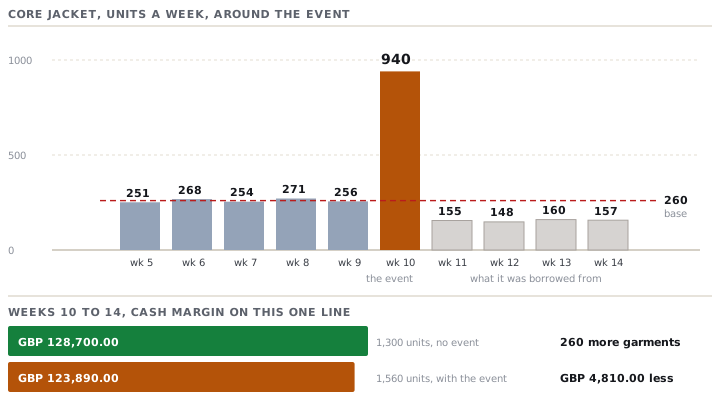
In weeks 5 to 9 the core jacket sold 251, 268, 254, 271 and 256 — an average of 260, and never more than 4.2% away from it. In the event week it sold 940.
Then weeks 11, 12, 13 and 14: 155, 148, 160 and 157. Six hundred and twenty jackets across four weeks against a baseline of 1,040 — 40.4% below where the line had been sitting all season.
That trough is the lesson. A customer who buys a jacket in week 10 does not buy another in week 12. A man who was going to replace his suit in November replaced it in September at twenty per cent off, and the sale that would have carried a GBP 99.00 margin carried GBP 66.50 instead. The event did not only discount the extra garments it created. It discounted a share of November's garments as well, and then took them out of November.
Judge that over the event week and it is a triumph. Judge it over five weeks and here is the same range.
| Code | Baseline units | Actual units | Baseline margin | Actual margin | Difference |
|---|---|---|---|---|---|
| VL-2110 entry suit | 460 | 599 | 14,490.00 | 13,407.00 | −1,083.00 |
| VL-3320 core jacket | 1,300 | 1,560 | 128,700.00 | 123,890.00 | −4,810.00 |
| VL-3325 core trouser | 1,525 | 1,762 | 80,474.25 | 76,823.94 | −3,650.31 |
| VL-4400 premium jacket | 290 | 325 | 45,770.70 | 42,888.39 | −2,882.31 |
| VL-5150 overcoat | 45 | 53 | 9,997.65 | 9,933.17 | −64.48 |
| Range | 3,620 | 4,299 | 279,432.60 | 266,942.50 | −12,490.10 |
Every line sold more garments. Every line earned less money. The range sold 679 extra garments over the five weeks and was GBP 12,490.10 worse off for them, before a penny of the cost of running the event.
The cost of running it
An event is not free even before the price comes down. These costs are usually invoiced to a marketing budget rather than to the range, which is exactly why they go missing from the verdict.
| GBP | |
|---|---|
| Email and paid social | 4,900.00 |
| Printed window and in-store kit, 96 doors | 2,400.00 |
| Extra store hours across the event week | 3,600.00 |
| Reticketing down and back up again | 1,700.00 |
| Total | 12,600.00 |
Margin lost, GBP 12,490.10. Cost of running it, GBP 12,600.00. The event cost Vellacott GBP 25,090.10. It is worth noticing that the two halves were almost identical: a reader who had counted only one of them would have been exactly half right.
The number the whole verdict rests on
Everything above compares what happened with what would have happened otherwise, and nobody has ever observed what would have happened otherwise. The baseline is an estimate. The honest way to present a promotional result is to say so, and then show how much the answer moves when the estimate moves.
For this event the range baseline was GBP 55,886.52 of cash margin a week. Move it and the verdict moves with it.
| Baseline | Margin difference | After the GBP 12,600.00 of event cost |
|---|---|---|
| 10% lower than estimated | 15,453.16 | 2,853.16 |
| As estimated | −12,490.10 | −25,090.10 |
| 10% higher than estimated | −40,433.36 | −53,033.36 |
So the single most useful sentence Vellacott can write about the Tailoring Event is not "it lost GBP 25,090.10". It is this:
The event paid only if the tailoring range would have sold 9.0% less over those five weeks than the weeks either side of it suggest.
Now the argument is about something you can check, rather than about whether promotions are a good idea in general. And Vellacott can check it. The core jacket's five pre-event weeks were 251 to 271 units, a spread of 4.2% around the average, and the same five weeks last autumn came in within 6% of the same shape. A baseline that is wrong by more than 9.0% is outside anything the line has done in two years.
The verdict holds. It holds by less than most people would like, and saying so is the difference between a result and an opinion.
What the brief should have said
Same event, same twenty per cent, four changes to the piece of paper.
- Declare the measurement window before the event, and make it long enough to hold the payback. Vellacott's tailoring customer does not come back within four weeks, so a four-week window measures the borrowing and not the repayment. Five weeks was long enough here only because the trough had flattened by week 14. The way to know that is to look at where the line returned to baseline, not to pick a round number.
- Write the baseline down, in units and in cash margin, before the event runs. A baseline agreed afterwards is a negotiation.
- Make at least one target a margin target. All three of Vellacott's targets were volume or sales value, and both of those go up automatically when the price goes down. A brief made entirely of targets that a discount cannot fail is not a brief.
- Put the cost of running the event in the same table as the margin. GBP 12,600.00 sitting in a marketing budget is GBP 12,600.00 that never meets the result it paid for.
Rewritten, target three becomes: cash margin on tailoring across weeks 10 to 14 to exceed the stated baseline of GBP 279,432.60 by at least the GBP 12,600.00 the event costs to run. That target would have needed GBP 292,032.60, and the event delivered GBP 266,942.50. It would have failed in week 14, in public, and spring would have been planned differently.
Check yourselfAn event week sells 2.4 times the baseline units at 25% off, on a range averaging a 55% margin. Did it work?Show the answer
You cannot say, and the honest answer is the whole lesson. The break-even is 0.25 ÷ (0.55 − 0.25) = 83.3% more units, and 2.4 times baseline is 140% more. So the event week made money: about GBP 0.31 of extra margin for every pound of full-price margin the week would have earned. Whether the event made money depends entirely on the weeks afterwards, and nothing in the question tells you about them. Ask for the four or five weeks following, line by line, against a baseline written down beforehand.
Check yourselfYour promotion analysis shows a gain of GBP 8,000 and your baseline could plausibly be 10% out either way. What do you report?Show the answer
Both numbers, and which way the sign turns. Report the single best estimate, the two ends of the plausible baseline, and the sentence that names the crossing point: "this event paid unless the baseline was understated by more than X%". If the sign flips inside the plausible range, the correct report is that the promotion cannot be judged on this evidence. Say too what would be needed to judge it: a longer window, a set of doors that did not run the event to compare against, or last year's equivalent weeks. Reporting GBP 8,000 alone is reporting the arithmetic and hiding the assumption it stands on.
Prompt · Judge a promotion that has already finished
When an event looked like a success in its own week and you want the real answer.
Act as a retail planner reviewing a promotion that has finished. Refuse to give a verdict until you have the following, and ask me for anything missing rather than assuming it: the lines involved, with ticket price, landed cost and the discount applied; the weekly units and cash margin for at least five weeks before the event; the weekly units for the event week and for at least four weeks after it; and every cost of running the event, including advertising, print, extra hours and reticketing, whichever budget those costs were invoiced to. Then do this. First, state the baseline you are using, how you worked it out, and the weeks it came from. Second, show units and cash margin week by week for the whole window, actual against baseline, and mark the week the line returned to baseline. If it has not returned, say the window is too short to judge, and stop there. Third, total the margin difference across the window and subtract the cost of running the event. Fourth, and most important, work the answer out again with the baseline 10% lower and 10% higher, and tell me the baseline at which the verdict changes sign, as a percentage away from my estimate. Fifth, state in one sentence what would have to be true for the event to have paid. Sixth, rewrite the original targets so that this event could have failed against them. Do not describe the event-week uplift as a result. It is an input.
AI can make mistakes — check anything you act on.
Where this goes next
Two lessons in, the tools are a break-even and a window. Both are defensive: they tell you what a price cut costs and how to find out whether one worked.
Lesson 3 goes the other way. Vellacott's five price points are not five independent decisions. They are one structure, and the cheapest garment in it is not there to make money. Working out what it is there for, and what that is worth in pounds, is the last piece.