Lessons · Lesson 1 of 3
What a discount has to sell
Work out how many extra garments a price cut must sell before it has earned nothing, and learn the one sum the whole of pricing rests on.
Lesson 1 of 3 · 44 min
The situation
One day somebody will propose taking a fifth off the price of something you look after. They will tell you that you will make it up on volume. This lesson is the arithmetic that answers them, and it is a single division. The cost of making a garment does not fall when its price falls. So the whole of the discount comes out of the profit. The number of extra items you must sell to break even is much larger than instinct suggests.
Second week of September, the buying office at Vellacott in Nantwich. Vellacott sells men's tailoring: 96 stores and a website. Its customer buys a jacket for a wedding, then comes back for a second one. The range is sold as separates — a jacket in a chest size, a trouser in a waist size. Two thirds of the people who buy either one buy both on the same afternoon.
Marcus Ollerenshaw buys tailoring. Marisa Wardlow plans it. On the desk between them is a competitor's email, forwarded by a store manager that morning: twenty per cent off all tailoring, this weekend, in every door. A door is the trade word for one shop.
The question is not whether to match it. Marisa asks a different question first, and the whole of this course is built on it: if we did, how much more would we have to sell before we had earned nothing?
Most people guess twenty per cent. On Vellacott's core jacket the answer is 48.9%, and that is the good case.
The basis, stated once
Half the arguments in retail pricing are two people using the same word for two different numbers. So this course fixes its basis in one paragraph and never moves it.
Every ticket price below is what a customer pays at the till, sales tax included. Vellacott's market charges tax on menswear at 20%, and that tax is never Vellacott's money. It is collected and passed on. So every margin below is worked out on the net selling price, which is the ticket divided by 1.2. It is worked out against the landed cost, which is what one garment costs sitting on Vellacott's own shelf: the supplier's price converted into pounds, plus freight, duty and clearance. The cash margin is the net selling price minus the landed cost — the margin in money rather than in per cent.
Two things follow, and both are worth knowing before the arithmetic starts.
- A percentage off the ticket is the same percentage off the net selling price, because the tax is a fixed proportion of the price. Twenty per cent off GBP 195.00 is twenty per cent off GBP 162.50. So tax makes no difference at all to anything in this lesson, which is why it is settled here and then dropped.
- Landed cost does not move when the price moves. The garment costs what it costs. That single fact is why a discount behaves the way it does.
This course does not re-teach how a landed cost is built up from a supplier's quotation — that is course 16.1, and course 8.1 on the factory side. It does not teach the markdown ladder that clears a season's leftovers, which is course 17.4. Here, costs arrive as given data, and the only decision is what to charge.
The range
One range, one season. Everything in all three lessons comes from this table.
| Code | Line | Ticket | Net | Landed | Cash margin | Margin | Season units |
|---|---|---|---|---|---|---|---|
| VL-2110 | entry two-piece suit | 99.00 | 82.50 | 51.00 | 31.50 | 38.2% | 2,400 |
| VL-3320 | core jacket | 195.00 | 162.50 | 63.50 | 99.00 | 60.9% | 5,200 |
| VL-3325 | core trouser | 95.00 | 79.17 | 26.40 | 52.77 | 66.7% | 6,100 |
| VL-4400 | premium half-canvas jacket | 295.00 | 245.83 | 88.00 | 157.83 | 64.2% | 1,450 |
| VL-5150 | overcoat | 425.00 | 354.17 | 132.00 | 222.17 | 62.7% | 240 |
All money is in pounds, per garment. The core jacket is made by Verrazzo Tailoring. The rest of the supply base does not affect a single decision in this course, and that is worth noticing on its own. Pricing is one of the few parts of a merchandiser's job where the factory is not in the room.
Across the season that range sells 15,390 garments. It books GBP 1,967,391.30 of net sales and keeps GBP 1,194,471.30 of cash margin. That is a blended margin of 60.7% — the margin of the range taken as one.
The discount comes out of one place
Take the core jacket at twenty per cent off.
The ticket goes from GBP 195.00 to GBP 156.00. The net selling price goes from GBP 162.50 to GBP 130.00, which is GBP 32.50 less. The landed cost is GBP 63.50 before the discount and GBP 63.50 after it.
So the cash margin goes from GBP 99.00 to GBP 66.50, and the whole GBP 32.50 has come out of the margin. Not out of the cost. Not out of the tax. Not shared with anybody. A discount is money taken from one line of the profit and loss account, and there is only one line it can come from.
That is why the volume arithmetic is so hard. To earn the same cash as before, the jacket now has to sell GBP 99.00 divided by GBP 66.50 times as many units — 1.49 times, or 48.9% more.
The whole table, and the shape it makes
Run the same division at every depth of discount on the same jacket.
| Off the ticket | Ticket | Net | Cash margin | Multiple of units needed | Extra units needed |
|---|---|---|---|---|---|
| — | 195.00 | 162.50 | 99.00 | 1.00 | — |
| 5% | 185.25 | 154.38 | 90.88 | 1.09 | 8.9% |
| 10% | 175.50 | 146.25 | 82.75 | 1.20 | 19.6% |
| 15% | 165.75 | 138.13 | 74.63 | 1.33 | 32.7% |
| 20% | 156.00 | 130.00 | 66.50 | 1.49 | 48.9% |
| 25% | 146.25 | 121.88 | 58.38 | 1.70 | 69.6% |
| 30% | 136.50 | 113.75 | 50.25 | 1.97 | 97.0% |
| 40% | 117.00 | 97.50 | 34.00 | 2.91 | 191.2% |
| 50% | 97.50 | 81.25 | 17.75 | 5.58 | 457.7% |
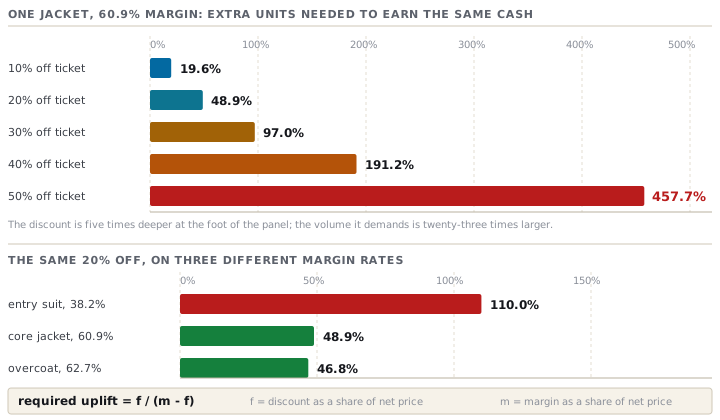
Read the last column downwards. The discount doubles from 10% to 20%, and the volume you need more than doubles, from 19.6% to 48.9%. Double the discount again to 40% and the requirement is now 191.2%. At half price the jacket must sell five and a half times as many units as it did at full price, and a half-price sale that sells four times the volume has still lost money.
The one line of algebra
Everything above is a single line of algebra, and it is worth learning by heart, because you can do it in your head in a meeting.
required uplift = f / (m - f)

f = the discount, as a share of the net selling price
m = the cash margin, as a share of the net selling price
Check it on the jacket. f is 0.20 and m is 0.609, so 0.20 ÷ 0.409 = 48.9%. Now check it on the entry suit, whose margin is 38.2%: 0.20 ÷ 0.1818 = 110.0%. The entry suit must sell more than double to survive the same discount the jacket survives on half as much.
Three things fall straight out of that sum, and none of them is obvious before you have written it down.
- The break-even depends on the margin rate, not on the price. The overcoat at GBP 425.00 and the core jacket at GBP 195.00 need almost the same uplift from a twenty per cent event — 46.8% and 48.9% — because their margin rates are within two points of each other. The price does not matter. The rate is everything.
- A discount as deep as the margin rate can never be earned back. If f equals m, the bottom of the sum is zero: at a 60.9% discount the jacket earns nothing per unit, however many it sells. Go deeper and every extra unit makes the loss bigger. The point at which "sell more of them" stops being a possible answer is your own margin rate, and most people have never worked out where it is.
- Thin-margin lines cannot be promoted. This is the most useful consequence of the three, and lesson 3 is built on it. The lines a customer watches the price of most closely are usually the lines with the least margin to give away. So a discount across the whole range asks the most from exactly the products least able to pay it.
The same sum run backwards: what a price rise can afford to lose
The mirror image is cheaper to buy, and almost nobody works it out.
Put the core jacket up 5%, from GBP 195.00 to GBP 204.75. The net goes to GBP 170.63 and the cash margin to GBP 107.13. Vellacott can now lose 7.6% of its units and be exactly where it started: 99.00 ÷ 107.13 is 0.924, so 92.4% of the old volume earns the old cash.
Set the two side by side. A 5% cut needs 8.9% more units to stand still. A 5% rise survives losing 7.6% of them. The gap is small at 5%, and it grows fast: at 20% the cut needs 48.9% more units, while a 20% rise survives losing 24.7% of them.
When the cost moves instead of the price
The same arithmetic answers the question that arrives from the supply side. Verrazzo gives notice of a price rise that puts GBP 3.00 on the core jacket's landed cost: GBP 63.50 becomes GBP 66.50.
Leave the ticket alone and the cash margin falls from GBP 99.00 to GBP 96.00. That is GBP 3.00 a jacket, and on 5,200 jackets a season, GBP 15,600.
There are two ways to pass it on, and they are not the same size.
- Hold the cash margin. The net must rise by exactly GBP 3.00, to GBP 165.50. The ticket becomes GBP 198.60.
- Hold the markup. Vellacott's jacket sells at 2.56 times its landed cost. Keeping that multiple means a net of GBP 170.18 and a ticket of GBP 204.21, which Vellacott would put on the rail at GBP 205.00.
A GBP 3.00 cost increase has become a GBP 3.60 price increase one way and a GBP 9.21 price increase the other. Both can be defended. Only one of them is what most cost-plus pricing rules do automatically, and it is the larger one. Then run the sum backwards on the difference: the extra GBP 5.61 of ticket buys GBP 4.68 of net margin, and the jacket keeps that only if it does not lose more than 4.5% of its volume to the higher price.
Check yourselfYour line has a 45% margin. Marketing wants a 25% discount for a weekend. Without a calculator, how much more do you have to sell?Show the answer
0.25 ÷ (0.45 − 0.25) = 0.25 ÷ 0.20 = 125%. You have to sell one hundred and twenty-five per cent more — two and a quarter times the volume — to earn the same cash. Notice how much closer this is to the boundary than the core jacket's 48.9% at 20%. A 45% margin line has only twenty points of room left after a 25% cut, and the requirement grows very fast as that room closes. At a 40% discount the same line earns 5 pence in the pound and needs to sell nine times as many.
Check yourselfTwo lines, both discounted 20%. One has a 38.2% margin and sells 2,400 a season; the other has a 62.7% margin and sells 240. Which one is the expensive discount?Show the answer
The thin one, and it is not close. The 38.2% line needs 110.0% more units and the 62.7% line needs 46.8%. Volume does not enter the break-even at all — it decides the size of the bill, not the shape of it. On the entry suit, 2,400 units at GBP 16.50 of discount each is GBP 39,600 given away before a single extra garment is sold. On the overcoat, 240 units at GBP 70.84 is GBP 17,001.60. The cheap-looking line is the expensive one, twice over: it needs more than double the uplift, and it puts more than double the money at risk.
Prompt · Tell me what this discount has to sell
Before you agree to a price cut, on one line or on a whole range.
Act as a retail planner testing a proposed price reduction. I will give you lines. Treat every number I give you as given data, and never invent one. For each line I will state: the ticket price, the sales tax rate in my market (or I will tell you the prices are already net of tax), the landed cost per unit, the units it normally sells in a week, and the discount being proposed as a percentage off the ticket. Do the following, in this order. First, convert each ticket to a net selling price, and say once whether you are working at retail or at cost. Second, give me the cash margin per unit before and after the discount, and confirm that the whole of the discount has come out of the margin. Third, give me the extra volume needed to earn the same cash margin, as a multiple and as a percentage, using: required uplift = the discount divided by (the margin minus the discount), where both the discount and the margin are shares of the net price. Fourth, turn that percentage into units a week, so I can compare it with what the line actually sells. Fifth, name any line whose discount is close to or above its own margin rate, and say plainly that no volume recovers it. Sixth, sort the lines by required uplift, tell me which one the discount is most expensive on, and say why that is usually the line that looks cheapest. Do not tell me whether the discount will work. You cannot know how my customers will respond, and neither can I. Tell me only what it would have to achieve.
AI can make mistakes — check anything you act on.
Where this goes next
You now have the floor: the volume at which a discount has earned nothing. It is larger than anybody guesses, and it is one division.
Lesson 2 is what happens when a real promotion clears that floor comfortably and loses money anyway. Vellacott ran an event in week 10, set three targets, and beat all three by a distance. By week 14 it was down GBP 25,090, and the reason is not in the break-even arithmetic at all. It is in the window somebody chose to measure it over.