Lessons · Lesson 3 of 3
A week's cover in ninety minutes
Treat a live show as a burst of demand rather than a channel. Measure what it takes out of the stock pool, work out which of that stock somebody else was going to sell, and build the cover test that says what may be exposed to it before the show is booked.
Lesson 3 of 3 · 34 min
Ninety minutes
A live selling broadcast is a host on camera for an hour and a half. She shows the clothes, and the audience buys during the programme. Everybody counts the orders afterwards, and the number is always startling. The question almost nobody asks beside it is where those garments came from. They came out of the same warehouse that supplies every other way the brand sells.
Show 2 went out on Thursday 14 October 2027, from half past seven in the evening until nine. Verity Nankivell hosted it. She wore the Farrowby in olive, said it ran true to size, and by the time the broadcast ended 348 jackets had been ordered.
Here is the number to put beside it. In week 8 — the week commencing 11 October 2027 — Halvergate's two always-on routes despatched 351 Farrowbys between them: 125 on the site and 226 on the marketplace. Those are despatches rather than net units, worked out from lesson 1's return rates. The site's 95 net units at a 24.0% return rate is 95 ÷ 0.760 = 125.0 despatches. The marketplace's 156 at 31.0% is 156 ÷ 0.690 = 226.1.
So the always-on business moves 351 jackets in one hundred and sixty-eight hours, and the show moved 348 in ninety minutes. Per hour that is 2.09 against 232.0 — 111 times the ordinary rate.
The replay is a different animal. Over the six days that followed, another 122 orders arrived. That is 0.85 an hour, which is below the always-on rate. Whatever the ninety minutes is, the tail of it is not more of the same.
One pool, three taps
Halvergate has one warehouse and one stock pool. The site, the marketplace and the show all pick from it. Nothing is ring-fenced, nothing is reserved for a broadcast, and the Autumn 27 buy was 5,400 Farrowbys placed before the phase opened. The repeat order was raised in week 5 and lands in week 19, which is three weeks after the phase closes.
So no unit sold in the sixteen weeks was replaced inside the sixteen weeks. Say that plainly, because everything that follows rests on it. The show could not create a jacket. It could only decide which week a jacket left the building, and down which route.
The phase used up 4,821 of the 5,400. That is the 4,610 net units from lesson 1, plus the returns that could not go back into full-price stock. Those are 8.0% of the 584 site returns and of the 423 live returns, and 14.0% of the 930 marketplace returns. That is 47 plus 34 plus 130, or 211 jackets. Closing stock was 579.
What the show actually consumed
Show 2 despatched 470 jackets: 348 in the broadcast and 122 from the replay. 185 came back. Net units, 285.
But 470 is not what the show took out of the pool, and 285 is not either.
- On the night, the pool falls by the full 470. Every one of them is picked, packed and gone.
- Over the following weeks, 170 of the 185 returns go back into stock. That is 185 less the 8.0% graded out, which is 14.8, rounded here to 15.
- So the show permanently consumed 300 jackets, and for several weeks it had removed 470.
That gap between 470 and 300 is not an accounting nicety. It is the mechanism. The shelf is short by 470 in the weeks straight after the broadcast, which is exactly when the site and the marketplace are trying to trade. The jackets come back later, in ones and twos, and some of them come back into a week where the size has already gone dark and cannot be reordered.
And they did not come out of the pool evenly.
| Size | Show 2 despatches | Share of the show | Ordinary share of despatches |
|---|---|---|---|
| 8 | 18 | 3.8% | 11.0% |
| 10 | 92 | 19.6% | 17.0% |
| 12 | 168 | 35.7% | 23.0% |
| 14 | 126 | 26.8% | 21.0% |
| 16 | 34 | 7.2% | 15.0% |
| 18 | 32 | 6.8% | 13.0% |
| Total | 470 | 100% | 100% |
The show's share column sums to 99.9%, because each row is rounded to one decimal place. The ordinary column sums to 100% exactly. The middle three sizes are 61.0% of the style's ordinary despatches and 82.1% of the show's. The reason is not mysterious, and it is not the audience's fault. A host holds up one jacket, in one size, and says it fits. The people watching buy that size and the two either side of it. A show does not sample a style's size curve. It samples the host.
Apply that skew to the 300 jackets the show permanently consumed and 246 of them came out of sizes 10, 12 and 14, and 54 out of sizes 8, 16 and 18.
Cover, by size, before the show is booked
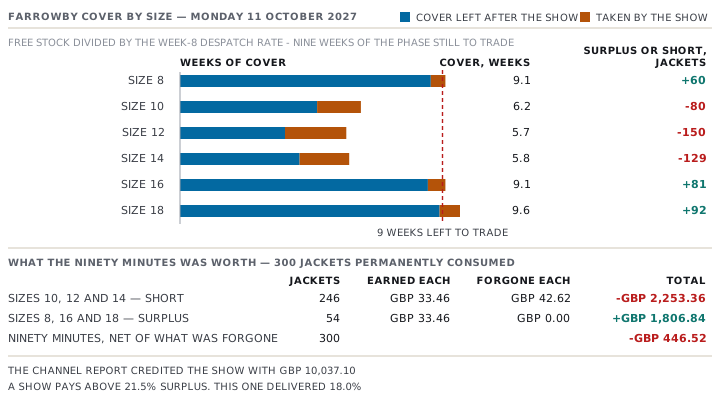
Here is the table Marnie should have been shown before she booked the date. Cover is how many weeks the stock you hold will last at the rate you are selling it. The table is built on the Monday of week 8, four days before the broadcast, from two things Halvergate already had: free stock by size, and the despatch rate by size.
Nine weeks of the phase remained, weeks 8 to 16. Demand does not hold flat across them, so the projection uses lesson 2's site index as its rate of decline. The site fell from 100% in week 1 to 73.1% in week 8, which is seven weeks. So the weekly factor is 0.731 raised to the power of one seventh, or 0.9562 — a fall of 4.4% a week. Nine weeks of 351 despatches falling at that rate is 351 × (1 − 0.9562 to the ninth) ÷ (1 − 0.9562), which is 2,658.8 jackets, or 2,659 to the nearest one. The size split below is that total shared out on the despatch shares.
| Size | Free stock | Share of despatches | Despatches a week | Cover, weeks | Projected need, weeks 8 to 16 | Surplus or short |
|---|---|---|---|---|---|---|
| 8 | 352 | 11.0% | 38.6 | 9.1 | 292 | 60 surplus |
| 10 | 372 | 17.0% | 59.7 | 6.2 | 452 | 80 short |
| 12 | 462 | 23.0% | 80.7 | 5.7 | 612 | 150 short |
| 14 | 429 | 21.0% | 73.7 | 5.8 | 558 | 129 short |
| 16 | 480 | 15.0% | 52.7 | 9.1 | 399 | 81 surplus |
| 18 | 438 | 13.0% | 45.6 | 9.6 | 346 | 92 surplus |
| Total | 2,533 | 100% | 351.0 | 7.2 | 2,659 | 126 short |
Three sizes have less cover than the phase has weeks. Three have more. 233 jackets, in sizes 8, 16 and 18, were surplus to everything the site and the marketplace were going to ask for.
That is the number a show is for. A channel that can empty a week's cover in ninety minutes is not a way to sell more of what already sells, because there is none of it spare. It is a way to sell the part of a buy that nothing else will reach. Verity was briefed on the olive, in her own size, because it photographed well.
Size 12 is the sharpest line in the table. It had 5.7 weeks of cover against nine weeks to trade, so it was 3.3 weeks short before anybody switched a light on. The ninety minutes took 168 despatches out of it, which at 80.7 a week is another 2.1 weeks of cover, gone between half past seven and nine.
What the ninety minutes was worth
The channel report credited show 2 with its contribution, and the arithmetic is lesson 1's, done on the show's own counts.
Revenue 285 × GBP 108.00 = GBP 30,780.00. Commission 285 × GBP 8.64. Fulfilment 470 × GBP 5.20. Returns 185 × GBP 10.90. The show itself, GBP 1,850.00. Goods 285 × GBP 42.00. Contribution GBP 10,037.10.
Per jacket permanently consumed that is GBP 10,037.10 ÷ 300 = GBP 33.46.
Now the comparison the report does not make. When stock is the constraint, the right question about a unit is not what it earned but what it earned instead of — and for 246 of those 300 jackets there was a queue waiting.
A unit of stock is not the same thing as a net sale, because returns come back and some of them cannot be resold at full price. On the site, every net unit carries 0.32 returns behind it (lesson 1) and 8.0% of those are graded out. So a net sale costs 1.0256 jackets of stock and earns GBP 50.97 — that is GBP 49.70 a jacket of stock. On the marketplace it is 0.4493 returns a net unit and 14.0% graded out, so 1.0629 jackets earning GBP 38.58 — GBP 36.30. Weight those by the two routes' net units for the phase, 1,850 against 2,070, and the blend is GBP 42.62 a jacket of stock.
| Jackets of stock | Earned at the show | Would have earned | Difference | |
|---|---|---|---|---|
| Sizes 10, 12 and 14 — short | 246 | GBP 33.46 | GBP 42.62 | GBP 9.16 lost a jacket |
| Sizes 8, 16 and 18 — surplus | 54 | GBP 33.46 | GBP 0.00 | GBP 33.46 gained a jacket |
| Net | 300 | GBP 446.52 lost |
246 × GBP 9.16 is GBP 2,253.36 given up. 54 × GBP 33.46 is GBP 1,806.84 created. The ninety minutes everybody celebrated was worth minus GBP 446.52, and the report said GBP 10,037.10.
Put it the other way round, which is the way that sticks. The show sold 54 jackets that would not otherwise have sold, and it paid GBP 2,253.36 to do it. That is GBP 41.73 a jacket, to earn GBP 33.46 on each of them.
The show is not a bad idea. The brief was. Turn the sum around and it gives you the test:
A show pays when more than 21.5% of the stock it consumes comes out of sizes that would otherwise finish the phase unsold.
Had all 300 come out of short sizes, the show would have given up 300 × GBP 9.16, or GBP 2,748.00. Every jacket moved from a short size to a surplus one swings the answer by GBP 33.46 gained plus GBP 9.16 not lost, which is GBP 42.62. So covering GBP 2,748.00 takes 64.5 jackets of the 300 — 21.5%. Show 2 delivered 54, or 18.0%. It missed the bar by ten and a half jackets, which is why the answer is a small negative rather than a disaster, and why the fix is a brief rather than a cancellation. Send Verity out in a 16, in the colour with 330 units behind it, and the same ninety minutes clears the tail of the buy at GBP 33.46 a jacket against nothing.
The return rate belongs to the moment of the order, not to the channel
One more number moves when the shape of demand moves. Lesson 1 gave the live channel a 38.0% return rate. Split the three shows' 1,113 despatches by when the order was placed, and there is no such rate.
| Despatched | Returned | Return rate | Net units | Contribution per net unit | |
|---|---|---|---|---|---|
| Inside the broadcast | 812 | 349 | 43.0% | 463 | GBP 31.98 |
| From the replay, the six days after | 301 | 74 | 24.6% | 227 | GBP 38.87 |
| Live channel, blended | 1,113 | 423 | 38.0% | 690 | GBP 34.25 |
The replay returns at 24.6%. Halvergate's own site returns at 24.0%. Those are the same kind of buyer, buying the same jacket with the same amount of thought, and the six-tenths of a point between them is not worth a sentence. The ninety minutes returns at 43.0%, and that is worth several. Somebody who buys in ninety seconds because a host said it runs true to size has not measured anything, and one in every 2.3 of them sends it back.
So the channel's headline rate is a mix, and a mix moves without anybody's behaviour changing. Hold both sub-rates exactly where they are and let the replay grow from 27.0% of despatches to 45.0%. The blended figure then lands at 0.550 × 43.0% + 0.450 × 24.6% = 34.7%. Three points and a bit off the return rate, purely from a change in the shape of the audience.
Check yourselfMarnie reports that the live channel's return rate is coming down: 38.0% last phase, 34.7% projected for the next one, which she puts down to Verity's fit guidance. Is she right?Show the answer
There is no evidence in that number either way. Hold both underlying rates exactly where they are — 43.0% inside the broadcast, 24.6% from the replay — and move the replay's share of despatches from 27.0% to 45.0%. The blend lands on 34.7% with nobody behaving differently. A blended rate across two groups that differ by eighteen points moves whenever the mix moves. The measurement that would test her claim is the broadcast rate on its own: if 43.0% falls, the guidance is working. And a shift towards the replay is worth having regardless, at GBP 38.87 a net unit against GBP 31.98. It is simply not evidence about fit, and reporting it as though it were will get the guidance credited for something it did not do.
Check yourselfAshok wants the cover test run on the style rather than size by size, on the grounds that it is one buy and one decision. Total cover at Monday of week 8 is 7.2 weeks against nine weeks to trade, so the style is short and no show should be booked. What does that lose?Show the answer
The decision itself. The total says expose nothing. The size-by-size table says 233 jackets could have gone out with nothing given up at all, and the phase closed with 579 unsold in exactly those three sizes. So refusing the show would have been wrong too. Not booking is not the free option it looks like. The total also gets the size of the problem wrong in both directions: it reports the style as 126 short when size 12 alone is 150 short and size 18 is 92 long. And it cannot produce the only number that governs the decision, which is the surplus share of what the show will actually consume. A total has no surplus in it, because the surplus and the shortage have already cancelled each other out.
Prompt · Say what stock may go to a channel that sells fast
Before booking a broadcast, a drop or any event that can empty a week's cover in an hour, on a buy with no repeat arriving inside the phase.
I am deciding what stock to expose to a channel that sells in a burst rather than at a steady rate. Run the cover test BEFORE the event is booked. Cover is how many weeks the stock I hold will last at the rate I am selling it.

I will give you: free stock by variant, the weekly despatch rate by variant on my always-on routes, how many weeks of the phase remain, and whether any replenishment actually LANDS inside those weeks. I will also give you the event's fixed cost, its price, its commission, its fulfilment fee, its measured return rate, and the size mix of a previous event if I have one.

Work in DESPATCHES, not net units. Divide net units by one minus the return rate to get there, and say when you have done it.

First, weeks of cover by variant: free stock over the weekly despatch rate. Project the need over the weeks remaining. If I give you a rate of decline from my own trading, use it rather than a flat rate, and state the weekly factor you worked out. Mark every variant SHORT or SURPLUS against the weeks remaining, and total the surplus. Do NOT run this on the style total: a total has the surplus and the shortage already cancelled out, and it cannot answer the question.

Second, work out what the event will actually consume. Despatches are not stock consumed: returns come back, minus the share that cannot go into full-price stock. Show both the immediate hole and the permanent one, and say how many weeks the shelf stays short.

Third, price it against the alternative rather than against zero. For every variant that is SHORT, the event's stock was going to sell anyway, so the comparison is the event's contribution per unit of STOCK against what my always-on routes earn per unit of stock. For every variant that is SURPLUS, the comparison is against nothing. Give me the net, and the break-even surplus share.

Fourth, split my event's return rate by when the order was placed — inside the broadcast against afterwards — if I have the counts. Tell me whether the headline rate is a mix, and what it becomes if the mix moves without anybody's behaviour changing.

Rules. Do not name any platform's fee schedule. Where a share is an assumption rather than a count, label it. If I cannot show that a variant ended a previous phase unsold, do not call it surplus on a projection alone: say the surplus is UNKNOWN and give me the range. And if the answer is that the event loses money, say whether the fix is the brief or the cancellation, and show the arithmetic that decides which.
AI can make mistakes — check anything you act on.