Lessons · Lesson 1 of 3
What a unit earns down each route
Work out what one garment really earns down three selling routes, using your own contract instead of a guess. You will find that the route with the most sales is not the route that earns the most.
Lesson 1 of 3 · 38 min
The brand, the phase, the basis
The same jacket, at the same price, does not leave the same money behind everywhere. It depends on where it was sold. One route hands part of the price to whoever owns the page. Another pays for a broadcast. All of them pay to send the parcel out. This lesson works out, coin by coin, what is really left of one garment's price.
Halvergate makes and sells outerwear and knitwear. It has no shops. It sells the same range down three routes at once, and this course is about what that costs.
- Its own site, halvergate.com. Halvergate owns the page, the price and the customer.
- A marketplace. Halvergate is one seller among many, on a category page it does not control.
- A live channel. A host shows the range in a scheduled broadcast, and the audience buys during the show.
Everything here happens in Autumn 27: sixteen trading weeks, from the week commencing 23 August 2027 to the week commencing 6 December 2027. One garment carries the whole course — HLV-118 Farrowby, a quilted jacket in three colours and six sizes. Eighteen variants in all.
Four people appear.
- Ottilie Pengelly is head of merchandising. She owns the quantity and the money.
- Idris Hathersage runs the marketplace business. He owns the listings.
- Marnie Osgerby runs the live channel. She books the shows and briefs the hosts.
- Ashok Rasiah is the commercial analyst. He owns the numbers everybody argues about.
Say the basis once. All prices exclude value added tax (VAT). Cost is the delivered cost of the goods, GBP 42.00 a jacket, the same down every route. A despatched unit is one that left the warehouse. A net unit is one the customer kept. Contribution is what is left after every cost that moves with the sale — commission, payment fee, fulfilment, returns, advertising. It is struck before the costs that do not move with the sale: the office, Ashok's salary, the brand advertising that names no product.
Three prices, and they are not a mistake
| Route | Price to the customer | Why it is that price |
|---|---|---|
| Own site | GBP 120.00 | The brand's own ticket |
| Marketplace | GBP 120.00 | Held level with the site on purpose. Lesson 2 shows what happens when it is not |
| Live show | GBP 108.00 | A show price. The offer is the reason people watch |
The live price is a 10.0% discount. It is not a rounding error in the plan. It is the mechanism. Nobody watches a ninety-minute broadcast to pay the shelf price. That discount has to earn its place, and by the end of this lesson you will be able to say whether it does.
Two costs that behave differently from all the others
Most of a unit's costs are simple. A commission is a percentage of the price. The goods cost what they cost. Two costs are not simple, and they are the two that people model wrongly.
Fulfilment is paid on every DESPATCH, so a return means you paid it for nothing. Fulfilment is the pick, the pack and the carriage out. If a quarter of what you send comes back, you pay all that on four jackets for every three you keep. So the fulfilment cost per net unit is not the fee. It is the fee divided by one minus the return rate.
Returns cost is paid per RETURN, and there are more returns behind a net unit than the return rate suggests. At a return rate of r, every net unit carries r / (1 − r) returns behind it, not r. At 24.0% that is 0.32 returns a net unit. At 38.0% it is 0.61.
fulfilment per net unit = fulfilment fee ÷ (1 − r)
returns cost per net unit = cost per return × r ÷ (1 − r)
That second denominator is where most channel comparisons go wrong. And it goes wrong in the direction that flatters the channel with the worst returns.
The build, route by route
| Own site | Marketplace | Live show | |
|---|---|---|---|
| Price | GBP 120.00 | GBP 120.00 | GBP 108.00 |
| Commission | — | GBP 18.00 | GBP 8.64 |
| Payment fee | GBP 2.00 | in the commission | in the commission |
| Fulfilment, per despatch | GBP 4.90 | GBP 6.90 | GBP 5.20 |
| Return rate | 24.0% | 31.0% | 38.0% |
| Fulfilment and payment, per net unit | GBP 9.08 | GBP 10.00 | GBP 8.39 |
| Cost per return | GBP 11.86 | GBP 14.28 | GBP 10.90 |
| Returns, per net unit | GBP 3.75 | GBP 6.42 | GBP 6.68 |
| Storage | — | GBP 1.60 | — |
| Advertising to win the sale | GBP 14.20 | GBP 3.40 | GBP 8.04 |
| Cost of goods | GBP 42.00 | GBP 42.00 | GBP 42.00 |
| Contribution per net unit | GBP 50.97 | GBP 38.58 | GBP 34.25 |
| Contribution as a share of price | 42.5% | 32.2% | 31.7% |
Every figure in that table comes from the ones above it. Here are three worked examples, so you can check the rest.
- Own site, fulfilment and payment per net unit. The payment fee is 1.5% of GBP 120.00 plus GBP 0.20, so GBP 2.00. Add the GBP 4.90 fulfilment fee and you have GBP 6.90 a despatch. Divide by 1 − 0.240: GBP 9.08.
- Marketplace, cost per return. The marketplace charges GBP 4.20 to process a return in its network. Add the grading loss: 14.0% of GBP 72.00, the gap between the GBP 120.00 ticket and the GBP 48.00 outlet price, is GBP 10.08. Total GBP 14.28. Then GBP 14.28 × 0.310 ÷ 0.690 = GBP 6.42 a net unit.
- Live show, advertising. There is no advertising. There is a show, and a show is a fixed cost: GBP 1,850 each. That is a host fee of GBP 1,200, studio and crew at GBP 450, and samples at GBP 200. Halvergate ran three shows in the phase, GBP 5,550 in total, and they sold 690 net units between them. GBP 5,550 ÷ 690 = GBP 8.04 a unit.
The order changes when you change the column
Here are the three routes for the whole phase.
| Route | Net units | Revenue | Contribution | Share of revenue | Share of contribution |
|---|---|---|---|---|---|
| Own site | 1,850 | GBP 214,320.00 | GBP 88,368.10 | 39.9% | 46.1% |
| Marketplace | 2,070 | GBP 248,400.00 | GBP 79,860.60 | 46.2% | 41.6% |
| Live show | 690 | GBP 74,520.00 | GBP 23,632.50 | 13.9% | 12.3% |
| Total | 4,610 | GBP 537,240.00 | GBP 191,861.20 | 100% | 100% |
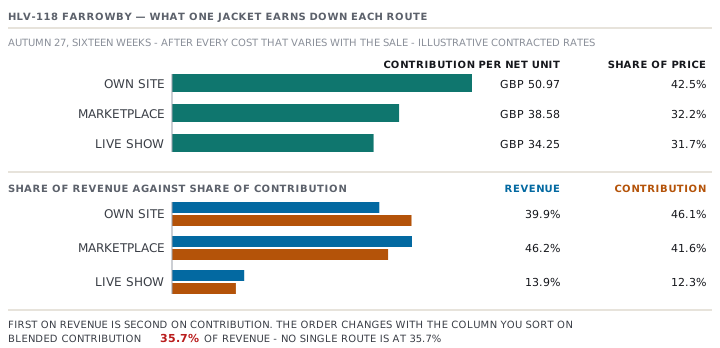
The marketplace is the largest route by revenue and the second largest by contribution. The site is the second largest by revenue and the largest by contribution. The order changes depending on which column you read. Every channel report Halvergate produces is sorted on the revenue column.
Two notes on how that table is built, because a table nobody can reproduce is a table nobody should trust.
- The site's revenue is not simply 1,850 × GBP 120.00. 320 of those units were sold in a discount event in week 9 at GBP 96.00, where the contribution is GBP 32.45 rather than GBP 50.97. The other 1,530 were full price. Lesson 2 is about that week.
- Each percentage is that route's share of the total in the same column. Those two share columns are the whole point of the table.
Halvergate's blended contribution across the three routes is 35.7% of revenue. No single route is at 35.7%. That is what a blend is, and it is why a blended figure cannot govern a decision about one route.
What that is worth, and the question it cannot answer
Suppose next season's plan moves 400 units from the site to the marketplace, at the same GBP 120.00 price. Revenue does not change by a penny. Contribution falls by 400 × (GBP 50.97 − GBP 38.58) = GBP 4,956.00.
That is the whole argument in one line. It is also the argument nobody has, because nobody looks at the contribution column.
Now the honest half, and it is the larger half.
That calculation assumes the site sale was available. The marketplace's 2,070 units may be people who would never have found halvergate.com. People who search a marketplace the way other people search a search engine, and who have never heard of the brand. If that is who they are, the marketplace took GBP 4,956.00 off nobody. It added GBP 79,860.60 that would not otherwise exist, and the comparison above is meaningless.
Halvergate does not know which it is. It has not measured how many marketplace buyers would have bought on the site instead. It has no clean way to measure that without switching the marketplace off, and switching a marketplace off for a season is a very expensive experiment. So the honest position is that the figure is unknown. The useful thing to do with an unknown is to find the point at which it starts to matter.
The marketplace adds contribution unless more than 75.7% of its buyers would have bought on the site anyway.
That figure is GBP 38.58 ÷ GBP 50.97. Below it, the marketplace is making Halvergate money even after allowing for the sales it takes off the site. Above it, Halvergate is renting out its own customers. 75.7% is a high bar, and most people's instinct is that a marketplace's audience is mostly new. But an instinct is not a measurement, and this course will not let you record one as the other.
Check yourselfThe table's combined fulfilment-and-payment row reads GBP 9.08 for the site and GBP 8.39 for the live channel, so the site looks the dearer of the two. Is it?Show the answer
No, and the row is what misleads you. The site's GBP 9.08 has a GBP 2.00 payment fee inside it, and the live channel's commission has already absorbed its own payment fee. Compare fulfilment on its own. The site pays GBP 4.90 ÷ 0.760 = GBP 6.45 a net unit. The live channel pays GBP 5.20 ÷ 0.620 = GBP 8.39. The live channel is nearly a third dearer, because a 38.0% return rate means paying carriage on a great many jackets that come straight back. Never compare a line between two channels until you know what each of them has folded into it.
Check yourselfMarnie proposes a fourth show, at the same GBP 1,850. She expects it to sell 60 net units. Should Halvergate run it, on this lesson's numbers alone?Show the answer
No, and the arithmetic is quick. A show's fixed cost spread over 60 net units is GBP 30.83 a unit. The contribution before the show cost is GBP 108.00 − GBP 8.64 − GBP 8.39 − GBP 6.68 − GBP 42.00 = GBP 42.29. So the show contributes 60 × (GBP 42.29 − GBP 30.83) = GBP 687.60, against nothing at all if those units were going to sell elsewhere anyway. The break-even audience is GBP 1,850 ÷ GBP 42.29 = 43.7 net units, so 60 clears it. But only just, and only if all 60 are units the other routes would not have sold. Lesson 3 is about the case where they would.
Prompt · Build what a unit earns down every route I sell it
When you sell the same garment down more than one route, and your channel report shows revenue with a blended margin at the bottom.
I am building the contribution per unit of one garment, down every route I sell it. Contribution is what is left after every cost that moves with the sale, and before the costs that do not.

I will give you, for each route: the price to the customer, the commission or referral rate from MY OWN agreement, the payment fee if it is charged separately, the fulfilment fee per despatch, my measured return rate, the platform's charge to process a return, any storage or listing fee, the advertising cost for that route, and the delivered cost of the goods. For any route whose cost is FIXED rather than per-unit — a broadcast, an event, a retainer — I will give you the total bill and the net units it produced.

Build a contribution table. Two rules on the arithmetic, and I want to see both steps. Fulfilment per NET unit is the fee divided by one minus the return rate, because a return means I paid it for nothing. Returns cost per NET unit is the cost per return times r, divided by one minus r, because every net unit carries more than r returns behind it. Show me the returns-per-net-unit figure itself, not only the money.

If I tell you that a share of returns cannot go back into full-price stock, and what the salvage price is, add that grading loss into the cost per return. Label it as an ASSUMPTION, kept separate from the parts that are on an invoice.

Then give me, for the whole period: net units, revenue, contribution, and each route's share of revenue AND share of contribution, side by side. Tell me plainly whether the order changes between those two columns, and what it costs to move one unit from the best route to the worst.

Four rules. Do not quote me any platform's commission, referral fee or fulfilment rate. If I have not given you a number, say it is missing and leave the row blank. Never compare a combined line between two routes without first saying what each of them has folded into it. State that the blended contribution rate describes no single route. And if I ask whether one route is taking sales off another, tell me that is UNKNOWN unless I have measured it, then give me the break-even share of buyers at which it starts to matter.
AI can make mistakes — check anything you act on.