Lessons · Lesson 3 of 3
A discount promised in advance
Cost a points scheme out of the file that will have to pay for it: what the promise is worth, how much of it can never be claimed, who the money actually reaches, and the rise in repeat buying the scheme would have to cause before it broke even.
Lesson 3 of 3 · 34 min
What a points scheme actually is
Almost every retailer either runs a points scheme or is being asked to start one. The case for it is usually made in the language of relationships rather than money. Costing one takes four steps, in order. What the promise is worth. How much of it will never be claimed. Which customers the money actually reaches. And how much more often people would have to buy.
Greta's proposal is the one every brand writes: one point for every GBP 1 spent, and 100 points redeem for GBP 5.00 off a future order. To redeem a point is to hand it back and take the money off.
Strip the language off it and it is a discount of 5.0% of everything you sell, granted today and collected later. It is not a marketing campaign with a budget that can be stopped. It is not a communications programme. It is a standing price reduction a customer can claim whenever they choose, on terms you have already published. The reason it does not appear in a margin report is that nobody has redeemed it yet.
That is also why the accountants get to it before the merchandisers do. A points balance a customer can spend is not a marketing expense that will happen one day. It is an obligation the business has already taken on. Revenue booked against an order that comes with points attached is partly revenue for something that has not been delivered yet.
So cost it like a price change, not like a campaign. Four questions, in order: what is promised, how much of it can be claimed, who gets it, and what behaviour would have to change for it to be worth having.
One: what is promised
The scheme issues one point for every GBP 1 of revenue, and each point is worth GBP 0.05 when redeemed. Over the twenty-four months of the file Quillingford took GBP 4,355,809.60, so the face value issued — the full amount printed on the vouchers — would have been
GBP 4,355,809.60 times 0.05 = GBP 217,790.48
That is the maximum the business could owe. It is exactly 5.0% of revenue, because that is what the scheme is.
Two: how much of it can be claimed
Here the file starts answering back. A customer cannot redeem 61 points, because the threshold is 100. So work out, band by band, how many whole GBP 5.00 vouchers each kind of customer would actually have reached over the two years.
| Orders in the window | Customers | Spend per customer, GBP | Points | Whole vouchers | Face value each, GBP | Band total, GBP |
|---|---|---|---|---|---|---|
| 1 | 28,476 | 61.20 | 61 | 0 | 0.00 | 0.00 |
| 2 | 7,120 | 129.60 | 129 | 1 | 5.00 | 35,600.00 |
| 3 | 2,940 | 201.30 | 201 | 2 | 10.00 | 29,400.00 |
| 4 | 1,180 | 275.60 | 275 | 2 | 10.00 | 11,800.00 |
| 5 | 680 | 352.50 | 352 | 3 | 15.00 | 10,200.00 |
| 6 or more | 940 | 567.66 | 567 | 5 | 25.00 | 23,500.00 |
| Whole file | 41,336 | 110,500.00 |
That table uses each band's average spend, which understates the answer. The rounding down to a whole voucher happens per customer, and inside every band there are customers who spent well above the average. The largest single case is the one-order band, where 4,042 of the 28,476 one-order customers spent GBP 100 or more and so do earn one voucher. That is GBP 20,210.00 the band table misses entirely.
Roshan ran it per customer over the whole file rather than per band. The real earned face value is GBP 134,000.00: the band figure, plus the one-order band's GBP 20,210.00, plus the same kind of spread inside the other five bands.
So of GBP 217,790.48 promised, GBP 83,790.48 can never be claimed, which is 38.5% of the promise. Not because customers forget, but because 85.8% of one-time buyers never reach the first threshold in the first place. The scheme's real cost as a share of revenue is 3.1%, not 5.0%, and that difference comes from the shape of this file rather than from anybody's intentions.
Three: who the money reaches
Now put the earned value beside the file it comes from.
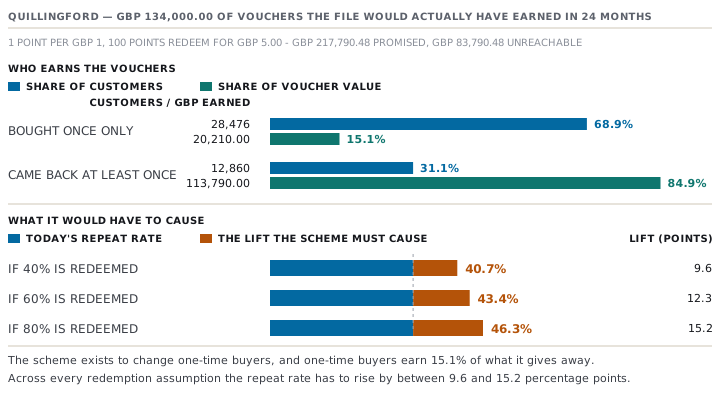
- One-time buyers: 28,476 customers, 68.9% of the file. Vouchers earned: GBP 20,210.00, which is 15.1% of the face value.
- Everyone who came back at least once: 12,860 customers, 31.1% of the file. Vouchers earned: GBP 113,790.00, or 84.9%.
Read those two lines together and the scheme's problem is plain. It is being proposed in order to turn one-time buyers into repeat buyers, and it pays almost nothing to one-time buyers and almost everything to people who were coming back anyway. The money goes where the behaviour already is.
That is not an accident, and it is not a badly chosen threshold. It is what a spend-based scheme does by construction. The reward is proportional to the behaviour you wanted to change, so the people who have not changed get the smallest reward.
Four: what it would have to cause
Now the cost, and the first genuinely unknown number in the course.
Redemption is unknown. Quillingford has never run a scheme, so it has no history of how many earned vouchers get used, and there is no number in this file or anywhere else that can supply one. The course will not import a benchmark for it. Instead it is an explicit assumption, and the arithmetic is run again at both edges of a plausible range, so you can see how much the answer depends on it.
Assume 60% of earned vouchers are redeemed. That is an assumption, not a measurement, and it is the weakest link in everything below.
| Line | Amount, GBP | Where it comes from |
|---|---|---|
| Margin given away | 80,400.00 | GBP 134,000.00 earned, 60% redeemed, at full face value |
| Platform fee | 34,800.00 | GBP 1,450.00 a month for 24 months |
| Set-up and integration | 24,000.00 | One-off, quoted |
| Total | 139,200.00 |
What behaviour pays for GBP 139,200.00? From lesson 1, an order is worth GBP 30.42 of contribution. But an extra order also earns points. A one-time buyer who places a second order goes from about 61 points to about 129, crosses the threshold and earns one voucher, which at the assumed redemption costs GBP 3.00. So each conversion is worth GBP 27.42 net, not GBP 30.42.
GBP 139,200.00 divided by GBP 27.42 = 5,077 conversions
Five thousand and seventy-seven one-time buyers would have to place a second order they would not otherwise have placed. Put that against the file: 12,860 customers have ever placed a second order, which is 31.1%. Adding 5,077 takes it to 17,937, or 43.4% — a rise of 12.3 percentage points, and a 39.5% relative increase in the repeat rate.
| Assumed redemption | Margin given away, GBP | Total cost, GBP | Net per conversion, GBP | Conversions needed | Repeat rate needed | Rise needed |
|---|---|---|---|---|---|---|
| 40% | 53,600.00 | 112,400.00 | 28.42 | 3,955 | 40.7% | 9.6 points |
| 60% | 80,400.00 | 139,200.00 | 27.42 | 5,077 | 43.4% | 12.3 points |
| 80% | 107,200.00 | 166,000.00 | 26.42 | 6,284 | 46.3% | 15.2 points |
Across the whole plausible range of the one number nobody knows, the scheme needs the repeat rate to move by between 9.6 and 15.2 percentage points. There is no version of the assumption that makes it a small ask.
Note which way the assumption cuts, because it is the opposite way round from how it is usually presented. Low redemption makes the scheme look cheap. But low redemption means most members never use it, which is not evidence that it is changing anybody's behaviour. The cheap version and the effective version are the same scheme at two different levels of failure.
The redesign that reaches the right people, and costs more
The obvious fix is to lower the threshold so that one-time buyers can reach it. Keep the same 5.0% earn rate and make it 50 points for GBP 2.50 off.
It works, in the sense that it does what it was meant to do. Of the 28,476 one-order customers, 21,470 spent GBP 50 or more and now earn a voucher, and the 4,042 who spent GBP 100 or more earn two:
21,470 times GBP 2.50, plus 4,042 times GBP 2.50 = GBP 53,675.00 plus GBP 10,105.00 = GBP 63,780.00
That is against GBP 20,210.00 under the 100-point threshold. Across the whole file the earned face value rises from GBP 134,000.00 to GBP 182,400.00, up 36.1%, and the one-time buyers' share of it rises from 15.1% to 35.0%. The money now lands on the people the scheme exists to change.
And it is worse, not better.
- Margin given away at 60% redemption: GBP 109,440.00.
- Plus the same GBP 34,800.00 and GBP 24,000.00: total GBP 168,240.00.
- A conversion now crosses one extra GBP 2.50 threshold, costing GBP 1.50, so it is worth GBP 28.92 net.
- Break-even: 5,818 conversions, a repeat rate of 45.2%, which is a rise of 14.1 percentage points.
The redesign that finally reaches one-time buyers needs a bigger change in behaviour to justify itself than the one that ignored them, because reaching more people costs more money. That is uncomfortable, and it is the honest result. There is no threshold at which the arithmetic becomes easy. There is only a choice about who the discount goes to.
Check yourselfThe board is told the scheme costs 5% of revenue. Roshan says 3.1%. Who is right, and why does the difference matter for what the scheme will achieve?Show the answer
Both figures are correct about different things. 5.0% is what the scheme promises: one point per GBP 1 at GBP 0.05 a point, which on GBP 4,355,809.60 of revenue is GBP 217,790.48. 3.1% is what customers can actually reach, GBP 134,000.00, because a customer must build up 100 points before anything can be redeemed and 85.8% of one-time buyers never get there. The difference matters because the missing GBP 83,790.48 buys nothing: those customers get no discount and the business gets no change in behaviour from them, while still paying the platform fee. A large gap between the promise and the reachable value is a sign the threshold is shutting out the people the scheme was built for.
Check yourselfGreta argues that if redemption comes in low, the scheme is cheap and therefore low risk. Is that right?Show the answer
No, and the argument is the wrong way round. Low redemption does make it cheaper: at 40% the total cost falls to GBP 112,400.00 and break-even falls to 3,955 conversions, a 9.6-point rise instead of 12.3. But redemption is the members using the scheme, so a low rate means most of them are not engaging with it, which does not fit with it changing their buying. The cheap case and the effective case are the same scheme measured at two different levels of failure. And even in the cheapest case the required rise is 9.6 percentage points on a repeat rate of 31.1%, which is not a low-risk ask. The risk is not the cost. It is that the cost is certain and the rise is unknown.
Prompt · Cost my loyalty scheme like a price change
When a points scheme has been proposed and the paper says what it gives away but not what it has to cause.
Cost a proposed points scheme out of my own customer file, and treat it as a standing discount rather than as a campaign.

I will give you the earn rate, the redemption threshold, what a redeemed voucher is worth, my file broken into order-count bands with the spend per customer in each, my platform fee, any set-up cost, and my contribution per order.

Work through four questions in order, and show each one.

One, what is promised: total revenue times the value of a point, stated as a percentage of revenue.

Two, what can be claimed: band by band, how many whole vouchers each kind of customer actually reaches. Tell me plainly that a band-average calculation UNDERSTATES this, because the rounding down to a whole voucher happens per customer, and ask me for the per-customer count if I can produce one. Report the promised value that can never be claimed, as money and as a share, and the share of customers who never reach the first threshold.

Three, who it reaches: the share of customers who bought once, against their share of the voucher value earned. If the scheme is meant to change one-time buyers, say whether the money actually goes to them.

Four, what it must cause: total cost as margin given away plus fees, then the conversions needed to pay for it, remembering that an extra order also earns points and so reduces the net value of each conversion. Express the answer as the repeat rate my file would have to reach, and the rise in percentage points.

Four rules. Redemption is UNKNOWN unless I give you my own history: make it an explicit assumption, say it is the weakest link, and run the whole break-even again at a low, a middle and a high assumption, so I can see how much the answer depends on it. Do not treat unclaimed value as a saving, because it bought no discount and no change in behaviour. Do not quote me any industry figure for redemption, member spend or retention. And do not tell me whether to do it: tell me what it would have to achieve, and say out loud that a repeat rate rising after a launch is not evidence the launch caused it.
AI can make mistakes — check anything you act on.