Lessons · Lesson 1 of 6
- 01 · What a pattern carries that a drawing does not
- 02 · A wrong rule is not a wrong pattern
- 03 · What the nester optimises, and what it was never told
- 04 · Automatic against a marker maker: where each one wins
- 05 · The block library nobody maintains
- 06 · What survives a handover, and what silently does not
What a pattern carries that a drawing does not
Read a pattern file as data rather than as a picture, and say what is missing from a digitised outline before anybody builds a size range on it.
Lesson 1 of 6 · 20 min
The situation
6 January, the CAD room at Karnaphuli Apparel in Chattogram. CAD means computer-aided design: the software a pattern room draws and grades in. The order is PO LR-7714 from Ledbury Row, a British high-street chain. 24,600 pairs of CH-482, a men's cotton-twill chino. FOB USD 11.40 — FOB is the price with the goods loaded at the port, the buyer paying the freight from there. Order value USD 280,440. The costing leaves a margin of USD 0.96 a pair, so the whole order earns USD 23,616.
The development pattern was drafted on card by Larkfell Patterns, the studio Ledbury Row uses. Card cannot be emailed. So it went to a digitising bureau in Dhaka, which traces a card pattern into the computer: 23 pieces, USD 4.50 a piece, USD 103.50, back in two working days. The invoice line says CAD pattern, 23 pieces.
It is not a CAD pattern. It cuts a flawless size 32. On 3 February Ledbury Row confirms the range runs from waist 28 to waist 40, and the CAD room finds there is nothing in the file to grade with.
This lesson is about what a pattern really holds, once you stop looking at it as a picture.
Eight things, and only one of them is a shape
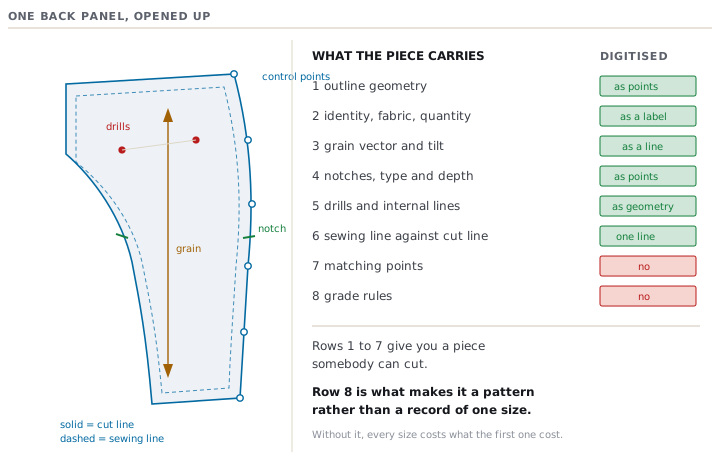
A pattern piece is a small structured record. Take the CH-482 back panel apart and it carries eight kinds of thing.
- Outline geometry — the closed boundary of the piece, and, above all, how that boundary is stored.
- Identity — piece name, piece code, how many to cut, in which fabric, whether it is a mirrored pair, whether it is fused.
- A grain vector — a stated direction, with an allowed tilt in degrees, for this piece. Course 4.3 covers what that decision does to the finished garment. Here it matters only that it is a number attached to the piece, and not a line somebody drew.
- Notches — position along the edge, type, and depth. A notch is a claim about two pieces meeting, so it only helps when both carry it.
- Internal geometry — drill holes, dart legs, placement lines, fold lines. A drill is a small hole punched inside the piece to mark where a pocket or a dart goes.
- Seam-allowance semantics — which line is the sewing line and which is the cutting line, edge by edge, because allowances differ from edge to edge.
- Matching points — where a stripe or a check must line up with the neighbouring piece.
- Grade rules — the increments that turn this piece into every other size.
Items 1 to 7 give you a piece somebody can cut. Item 8 is what makes it a pattern rather than a record of one size. It is also the one thing a digitiser cannot produce, because it was never on the card.
What arrived, and what did not
| What a piece carries | On the card | In the digitised file | In a pattern object |
|---|---|---|---|
| Closed outline | yes | yes | yes |
| Curves that can be edited | as a drawn line | as sampled points | as control points |
| Piece name and code | written in pencil | as a text label | as a field |
| Cut quantity and fabric | written in pencil | not carried | as fields |
| Mirror and fusible flags | implied | not carried | as fields |
| Grain direction | drawn | as a line | as a vector with a tilt tolerance |
| Notches | cut into the edge | as points on the outline | as notch objects with a type |
| Drills and internal lines | punched and drawn | as loose geometry | as objects tied to the piece |
| Sewing line against cutting line | one outline, allowance included | one outline, allowance included | stated per edge |
| Grade rules | not on the card | not carried | a rule table |
Read the last column of that table as a definition. A digitised pattern with no grade rules is a drawing. It is an accurate, useful, dimensionally correct drawing. And every size after the first one costs exactly what the first one cost.
Why the curve matters more than it sounds
Row two of that table looks like a technicality. It is the row that cost the sample room a week.
CAD does not store a curve as a list of points sitting on it. It stores a few control points and a rule for drawing the curve between them. Move one control point and the whole curve moves smoothly, because the curve comes from the control points rather than from a string of samples.
A digitiser does the opposite. It samples. The CH-482 back panel arrived with the side seam described by 142 points. The same seam, drafted, needs 9 control points.
On 12 February the fit session asked for 0.4 cm out of the side seam below the hip. On a drafted curve that is two control points and about 3 minutes. On 142 sampled points the operator dragged points by hand. The sample room sent the trouser back and called the seam wavy: a plot showed a 1.2 mm ripple over 18 cm of seam. That is nothing on a measurement sheet and plain to see on a pressed trouser. Fitting the curve properly took 25 minutes.
What the second invoice was
Rebuilding the CH-482 set as a pattern took the CAD room 13.5 hours. Refitting curves. Turning outline points into notch objects. Stating grain vectors and tilt tolerances. Splitting the sewing line off the cutting line, edge by edge. Filling in fabric and cut quantity on every piece. Only then building a grade rule table.
At Karnaphuli's loaded CAD rate of USD 7.40 an hour, that is USD 99.90 — against a digitising invoice of USD 103.50. The file cost almost the same amount twice, and only the first amount was ever budgeted.
The money is not the problem. The problem is that those 13.5 hours fell in the week the size set was due, and the size set moved four days.
Check yourselfA buyer sends you a pattern as a file. In ten minutes, without a pattern maker, how do you find out whether it is a pattern or a drawing?Show the answer
Open one piece and answer four questions. Does the piece carry a fabric and a cut quantity as fields, or is that information in a text label somebody typed? Is there a rule table anywhere, and does it have a row for more than the base size? Are the notches objects you can select, or points on the outline you cannot tell from the rest? And is there one outline per piece or two? One outline means the sewing line is unknown, and every seam allowance in the garment is now a guess. Four answers, and the difference between them is the whole cost of the next size range.